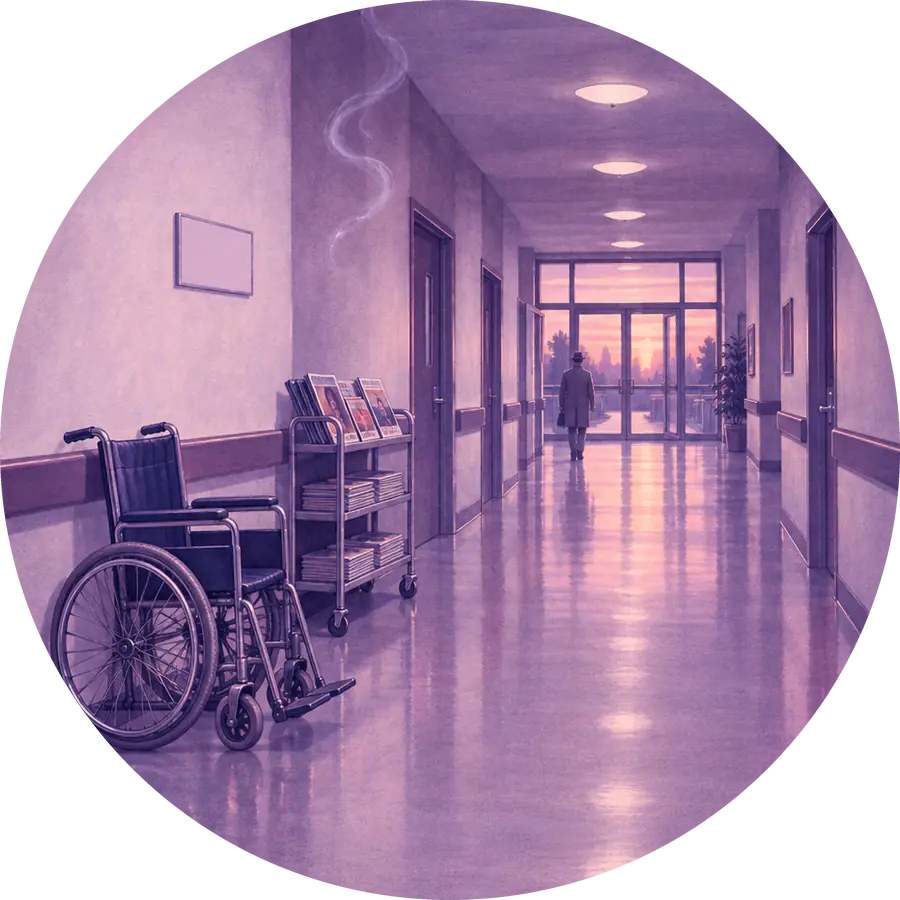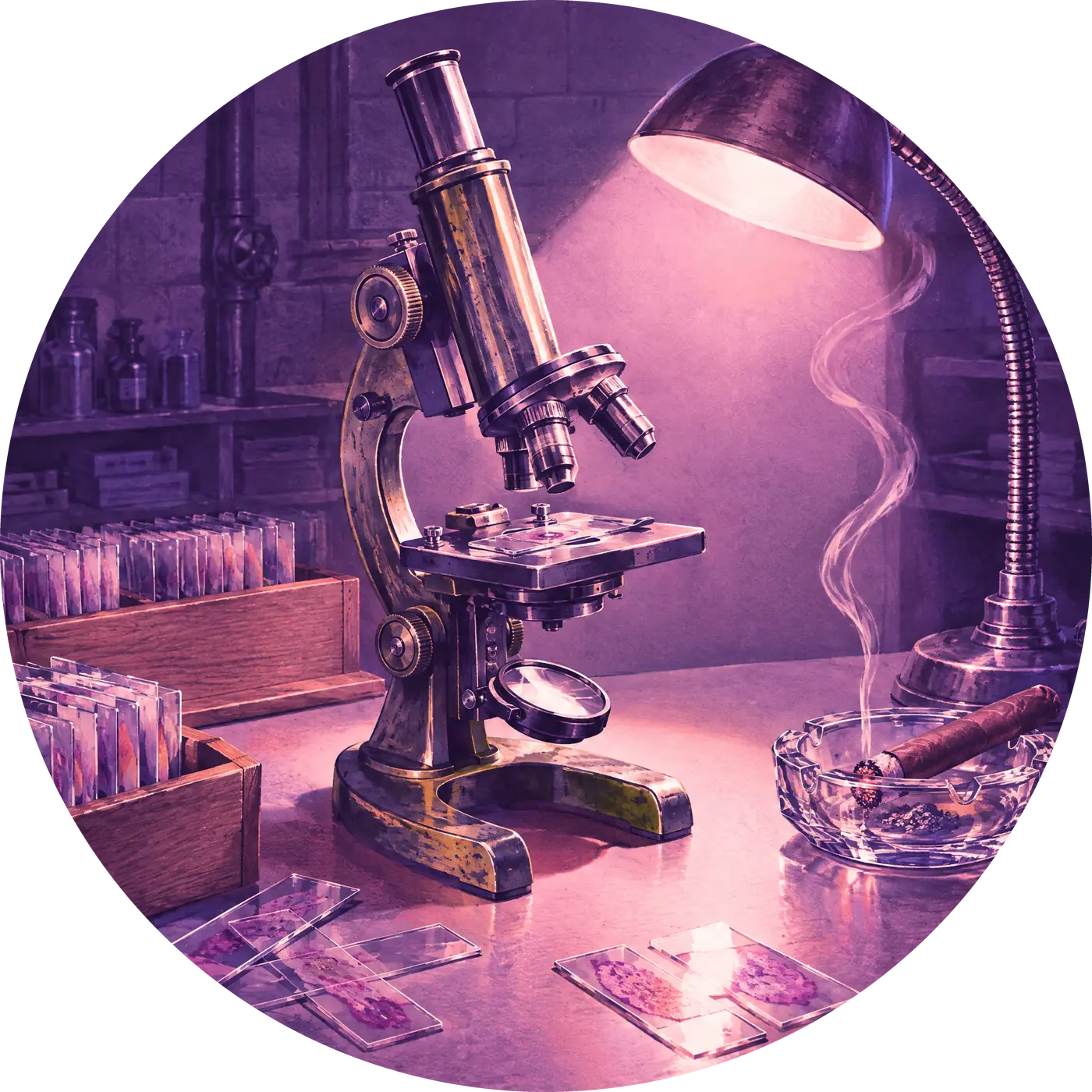
Midmorning, a broiling summer day in Burlington, Pennsylvania. Ninety degrees in the shade, seventy-eight per cent humidity, and hotter down by the steel mills and the rail yards, where nobody takes a reading. Inside Three Counties Hospital it is cooler, but not much. Only the fortunate or the influential get air conditioning. In Admitting, chief clerk Madge Reynolds, thirty-eight, is on her sixteenth Kleenex. Twenty-six patients are going home today instead of twenty-four, and two died in the night, so four names come off the long waiting list. She starts to dial. In the clinics Dr. McEwan, the ear, nose and throat man, snaps at a deaf old labourer; he crumpled the fender of his new Olds this morning after a fight with his wife. Fat Dr. Toynbee lights a cigarette from the stub of the last and tells a patient to lose weight and stop smoking. In a corridor Miss Mildred of Records, fifty-two and five foot nothing, chases down the staff pathologist to sign some autopsy forms. Dr. Joseph Pearson is sixty-six. There is egg on his tie. He signs without reading, grumbling, a big cigar in his mouth, and he ignores the No Smoking signs.
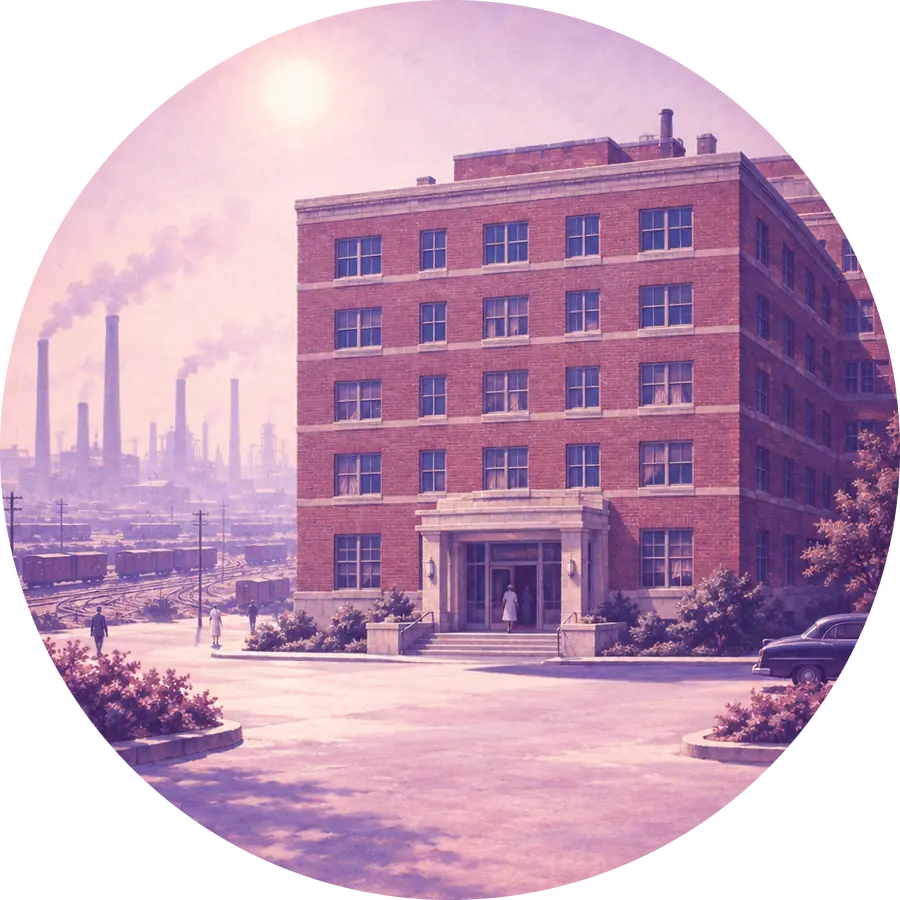
Upstairs the surgeons drift in for coffee. Lucy Grainger, an orthopedic surgeon, defends her new Volkswagen against Gil Bartlett, who has a cream Cadillac and the only beard on the staff. Kent O’Donnell, chief of surgery, laughs with them. One floor up, in room forty-eight, George Andrew Dunton dies at 10:52. Nurse Elaine Penfield watches his wife and children weep, and thinks that tears are “the best obituary there is.” On another ward Nurse Wilding, fifty-six, rereads a letter: her son, a navy lieutenant, was married yesterday in San Francisco, without her. She puts it away and writes on a chart. In Obstetrics a mother about to have her tenth child tells Dr. Charles Dornberger that childbirth is her holiday: no dishes, no washing, no cooking. In the kitchens the chief dietitian, Mrs. Hilda Straughan, two hundred pounds, samples the raisin pie and resolves to nag the administrator again about the old dishwashers. In Radiology, Dr. Ralph Bell finds the crater of an ulcer and tells a car dealer’s sales chief, “You’ll live.” And student nurse Vivian Loburton, nineteen, a lumberman’s daughter from Oregon, swears at a stuck zipper and runs to her ward. It is eleven o’clock on the fifteenth of July.
At eleven the off-key bell of the Church of the Redeemer chimes, and O’Donnell walks down to Administration. He is forty-two, a former college quarterback with a football-scarred nose and hair going grey, and he still squares his shoulders before a decision. In the corridor Bill Rufus, a senior surgeon in a tie of four colours, stops him. Surgical reports from Pathology are taking far too long. During an operation a pathologist freezes a slice of tissue and gives a quick verdict, benign or malignant. Then the full report follows from properly prepared slides, and sometimes it reverses the first. Last week Rufus’s patient, a Mrs. Mason, was told her breast tumour was benign. Pearson took eight days to report that it was malignant. By then she had gone home, and Rufus had to call her back. O’Donnell promises that something will be done.
In the administrator’s office Harry Tomaselli is bent over the plans for the extension, a new wing and a new nurses’ home: the New Jerusalem, he calls it. Orden Brown, president of a steel mill and chairman of the board, expects half a million dollars by January, and ground broken in March. It was Brown who brought O’Donnell here three and a half years ago. O’Donnell was a Harvard man, chief surgical resident at Columbia Presbyterian, and the hospital Brown showed him appalled him: a run-down building, slack standards, a doddering administrator. On the plane home he asked himself what he wanted to leave behind. From La Guardia he wired two words: “I accept.” Since then he has tightened the rules, brought back the tissue committee that catches needless operations, and eased out weak surgeons. One of them had removed the only kidney of a man who had no other; the autopsy found it. But the old guard holds out. Its stronghold is Pathology. Joe Pearson has been there thirty-two years, and he plays chess with Eustace Swayne, the department-store millionaire on the board. O’Donnell turns from the plans. “Harry,” he tells Tomaselli, “I think we may have to go to war with Joe Pearson.”
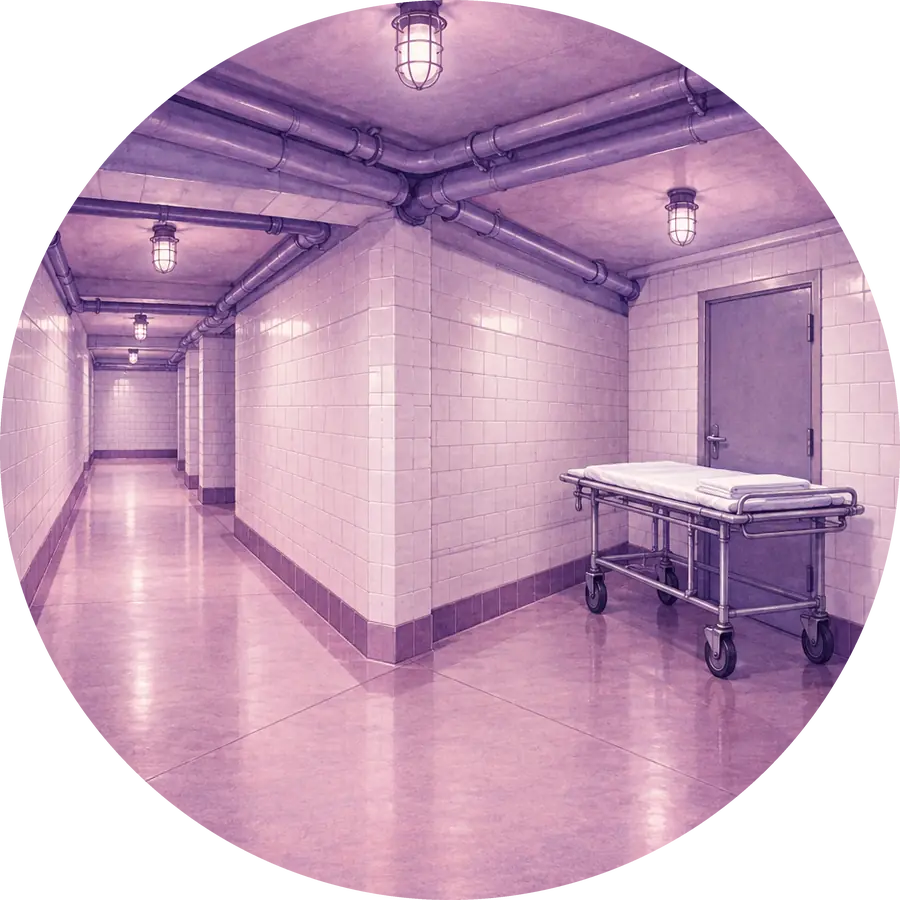
The dead go down by the freight elevator and the back corridors. It is the last service a hospital gives, and Nurse Penfield has walked it about fifty times in eleven years. In the basement the corridor forks; the sign to the left reads Pathology Department, Morgue. George Rinne, who keeps the morgue, swabs the table and trades the old joke with the orderly. Roger McNeil, the pathology resident, twenty-seven, lays out instruments that are clean but not sterile. Mike Seddons, a red-haired surgical resident on a stint in Pathology, breezes in and starts the notes on Dunton’s body: an appendix scar, a mole. Six student nurses file in to watch, and Seddons notices a brunette, a first-year girl, Vivian Loburton. Then Pearson arrives and scrubs in silence. Seddons ties his gown, powders his hands, holds his gloves. A maestro, Seddons thinks. A natural ham. Pointing his cigar at the body, Pearson gives the nurses his sermon.
“It is pathology which tests a patient’s blood, checks his excrements, tracks down his diseases, decides whether his tumor is malignant or benign. It is pathology which advises the patient’s physician on disease and sometimes, when all else in medicine fails … it is the pathologist who makes the final diagnosis.”
…Their eyes followed his finger to the framed maxim thoughtfully provided by a scientific supply house—Mortui Vivos Docent. Pearson read the Latin aloud, then translated. “The dead teach the living.” He looked down again at the body. “That is what will happen now. This man apparently”—he emphasized the word “apparently”—“died of coronary thrombosis. By autopsy we shall discover if that is true.”
— Arthur Hailey, The Final Diagnosis, Doubleday, 1959, chapter three
Then Pearson proves it. The Y-shaped incision, the rib cutters, the saw. Two of the nurses go pale and nobody leaves. Vivian steadies herself by remembering her mother, in the Oregon woods, tying a tourniquet on her father’s leg after a slip of his hunting knife. In the left coronary artery is the clot, no thicker than a piece of spaghetti. Dunton died of his heart, as everyone thought. Then Pearson stops. The lining of the chest is scarred. He opens a lung, and there it is: advanced tuberculosis, honeycombed, like ping-pong balls fastened together and cut through. Dunton came in shocked and dying, so nobody X-rayed his chest. “It’s always a tossup what we die of,” Pearson tells the nurses. Now Dunton’s family, his workmates, perhaps people in this hospital, will have to be checked for years. Remember him, Pearson tells them, the next time you ask a family for permission to do an autopsy. Seddons finds, to his own surprise, that he likes the old man. As if he had read his mind, Pearson smiles. “Pathology has its victories too, Dr. Seddons.” And he leaves in a cloud of cigar smoke.
At half past two the monthly surgical-mortality conference meets in the board room, forty surgeons around a long walnut table. Its purpose is to learn from deaths, not to blame. Lucy Grainger is thirty-five, seven years younger than O’Donnell. At the window he asks her to dinner, and she says she will look at her book. Pearson arrives late, chewing a sandwich. The first case is Gil Bartlett’s. A man of fifty-three came in grey and sweating, blood pressure seventy over forty, his belly rigid. Bartlett took him for a perforated ulcer and operated at once. He found no ulcer, and the man died. Pearson reads the autopsy. The abdomen was normal. In the chest there was an early pneumonia, and its pain had mimicked the belly. Then Pearson tosses his grenade: “We’re all aware that Dr. Bartlett rarely sees beyond the abdomen.” Bartlett flings back his chair. O’Donnell bangs the gavel. Lucy thinks about money. Bartlett makes perhaps fifty thousand dollars a year from his patients; Pearson is paid twenty-five thousand by the hospital, and the surgeon gets the glory for cutting out what the pathologist named. Afterward O’Donnell takes Pearson aside. The old man blames the administration: he asked for three technicians and got one. Offered a second pathologist, he refuses outright. He will run Pathology his own way. The lines of battle are laid.
Ten days later the cafeteria works as the hospital’s grapevine. Seddons sits down opposite Vivian, steals two of her French fries, and asks her to a road-show musical and dinner, paid for by a grateful patient whose hand he stitched. His policy is to love them and leave them. Upstairs Tomaselli, Brown and O’Donnell set the doctors’ quotas for the building fund, six thousand dollars from the seniors, four from associates, two from assistants. Then a carpenter named Bryan is on the line, shouting. His wife was in hospital nearly three weeks, he has no insurance, and the bill will put him in debt. Her surgeon, Dr. Reubens, explains: the tumour was benign, but Pearson took two and a half weeks to say so, and after Rufus’s case he would not send her home without the report. O’Donnell calls a meeting for that afternoon. He thinks of the night before. He took Lucy to dinner, and in her new apartment she told him he could stay. He said they should both think about it. She stood at the open door as the elevator closed.
The meeting is small and quiet. Harvey Chandler, the chief of medicine, warns against undermining a department head. Rufus will have no hole-and-corner conspiracy to boot the old man out. In industry, O’Donnell reflects, a man who isn’t doing his job is fired. In medicine the lines of authority are seldom clear, and every department head is master of his own domain. So they will send a friend. Dr. Dornberger, Pearson’s close friend, agrees to go. Then Tomaselli opens a drawer and produces a name: Dr. David Coleman, thirty-one, an honours graduate of New York University, a residency in three good hospitals. He has already written to him.
In the gross-conference room the organs of the week’s autopsies wait in white enameled pails, the brains in glass jars, one pail under a running tap to wash out the formalin. Pearson cuts a slice for the microscope and tosses the rest through a hole in the stone table, to be burned. Into the room comes Carl Bannister, the senior technician. He started with a high-school education, washing glassware, and became Pearson’s right hand. He works by rote, and McNeil thinks someday that may prove dangerous. With him is the new man, John Alexander, twenty-two, crew-cut, his shoes shined, with a college degree in medical technology. Pearson welcomes him to their tried and tested methods. Alexander’s wife is pregnant. Their first child died a month after birth. Pearson phones Dornberger for them: no fee for a hospital employee. Upstairs Dornberger, thirty-two years in practice, white-haired and courtly, writes the name on a card in pencil. He has always said he would quit before he weakened. Night calls come harder now. He gives himself three more months. Then a young woman calls in her first labour, and he feels his senses quicken, as they always have.
On a warm July evening Eustace Swayne holds court in his library over cognac. He is seventy-eight, and he founded a department-store empire. Medicine, he says, is weakening the race by saving the unfit. O’Donnell answers him. Slums and dirt and pollution are man-made, he says, and medicine is only catching up. It has one real problem, he says, individual human survival. “And survival is the oldest law of nature.” Swayne goes quiet. Then, softly, he says he may give a quarter of a million dollars to the extension. He will decide in a week or two. And by the way, he plays a good deal of chess with Joe Pearson, and he hopes Pearson will run his department for many years. In the car home O’Donnell reads the message plainly: the money, and hands off Joe Pearson. He thinks too of Swayne’s daughter, Denise Quantz, thirty-nine, separated, living in New York. That same night Seddons takes Vivian to the musical, then into the park near the hospital. Near midnight, in the grass, a searing pain shoots through her left knee. Seddons thinks she is putting on an act. Then he feels it as a doctor would: a small hard lump where none should be. She must see Dr. Grainger tomorrow.

Morning, and Pearson reads slides with McNeil. A woman’s mole could be a melanoma, common and deadly, or a blue nevus, rare and harmless. McNeil is honest enough to say he doesn’t know. There are no earlier cases to compare it with. “One of these days we’ve got to set up a cross file,” Pearson says. From behind them Bannister answers: “You’ve been saying that for five years.” Pearson calls it a blue nevus, and the woman is reprieved. At ten Dornberger comes down as the deputation. Pearson may get an assistant whether he wants one or not. Pearson reads the sheet aloud. “Dr. David Coleman.” Then, with bitterness and envy, “Age thirty-one.” In the cafeteria Lucy asks Dr. Bell to X-ray a student nurse’s knee. In the lab John Alexander suggests that the department could use a machine to process tissue, and Pearson shouts that he runs this department. That night Seddons meets Vivian in the residents’ quarters. Somebody down the hall is playing Chopin. Afterward he says he wants to marry her. And her knee? How could a little bump like that, she asks, be anything serious?
Boston, August the seventh. David Coleman accepts the post. He can start on the fifteenth. He asks that his responsibilities be clearly defined: Serology, Haematology and Biochemistry directly, and assisting Pearson with the rest. He has turned down seven other offers, two of them famous, and most of them better paid. He isn’t sure why. Pride is his strongest trait; learning came to him as easily as breathing. In high school the principal told him that apart from the principal himself, he hadn’t a friend in the place. Coleman despised himself and set out to correct it. He forced himself to play the sports he hated, until he was good at them. He chose pathology because it was the least glamorous field in medicine. For fifteen years he has worn that habit, like sackcloth, and now he can’t tell choice from penance.
In Dornberger’s office Elizabeth Alexander, twenty-three, mentions that she is Rh negative and her husband is Rh positive. Dornberger explains it in kitchen terms. Blood has ingredients called factors. If the baby inherits the father’s, the mother’s body may make antibodies that cross into the baby and destroy its blood. That is erythroblastosis fetalis. A blood-sensitization test will show whether she has the antibodies. If she has, the baby can be given new blood, an exchange transfusion, at birth. He leaves out the risk of stillbirth on purpose. She tells him he is wonderful. Down in the hospital Pearson goes up to see Vivian. His fingers on her knee are surprisingly gentle. He looks at the X-rays. “Shadows from shadow land,” he says. In the corridor he tells Lucy it could be a bone tumour, and it could be malignant. Then she will have to amputate. Suddenly Pearson looks very old.
At the airport O’Donnell watches a Viscount land and thinks that medicine, like flying, is always behind its own discoveries. Coleman steps off in an uncreased gabardine suit, no hat. In the car O’Donnell advises him to move slowly. Coleman hears a man telling him not to rock the boat, and decides against a long lease. That afternoon Elizabeth gives seven cc’s of blood in a brown corridor. She grew up in New Richmond, Indiana, in her father’s hardware store; John came in for red paint and she sold him green. Their first baby, Pamela, died at four weeks of what they were told was bronchitis. Seddons waits through Vivian’s biopsy in dread. Lucy’s note reads suspected osteogenic sarcoma, a bone cancer: if it’s confirmed, amputation, and even then the odds are poor. At 2:30 Lucy cuts a wedge from the bone below the knee and drops it into a jar of fixative. At 4:53 a messenger boy whistles into the lab and hands Bannister the day’s blood. In the tray is the sample marked Alexander, for sensitivity. John asks that his wife’s blood be tested three ways, in saline and in high protein as usual, and with an indirect Coombs test as well, the newer method that catches antibodies the older two can miss. Bannister has never heard of it. “We’re lab assistants,” he says, “and we work in here the way we’re told.”
Eight next morning, Coleman stands outside the hospital’s plain brick front. The cornerstone was laid in 1918. Pearson seldom comes in before ten. Bannister, caught sorting papers on Pearson’s desk, turns at once into a fawning guide. In Serology Alexander explains about his wife’s blood. No Coombs test? Coleman can hardly believe it. It is elementary. Bannister says it’s Dr. Pearson’s instructions. There is no Coombs serum in stock, so Coleman signs a requisition for it, coolly remarking that he expects more responsibility here than “ordering fifteen dollars’ worth of rabbit serum.” Then he looks around the lab. Worn equipment, dirty glassware, dust, and a fungus growing out of a worktable. Alexander is ashamed. They find that they come from the same small town. Coleman’s father was the country doctor there. Alexander asks him to dinner. Coleman puts him off, then despises himself for it. A classmate once toasted him as the man with the antiseptic heart.
Upstairs Mrs. Straughan is back in Tomaselli’s office about the dishwashers. New ones would cost almost eleven thousand dollars, and the building fund comes first. Staff have had intestinal flu. Tomaselli asks Pathology to test the machines for bacteria. After lunch Pearson hands Coleman eight slides: Vivian Loburton’s knee. Coleman reads them as benign, bone healing after an injury. Pearson reads them as osteogenic sarcoma. Both men know there is room for doubt, and the old man explodes. The public thinks a pathologist looks once into a microscope and knows. If he says malignant, Lucy Grainger must amputate, and if he’s wrong, “a nineteen-year-old girl has lost a leg for nothing.” Then let’s check the cross file, Coleman says. There is no cross file. To Coleman that is criminal, and he writes Pearson off as a procrastinator. Pearson sends the slides by air to the two best men he knows, Dr. Chollingham in Boston and Dr. Earnhart in New York.
Lucy tells Vivian it might be serious. Vivian is a minor, so her parents in Salem, Oregon, must consent to any amputation, and Lucy places the call. That evening, at a rosewood table in Swayne’s library, the old men play chess. Swayne says he has told Orden Brown and the chief of surgery that his quarter million comes with a condition: Joe Pearson runs his department for as long as he chooses. “It’s a young man’s world,” Swayne says, but old men still have power sometimes. Pearson is touched. He checkmates his host. Downtown, in the Regency Room, O’Donnell dances with Denise Quantz, in scarlet, until nearly one. Her marriage lasted ten years; she has twins of nearly seventeen and no divorce. In his apartment above the river they kiss. Then the telephone rings. One of his patients has taken a bad turn, and he calls her a taxi.

Next morning Pearson, tired from the chess, goes through the requisitions and finds one for Coombs serum, signed by Coleman in the place where Pearson always signs. Bannister has set it up and enjoys it. Alexander explains it is for his wife’s test, and Pearson shouts him down: he is not to go behind Pearson’s back with his technicians’ school ideas. Pearson does the test himself, in saline and in high protein. Bannister brings up the requisition. “We won’t need it now,” Pearson says. “Tear it up.” Bannister asks whether he should tell Dr. Coleman. No, Pearson will tell him himself. Bannister tears the requisition up and lets the pieces flutter into the wastebasket.
Then a child. A boy of four was struck by a car outside his own home and was dead when the ambulance got him here. McNeil has done the autopsy; he never gets used to children. In the anteroom wait a patrolman, the boy’s father, tall and red-eyed, and the driver, a mousy man with a straggling mustache. Pearson tells them the car did not kill the boy. It struck a glancing blow. There was a mild concussion and a broken nose, and the nose bled heavily. The boy lay on his back about ten minutes, waiting for the ambulance. Five would have been enough. The blood ran down his throat, and he suffocated. “I’m afraid that that was the cause of death,” Pearson says. The father breaks. The patrolman protests that his first-aid course taught him never to move an injured person. There are exceptions, Pearson says, and bleeding into the mouth is one. In the corridor afterward Pearson tells Coleman there was something he meant to say about the lab. It has slipped away. At lunch Coleman sits with the Alexanders. Medicine, he says, is like building a wall, one brick at a time, and he urges John to go to medical school. Elizabeth, eating for two, feels a sudden sharp pain. She decides not to bother her doctor yet.
The consultants’ answers are due. Vivian’s parents have flown in from Oregon. Seddons steals ten minutes to sit with her and make her laugh. In O’Donnell’s office Lucy realises, all at once, that she loves him. In the autopsy room Seddons is smoking and telling an undertaker joke over an old woman’s body. Coleman orders the cigarette out and the body draped. A family gives the body in trust, he tells them, to be treated “with care, respect, and dignity.” At home Elizabeth Alexander is pushing a carpet sweeper when the pain comes back, searing, in waves. She phones Dornberger. Her baby is coming, eight weeks early. In Pearson’s office Bannister is complaining about Coleman. Coleman has been checking the lab’s work: he split one sample in two and sent both halves through. Bannister recorded two different results. Pearson calls Bannister a fool and throws him out. Then he turns on Coleman. He is still in charge of this department, and he will be around a long time yet. A secretary brings in two telegrams, and Pearson hands them to Coleman. The phone rings: Dornberger has a premature labour coming in and no blood-sensitivity report. Pearson signs the form and sends it up. Then he turns back to Coleman.
Coleman thought: This is where pathology begins and ends; these are the borderlands where we must face the truth of how little we really know; this is the limit of learning, the rim of the dark, swirling waters of the still unknown. He said quietly, “Yes, they’re both definite. Dr. Chollingham in Boston says, ‘Specimen definitely malignant.’ Dr. Earnhart in New York says, ‘The tissue is benign. No sign of malignancy.’ ”
There was a silence. Then Pearson said slowly, softly, “The two best men in the country, and one votes ‘for,’ the other ‘against.’ ” He looked at Coleman, and when he spoke there was irony but no antagonism. “Well, my young pathologist friend, Lucy Grainger expects an answer today. She will have to be given one, and it will have to be definite.” With a twisted smile, “Do you feel like playing God?”
— Arthur Hailey, The Final Diagnosis, Doubleday, 1959, chapter fifteen
Pearson’s question hangs there while the ambulance carrying Elizabeth runs the red light at Main and Liberty. A patrolman waves it through. In Obstetrics Dornberger scans the report on top of his clipboard. “Sensitivity negative, eh? Well, there’s no problem there.” The hospital’s drill works smoothly: an intern clears the corridor, the elevator is emptied, an incubator is wheeled into the delivery room. Downstairs Pearson rereads the telegrams. For a woman of fifty he would say malignant without a qualm, but this girl is nineteen. Coleman suggests a new X-ray, in case the tumour has grown in two weeks. Grudgingly Pearson admits the young man is thinking all the time. Up in the fathers’ waiting room a gaunt man tells John this is his eighth child; it’s always all right, he says, and that’s their trouble. Dornberger comes in. It’s a boy, eight weeks early, three pounds eight ounces, in an incubator. “There’s always hope, son,” he says. In Radiology Vivian lies under the machine while a technician takes the films for Dr. Bell. There is no real change. Bell throws the ball back to Pathology.
Elizabeth asks John for the truth about the baby’s chances. Dornberger says just fair. She weeps, and then she tells him he must go to medical school; she will find a job. Through the nursery glass, gowned and masked, John looks at his son, not much bigger than his own two hands, in an incubator kept at ninety-eight degrees. Silently he tells him to fight. Downstairs Pearson looks at the new X-rays and makes up his mind. It is malignant, osteogenic sarcoma, quite definite. Lucy will amputate in the morning. Afterward he tells Coleman why he never asked his opinion in front of her: any doubt would have got out, and the family would have delayed. Coleman accepts that someone had to decide. But only the dissected leg will show who was right, too late to help her, and surgery has no way to put a leg back. That evening in New York O’Donnell wonders whether he has been unfair to Pearson. Swayne still has not confirmed the gift. At dinner he asks Denise to marry him. She could love him, she says, but she could never live in Burlington. Later, on her terrace, she warns him that she is possessive; she would need all of him. Back at her penthouse her seventeen-year-old daughter, Philippa, in pyjamas, kisses him and tells her mother not to lose this one.
At 8:30 precisely the operation begins. Lucy will take the leg above the knee. She broke the news last night; Vivian was dry-eyed, and then she sobbed. In the operating room Lucy’s calm is partly a pose, but here it is needed. An intern holds the leg up to drain the blood. A tourniquet goes high on the thigh. Lucy shows two medical students the flaps, like two shirttails, one long and one short. Tears run down the face of the sleeping girl. The anaesthetist makes a joke, then talks about his new house in Somerset Heights. This is the tragedy, Lucy thinks: it has happened too soon. Never again will the girl run or dance or swim quite as freely as other people. The bone gives with a snap. The leg falls and thuds to the floor. The intern bends for it, and Lucy stops him. A nurse wraps it in gauze and paper, and a messenger carries it down to Pathology. Seventy minutes in all. In the waiting room Seddons sits with Vivian’s parents. Her father paces. Her mother sits upright and still, and Seddons sees that she is the rock. Last night Vivian offered to set him free, a girl with one leg. He protested, loudly. He was afraid, and she was not.
The Alexander baby is three and a half days old. His breathing is weak, his feet are swollen and he is more yellow than he should be. Dornberger says that but for the report he would suspect erythroblastosis. The charge nurse, a red-haired girl a year out of training, begins “But surely—” and stops herself. In the lab Mrs. Straughan has come about her dishwashers. Alexander has tested them: the water runs only 110 to 130 degrees, and the plates come out carrying bacteria from the bowel. The real danger, Coleman says, would be a carrier, a healthy-looking person who spreads disease. When were the food handlers last checked? Bannister finds the ledger. February the twenty-fourth, nearly six months ago, and the kitchen hires new people all the time. Nobody sent specimens, he says, so how could they know? Coleman walks out with contempt, and Bannister stands drained. “He knows it all, don’t he?” he says. “Everything in the book.” His world is crumbling, and there is no place for him in the new one. In his office Pearson flings a fat file onto the desk: years of his own memos begging for a new hot-water system for the kitchens. Coleman reads them and apologises. Pearson phones the administrator.

Dornberger comes down, pipe in hand, and asks quietly whether the sensitization test could be wrong. No doubt about it, Pearson says. He did it himself. Coleman, trying to help, says that saline and high protein used to miss some cases, but with an indirect Coombs test as well it’s pretty well foolproof. “We didn’t do an indirect Coombs test,” John Alexander says. “I meant to tell you at the time,” Pearson says to Coleman. “It slipped my mind.” Coleman’s voice is ice-clear: anyone who has kept up in haematology knows those two tests don’t catch every case. Tomaselli asks why the ordered test was not done. Bannister is shaking. “I tore it up,” he says. The hospital has no Coombs serum, so Tomaselli phones the pathologist at University Hospital, and a police cruiser stands by at the emergency entrance to rush the baby’s blood across town. Alexander goes with it. Then Dornberger and Pearson are alone. In all his years Dornberger has never failed a patient through neglect, until this moment, and now he shares another man’s incompetence, a friend’s. He has covered for Pearson and fought his battles. But if this baby dies, he says, “I’ll take you before the medical board and I’ll break you in two.”
Dornberger scrubs to do the exchange transfusion without waiting for the result. In the small operating room off Obstetrics he explains each step to the intern. The cord was cut short at birth; normally it is left long when a transfusion is expected. He is talking to keep from thinking. He feels dizzy, and his hands are shaking. The intern asks if he is all right. He could say yes and carry on, and nobody but himself would know.
Then, in the same moment, he remembered all that he had said and believed over the years—about old men clinging to power too long; the boast that when his own time came he would know it and make way … He thought of these things, then looked down at his shaking hands.
“No,” he said, “I don’t think I am all right.” He paused, and aware for the first time of a deep emotion which made it hard to control his voice, he asked, “Will someone please call Dr. O’Donnell? Tell him I’m unable to go on. I’d like him to take over.”
At that moment, in fact and in heart, Dr. Charles Dornberger retired from the practice of medicine.
— Arthur Hailey, The Final Diagnosis, Doubleday, 1959, chapter twenty
Down in Pathology the call comes from University Hospital: the test is positive. The baby has erythroblastosis. O’Donnell, paged on his first day back from New York, takes over from Dornberger. His elation about Denise is gone at once, and he blames himself; he could have fired Joe Pearson and didn’t, for politics. He works through the vein in the cord, ten cc’s of blood out, ten cc’s in, five minutes to each exchange. After twenty-five minutes the baby gives a thin cry. “Sounds like he’s mad at us,” O’Donnell says. At fifty minutes the temperature drops to 94.3, then to 93. The breathing stops. Oxygen. A stimulant, straight into the heart. Down in Pathology Pearson asks Coleman, “Would you mind staying?” Coleman takes no satisfaction in having been right. He has worked out how Elizabeth was sensitized. In 1949, at a railroad crossing back in New Richmond, her father was killed and she nearly died. She was saved by transfusions, given before such blood was routinely matched for the Rh factor. And the doctor who ordered them must have been his own father. He cannot blame his father, and he cannot excuse Pearson by any other rule. In her room Elizabeth drinks orange juice brought by old Nurse Wilding, whose newly married son has shipped out to Hawaii without coming home. Upstairs O’Donnell presses the tiny chest and pleads with the child in silence. Ten minutes. The intern shakes his head. “I’m afraid he’s gone,” O’Donnell says. Then he rips off his mask and gloves. He will be, he says, with Dr. Pearson.
Pearson can’t bring himself to answer the phone. Coleman takes it, and tells him the baby has just died. In the lab John Alexander asks, “Why, Dr. Coleman? Why?” Then: “But he might have lived.” There is no room for evasion. “Yes,” Coleman says. “He might have lived.” O’Donnell and Dornberger come to Pearson’s door. O’Donnell blames himself too: for politics, for supping with Orden Brown and fawning on Eustace Swayne. He wants Pearson’s resignation by ten tomorrow morning. “Ten o’clock,” Pearson says. “You shall have it.” Then Tomaselli hurries in. There is typhoid in the hospital: two cases, and four more suspected. John goes up to Elizabeth and tells her he will apply to medical school, and she says yes. In her room Vivian asks Seddons to stay away for a week, so that she can be sure he loves her and not her misfortune. He bargains her down to five days. Her missing foot itches, and she asks where her leg is. In a refrigerator in Pathology, he tells her. “Mike darling,” she says, “please go downstairs and scratch the foot.”
The board room is crowded for the emergency staff meeting. Dr. Chandler, enjoying himself, lists the symptoms of typhoid. All the cases are employees, and somewhere among them there is a carrier. Then O’Donnell calls on Pathology.
As his chair went back the old pathologist rose to his feet.
Slowly his eyes swept the board room. They went the length of the table, then returned to its head. Looking directly at O’Donnell, Pearson said, “This epidemic should not have happened. Nor would it, if Pathology had been alert to a breakdown in hygiene precautions. It is the responsibility of my department, and therefore my own responsibility, that this neglect occurred.”
Again a silence. It was as if history had been made. In this room so many times Joe Pearson had charged others with error and misjudgment. Now he stood himself—accuser and accused.
— Arthur Hailey, The Final Diagnosis, Doubleday, 1959, chapter twenty-one
Then Pearson gives the orders. Every food handler is to be examined before the next meal is served. He takes a watch from his frayed woollen vest: it is 2:15. Ninety-five people, in batches of twelve, with stool samples in the hospital by tomorrow morning. “Constipation,” Pearson adds, “will not be taken as an excuse.” Afterward O’Donnell tells him privately that he will stay in charge of Pathology until the outbreak is over. Nothing else has changed. Pearson has already figured that out.
In the lab Pearson studies his forces like a general. There are some ninety-five stool cultures to read and a single carrier to find. From memory he lists the sugar tests and the reactions that will mark Salmonella typhi, and cites page sixty-six of the standing orders. Coleman is impressed in spite of himself. In the clinic Chandler examines the kitchen workers, a commander at the head of his troops. O’Donnell walks back to his office through the wreckage of a single day: a child dead through a test nobody did, a pathologist fired, an old obstetrician retired, typhoid in the kitchens. He asks himself what they have built.
He thought: We were all sure, so sure, that this regime was better than the last. We worked to make it so. We believed we were creating and progressing, building a temple of healing, a place where good medicine would be learned and practiced. But have we failed—ignominiously and blindly—through the very goodness of our own intentions? Have we been stupid and unseeing—our eyes on the cloud tops, uplifted by the glister of ideals, yet ignoring the plain earthy warning of everyday events? What have we built here? O’Donnell searched his mind. Is it, in truth, a place of healing? Or have we raised, in folly, a whited sepulcher—an empty, antiseptic shrine?
— Arthur Hailey, The Final Diagnosis, Doubleday, 1959, chapter twenty-two
O’Donnell crosses to the window. Below in the forecourt they keep coming: a man limping on a woman’s arm, a nurse handing a mother her baby, a boy swinging on crutches with the ease of practice. They come in hope, and the hospital has to deserve them. He resolves to rebuild, starting with Pathology. Denise phones from New York. She wants him for the weekend; the invitations are out, and she means to show him off. He can’t leave in an epidemic. “I did warn you, Kent,” she says. “I’m a very possessive person.” Next morning the specimens come into the lab in cardboard cups, and the place stinks. Alexander plates them one after another with a platinum loop. He tells Coleman that he will try for medical school, and when Coleman passes it on, Pearson says he wishes there were something he could say to the boy.
The fourth day. Ten typhoid cases now, four of them patients. Unless the carrier is found, the city health department will close the kitchens at five o’clock, and closing the kitchens means closing the hospital. Pearson has slept on a cot in his office and hasn’t shaved in two days. Eighty-nine plates have been read and two hundred and eighty subcultures planted, and a hundred and ten still wait. Bannister has been sent home exhausted. For the first time in its forty years Three Counties is turning the sick away; ambulances wait at the emergency entrance to take patients elsewhere. Orden Brown passes on word that Eustace Swayne wants to see O’Donnell, and O’Donnell says to hell with him. At three minutes to five the health officer arrives, and the Church of the Redeemer chimes as they all go down to the lab. O’Donnell tells Pearson the kitchens are closing. The old man’s face works. “I never thought I’d see the day . . .” he whispers.
They have reached the door when John Alexander says, “I have it.” He has ten sugar tubes in a rack. Pearson calls out each one, and Alexander checks it against the chart in the textbook. Glucose: acid, no gas. Lactose, nothing. Dulcitol, nothing. Sucrose, nothing. Mannitol, maltose and xylose: acid, no gas. Arabinose and rhamnose, no reaction. Indole, negative. It is typhoid. The plate is number seventy-two. Coleman checks the ledger: Charlotte Burgess, serving counter. The clock says seven minutes after five, and dinner is being served. In the cafeteria Tomaselli, O’Donnell and Mrs. Straughan quietly take a middle-aged woman away from the serving counter. She is to regard herself as a patient now. The food is to be burned and the dishes boiled. Upstairs Vivian lies waiting to be moved to another hospital and cannot reach Seddons. Under the coverlet the bed is flat where her leg should be. She has never felt so alone. Tomaselli puts down the telephone: Three Counties is back in business. And Mrs. Straughan’s new dishwashers are approved; work starts next week. She asks for a bigger refrigerator, too, and hopes this time it won’t take an epidemic.

Early next morning Coleman takes Vivian Loburton’s leg from the refrigerator and dissects it himself. Below the knee, on the inner side, he finds a hard, lumpish mass. Across town O’Donnell is shown into Eustace Swayne’s bedroom. A log fire roars there on a mild late-August morning, and the old man is frail. Pearson came to see him three days ago, Swayne says, with two requests. The first was that the gift carry no conditions, and Swayne has agreed. The second was that Swayne pay John Alexander’s way through medical school. He will, through a fund run by the hospital that will help others after him, and he adds one condition of his own. It is to be called the Joseph Pearson Medical Endowment. Upstairs Seddons finally comes to Vivian. He tries to lie and can’t. She asks him to go. He has looked into himself, at crowded beaches and dance floors and an artificial leg, and found only his own reflection. She doesn’t know if she is cured, she says, or if she isn’t, how long she has. He walks out. Down in the autopsy annex he finds Coleman dissecting a leg and reads the name on the open case file. He is sick against the corridor wall.
O’Donnell offers Coleman the directorship of Pathology. Coleman hesitates. The final diagnosis would then be his alone. He accepts. What is medicine for, O’Donnell asks him. People, Coleman says, “People who need us.” O’Donnell tells him what Pearson built in his time: the blood bank, the tissue committee, research on cancer of the thyroid. In a corridor O’Donnell meets Lucy Grainger and asks her to dinner tomorrow; Denise, he knows now, was a nostalgic interlude. Dreams do come true, Lucy thinks. At dusk, in the basement, Pearson is emptying his drawers after thirty-two years. Coleman tells him he dissected the leg. “You were right. I was wrong.” It was osteogenic sarcoma. “I’m glad I didn’t make a mistake,” the old man says slowly, “about that anyway.” Then he gives the young man the only advice he has left. The phone, the budgets, the salesmen with the unbreakable test tube, the courses you send others to. And the years slip by.
“…And then suddenly, one day, you’ll find everything you knew is out of date. That’s when it’s too late to change.”
…He said imploringly, “Listen to an old man who’s been through it all, who made the mistake of falling behind. Don’t let it happen to you! Lock yourself in a closet if you have to! Get away from the phone and the files and paper, and read and learn and listen and keep up to date! Then they can never touch you, never say, ‘He’s finished, all washed up; he belongs to yesterday.’ Because you’ll know as much as they do—and more. Because you’ll have experience to go with it . . .”
— Arthur Hailey, The Final Diagnosis, Doubleday, 1959, chapter twenty-four
Coleman says he will try to remember, and walks him up to the main floor. The evening bustle is beginning. A nurse hurries past with a diet tray. A man in a wheel chair holds his crutches like oars. Student nurses go by laughing, and somewhere a child is crying. Over the loudspeaker a voice calls Dr. Coleman to the surgical floor. “It’ll be a frozen section,” Pearson says. “You’d better go.” They shake hands. “Good luck.” One of the senior nurses says good night to Dr. Pearson, and he says good night. “Then, on the way out, he stopped under a ‘No Smoking’ sign to light a cigar.”