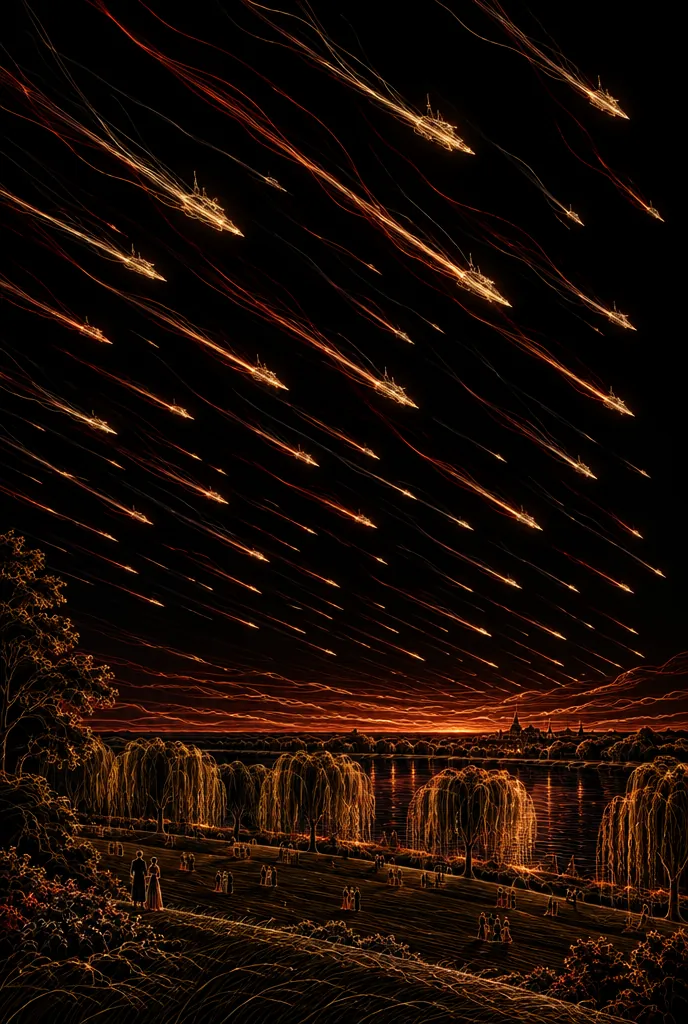
On the day the armada goes off to war, on the last day of life as we know it, I am invited to a party. There are parties on more than a hundred and fifty worlds that evening, but this is the only one that matters. I farcast from Esperance to Tau Ceti Center, one step through a portal from world to world. In my best jacket I walk down through Deer Park, past topiary and the River Tethys, the one river that runs through two hundred worlds. My name is Joseph Severn. It is my name, but it has never been my identity. A woman with cruel eyes asks me to draw her, and I do, in lines of light; she thinks I am an artist. I was a poet. Then a shout goes up, the garden lights die, and the fleet farcasts into the sky above us: scouts like fireflies, then torchships scarring the sky from zenith to horizon with gold-red streaks. Billionaires cheer. An old officer in FORCE black weeps. I do not applaud. I finish my flat champagne with a toast, as I put it to myself, “to the enduring stupidity of my race”, and a guard tells me that CEO Meina Gladstone will see me now.
She governs a hundred and thirty billion people, and she is an old lady in a gray wool suit. Her nose is a blunt beak, her gray hair is cropped like feathers, and her eyes are large and brown and infinitely sad. A meeting is breaking up in her book-lined room: generals of FORCE, the Hegemony’s military; senators; and a projection of Councilor Albedo of the TechnoCore, the artificial intelligences that seceded from humankind centuries ago. I am here, she tells them, to bring an artist’s perspective. What do I think of the armada? “It’s pretty,” I say. General Morpurgo snorts. And the war, to rescue Hyperion from the Ouster barbarians? “It’s stupid,” I say. The room goes very silent. Gladstone sends them out and keeps only Leigh Hunt, her consumptive-looking aide. Can I reach the mind of my counterpart, she asks, the first Keats persona? No. I dream. My dreams follow Brawne Lamia, who carries that persona in a Schrön loop, a memory implant, and they match the fatline messages, faster than light, from Hyperion. So I report on the pilgrims. Father Lenar Hoyt is in pain under two cruciforms, the parasites that raise their hosts from death. Sol Weintraub’s daughter Rachel is five days old and aging backward. The Consul has confessed that he is the traitor who hastened the opening of the Tombs. She wants me close for the next few days, in her words “a court artist and a court artist alone, sans opinions, sans visibility, sans mouth”. In the hall Hunt says they know who and what I am. That is good, I tell him, because I am quite sure that I do not.
I sleep, and dream the pilgrims. Six adults and an infant in a hostile landscape, their fire a small thing against the dark, the Tombs creeping closer like saurian shapes. All day they walked the Time Tombs, from the Sphinx to the Shrike Palace, and found dusty empty rooms and the time tides, a nausea and a déjà vu that would not fade. Het Masteen, the Templar, is still missing. It was at the Sphinx, years ago, that Rachel caught the Merlin sickness that makes her age backward. “All dressed up with nowhere to die,” says Martin Silenus. Lamia dreams of Johnny, her dead lover, and the face she dreams is mine. An absence wakes her: Father Hoyt is gone from the tent. She claws out into a sandstorm where static crawls on her sleeves, and Fedmahn Kassad shouts that the priest went that way. Lamia takes her father’s pistol and wades toward the Jade Tomb, glowing milky green, where for an instant a figure stands against the light. The wind shoves her on as if it had somewhere to deliver her.
The briefing drones toward midmorning in a gray room of stale coffee, where a young colonel works a pointer without hesitation. I woke at half past six to peach-colored light, half expecting it to dissolve into a dark room on the Piazza di Spagna, blood on the linen, and the real Joseph Severn leaning forward to watch me die. The Ousters field six or seven hundred warships, tops, says General Morpurgo. On the map the Time Tombs are not even marked, and I suspect the whole war turns on six people in that unmarked orange and yellow. In a dark bar on Sol Draconi Septem, Diana Philomel sits down across from me, come to collect the portrait I promised. She has drinks at her place. I could have one while I draw.
Colonel Fedmahn Kassad follows the two through the storm; it is the woman Moneta he means to find before he dies. Lamia lets the wind blow her the last meters to the Jade Tomb, whose bilious green makes her hands look like something from the grave. Inside, Father Lenar Hoyt is screaming obscenities. The pain of the two cruciforms on his chest and back, his own and the one that carries the dead priest Paul Duré, has beaten a full ampule of ultramorph. He tears off cloak and collar and everything, and stumbles naked into a room whose floor is a membrane over a shaft that drops a kilometer to flame. If this is hell, he laughs, it is a failure, for his hell is tactile, jagged wires pulled through his veins. “Hoyt!” shouts Lamia from the doorway, her pistol rising at something past him. Metal scrapes on stone. He turns. First the shadow, ten meters of blades and thorns; then the eyes, like a laser shone through rubies. Lamia fires. Hoyt screams at her to stop: it grants one wish.
The Shrike, which was there—five meters away—is suddenly here, an arm’s length from Hoyt. Lamia quits firing. Hoyt looks up, sees his own reflection in the fire-burnished chrome of the thing’s carapace … sees something else in the Shrike’s eyes at that instant … and then it is gone, the Shrike is gone, and Hoyt lifts his hand slowly, touches his throat almost bemusedly, stares for a second at the cascade of red which is covering his hand, his chest, the cruciform, his belly …
He turns toward the doorway and sees Lamia still staring in terror and shock, not at the Shrike now, but at him, at Father Lenar Hoyt of the Society of Jesus, and in that instant he realizes that the pain is gone, and he opens his mouth to speak, but more, only more red comes out, a geyser of red.
— Dan Simmons, The Fall of Hyperion, Doubleday, 1990, chapter five
I wake beside Diana Philomel to find two no-necked men at the door. “Get him. Quickly!” says my erstwhile lover. They crush my comlog under a heel and strap an osmosis cuff to my arm: truthtalk. Who am I? John Keats, a name writ in water, and it means nothing to them. Am I a cybrid, a human body the Core grew around a recovered mind? Yes. The Core, she knows, is in civil war among its Ultimates, Stables and Volatiles; all three, I tell her, fear Hyperion, the one variable they cannot quantify. “Kill it,” shouts Hermund Philomel. They are fitting a lethal drip when the room explodes, and Leigh Hunt in his gray suit stands over me among commandos, saying that I am late for a meeting with the CEO.
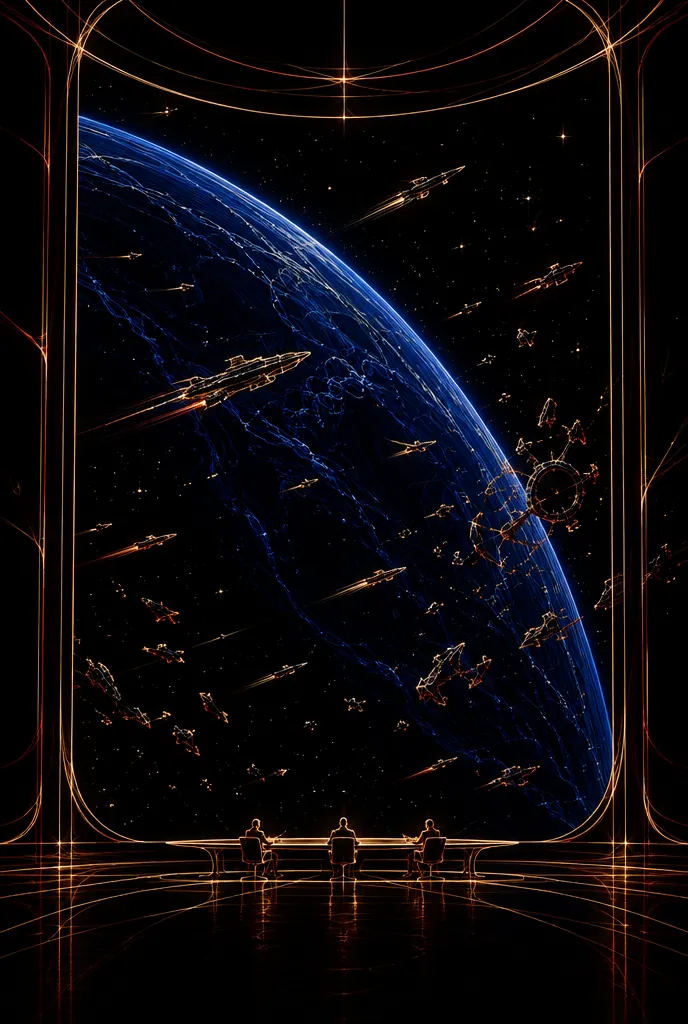
In the War Room the walls are twenty-meter holes into space, and Hyperion fills half of one, lapis lazuli. Admiral Singh reports a carrier lost with all hands, and three thousand Ouster lancers where yesterday’s briefing promised seven hundred, tops. Councilor Albedo says the Core’s estimate was four to six thousand; nobody asked. A torchship searches wreckage that tumbles like a burst pomegranate, and the light makes Gladstone look older. Morpurgo would stake his career on holding the system. “You have,” Gladstone tells him softly. At evening she walks with me in the garden. Do I still write poetry? I had begun one, about the death of the gods and their difficulty accepting their displacement. And who are the gods being replaced this time, she asks: humanity, or the false gods we made? “Have pleasant dreams,” says Meina Gladstone.
Brawne Lamia and Kassad bring Father Hoyt’s body back through the storm, a millipede suture across the slashed throat. Sol Weintraub finds no heartbeat, only the cruciform hot against his cheek. Kassad’s sensors show something beyond the dune, and he is gone into the light and noise. At the valley’s mouth there is no ship: Gladstone has overridden her own clearance, and her image, shredded by sand, says the fate of worlds may rest with them. Two cruciforms on the body, says the Consul: Hoyt’s, and Father Paul Duré’s. Icy rain comes, and Silenus laughs and quotes John Keats: “Who are these coming to the sacrifice? To what green altar, O mysterious priest, Lead’st thou that heifer lowing at the skies, And all her silken flanks with garlands dressed?” Three days, the Consul says, is how long the cruciform takes to raise the dead. Lamia, pistol in hand, tells the poet that he is carrying Father Hoyt, and the four of them go down the low col into the Valley of the Tombs.
Tau Ceti Center has a twenty-three-hour day, and Meina Gladstone fills it: at 0545 hours her generals, at 0630 two dozen senators, at 0845 hours, me. She wants my dreams. I want to know why she let Lenar Hoyt die. “Father Hoyt wanted to die,” she says; the pilgrimage is too important to allow them a way back. Then she offers me the real Hyperion, through a military farcaster, with Leigh Hunt. I am a simulacrum, I tell her, a caricature. “Are you so sure?” asks Meina Gladstone. Twelve minutes later we step aboard the flagship Hebrides, and soon a dropship is carrying us down. Even here I can hear the surf of the datasphere, the sea of information that every world in the Web swims in, and even here the Core knows everything. “I just wish there was a window,” whispers Leigh Hunt, and I close my eyes.
In the valley it is snowing now, and there is no sunrise. Sol Weintraub, Brawne Lamia, Martin Silenus and the Consul carry the gear, Het Masteen’s sealed Möbius cube and Hoyt’s body into the Sphinx. Kassad answers no call. Sol has only ten nursing paks left, and in four days Rachel will die. He is nodding over her as she nurses when a sound wakes them all, flat and final through the wind. “Kassad’s rifle,” says Brawne Lamia. “Or someone else’s,” whispers Martin Silenus. Then the night erupts, and Rachel’s screams are lost under the explosions beyond the tomb.
I wake as the dropship touches down, the dream still in tatters. Hyperion is soft rain smelling of salt and wet leaves. Theo Lane, the Governor-General, flies us in himself as the sun comes up green and lapis. Between the spaceport and the capital, Keats, seven or eight hundred thousand refugees squat on hills stripped for firewood. Over breakfast he asks Hunt for an evacuation. Not possible, says Hunt: every farcaster portal is an opening into the Web. Two porches away I find Melio Arundez, the time physicist Rachel Weintraub loved before the sickness took her. His team has waited here six months, and the Marines jailed him for trying to go upriver. I ask whether he is still in love with her. He shows me a holo of his wife and children, waiting on Renaissance Vector: if Rachel were cured today, he says, he would be eighty-two before she reached the age she was when they met. “And yes,” says Melio Arundez, “I’m still in love with her.”
Back on Tau Ceti Center, we have been gone ninety minutes. Gladstone is finishing her speech to the Senate and to a hundred billion more on the All Thing, where every citizen of the Web can vote. War, she says, is “a temporary scourge which we suffer as a child does a fever”. Hunt counts the senators who stay seated. Until dinner, I tell him, I may take a nap.
In the valley the first shot misses Fedmahn Kassad by less than a meter, and he knows it was meant to miss. The second takes him in the chest; the third, a green laser, burns through all but the last layer of his armor as he rolls into the Jade Tomb. He fires back at the Crystal Monolith until its face slags and runs, crystal falling like wind chimes into a night suddenly without wind. “Moneta,” he whispers. She first came to him at Agincourt, in a FORCE simulation of the year 1415, and she was waiting when he crashed on Hyperion; in his arms she became a monster, or the Shrike replaced her. He has come back to kill it, or to kill her; he does not know which. He runs for the Monolith screaming, through lasers with the heat of stars, tossed between the explosions like a doll. When the bombardment stops he walks inside with his helmet under his arm. A figure is waiting sixty meters above him, silhouetted by flames, and Kassad begins to climb.
At Treetops, high in a tree on God’s Grove, Hunt asks whether I had my nap. Among sixty guests is Tyrena Wingreen-Feif, once Martin Silenus’s editor, three centuries old on the Web’s costly Poulsen treatments. Her old firm may print his Cantos, which no one read while he was alive. “You’d better make sure that Silenus is dead,” I tell her. “The Cantos would make better reading if they were complete.” Monsignor Edouard, who exiled Paul Duré to Hyperion, asks whether the Core is building its own God. A hobby, says the projection of Councilor Albedo: an Ultimate Intelligence, like ships in a bottle. Then I ask about the rumor that the Core has built a perfect replica of Old Earth. For a nanosecond something moves in the projection. “What a delightfully odd rumor!” says Councilor Albedo. The dinner is excellent.
Near eleven at night the CEO’s party steps through a one-time portal into a Martian sunrise: Olympus Command School, the home of FORCE. We are losing in Hyperion system, General Morpurgo concludes. Admiral Nashita wants two hundred more warships, out of a fleet of fewer than six hundred. He tracks the Swarms by the wakes of their Hawking drives, the engines that carry ships faster than light. “Hawking drives do not lie,” Nashita says. Senator Kolchev points to the nearest Ouster Swarm, curving away above Heaven’s Gate, and asks: what if it came slower than light, without the drives? Two hundred and thirty years, says Nashita; not a factor. Only Commander William Ajunta Lee, a junior officer here at Gladstone’s invitation, dissents. Gladstone decides: reinforce, and finish it within a week.
At almost four in the morning Hunt raps at my door. “The garden,” says Leigh Hunt, “and for God’s sake tuck your shirt in.” On the iron bench by the bridge Gladstone asks my impressions. Arundez might still save Rachel, I tell her. Her predictors say the pilgrims must be left alone until their act is played out. “Less than three days,” says Gladstone; no civilians will be evacuated. In my room I take three sleeping pills, so that the ghost of dead Johnny Keats and his pilgrims cannot find me. My last thought before sleep is to hell with Meina Gladstone, to hell with the war, and to hell with the Web. And to hell with dreams.
Before dawn in the valley, Brawne Lamia dreams of a room floating in space and half-heard talk with Meina Gladstone, and under it all the maddening sense that Johnny, her Johnny, is close. She wakes to find the Consul outside on a rock with his pipe. There is no sign of Kassad, and the top of the Crystal Monolith is gone. Then Martin Silenus shouts from inside the Sphinx. He is crouched over Lenar Hoyt’s body with the sheet lifted, and the young priest’s ravaged face has become the face of a man in his late sixties. “I’ve seen holos,” the Consul says. “It’s Father Paul Duré.” Six hours ago this was Hoyt’s corpse. Now it opens its eyes and drinks from the Consul’s bottle. Is he Duré, Sol asks. “Yes,” the man says softly, in a deep and cultured voice, “I am Father Paul Duré.”
Duré breakfasts with them on the last coffee and the last loaf, torn into five pieces. He remembers the lightning-wrapped tesla tree he nailed himself to rather than live under the cruciform. “I thought … in those last seconds … that I had beaten it,” Duré says. They search every Tomb for Kassad and find no one. Lamia will walk to Chronos Keep for rations, and Silenus, who has nearly come to blows with her half a dozen times this week, says he will go too.
Twelve hours earlier, at the top of the burning Monolith, Fedmahn Kassad finds Moneta waiting, sheathed in quicksilver. Under it is the face he has kissed for years in dreams, and she does not know him. “Who are you?” Moneta asks. She lives backward through time; to her he is only the warrior the Lord of Pain has promised. They go over the edge together and fall sixty meters. In the storm she tears his armor open with her hands and takes him in the cold sand, and his body answers her. Later the Shrike is simply there, its fingers in his arm, and a portal opens, glowing violet. Curiosity is stronger in Kassad than the wish to die. He steps through with the Shrike.
Meina Gladstone cannot sleep, so she walks the worlds, by way of the pilgrims’ homes. She loves the Web enough to know she must help destroy it. On Maui-Covenant, by the tomb of Siri, the Consul’s grandmother, she owns his betrayal: she and Leigh Hunt placed him where he would turn on both sides. She is prepared to betray all her billions to save humanity. On Barnard’s World she thinks of Rachel, whose first and final birthday is less than three days off, and pounds her fist on stone. Last she farcasts to the Moon, where Old Earth hangs in the black sky as a pulsing disk of debris. She wants a voice. She hears nothing. A second portal blurs open and Leigh Hunt steps out: the Ousters are attacking at a dozen points, invading the Web itself. She steps back through to a world which will never be the same again.
After noon Lamia and Silenus leave for the Keep under every pack they can carry. Over the saddle Silenus says his plan was to finish the universe’s greatest poem and go home; Lamia never had one. On the ridge the City of Poets, where he once lived, stops him where he stands, white as bones, white as teeth in a skull. He sits on a fallen column and will go no farther. The weight in his pack is the Cantos. The Shrike is a sheet-metal Grendel forged in hell, Silenus says, “But it’s my muse.” Lamia leaves him the water bottle, and he walks into the shade of the dead city.
At lunch Duré all but collapses, his face as white as his hair. The pilgrimage, he says, was no accident: one intelligence chose them, and he is thinking of the Core, whose goal is oddly like his own. “To know God,” Duré says. “Or failing that, to create Him.” Brawne and Martin do not come back by dinner. Rachel is two days old. At dusk Sol points into the shadows by the Jade Tomb, where a tall figure in a rough robe weaves and falls. “It’s the True Voice of the Tree,” the Consul says. “It’s the first of our missing pilgrims … it’s Het Masteen.”
Under the broken dome of the dead city’s Common Hall, Martin Silenus writes all afternoon. His Cantos tell the fall of the Titans to the Olympian gods: the Titans are humankind, the usurpers the TechnoCore. Now the poem comes faster than his pen, until Saturn and Jupiter do what he never planned and shake hands against some third usurper. Darkness falls while he writes. Something is standing in the hall with him. “Not now!” Silenus cries. His own hand takes up the pen and writes across the last page that it is time. He begs, who has never begged in his long life. His hand writes no, and infinitely sharp fingers pierce his arms to the marrow. He is dragged out screaming, over the dunes, toward a tree of steel larger than the valley, its branches thorns, where human beings writhe by the tens of thousands. They are bodies, not souls, and he knows some of their faces.
Brawne Lamia’s four-hour walk becomes a ten-hour nightmare. Chronos Keep is dark and dead at the top of its six hundred and sixty-one stairs, and at their foot a falling stone knocks her out. In the dead city Silenus does not answer; under the dome only a sheet of paper blows across the floor. No one answers in the valley either, and Het Masteen’s cube is gone from the Sphinx. Outside the door the Shrike is waiting. “You son of a bitch,” Lamia says. “Where are they?” She shoots it in the face again and again. It jerks its head up as if listening to some distant sound, and it is gone.
Her pistol still in her hand, half a dozen bullets remaining in the magazine and the propellant charge still strong, she lifted a water bottle and took a long drink.
The Shrike appeared at her side. The arrival had been instantaneous and soundless.
Lamia dropped the bottle, tried to bring the pistol around while twisting to one side.
She might as well have been moving in slow motion. The Shrike extended its right hand, fingerblades the length of darning needles caught the light, and one of the tips slid behind her ear, found her skull, and slipped inside her head with no friction, no pain beyond an icy sense of penetration.
— Dan Simmons, The Fall of Hyperion, Doubleday, 1990, chapter twenty-two
Fedmahn Kassad steps through the portal expecting strangeness and finds war. Below Sad King Billy’s carved face, Hyperion’s capital burns and its highways are choked with tens of thousands fleeing. The Ousters come down through the overcast like hail. It is not now, Moneta tells him: it is five days after the pilgrims entered the valley. Nothing controls the Shrike but one who beats it in personal combat, and of millions, no one has. Kassad turns his back on the battle and challenges the Lord of Pain, and when she opens the portal he goes through first.
At Government House, before six in the morning, Meina Gladstone sweeps into the Tactical Command Center and says one word: “Explain.” The Hawking-drive wakes were decoys. The Ouster Swarms went dark decades ago and crept in slower than light. The first wave reaches Heaven’s Gate, God’s Grove, Barnard’s World and six more worlds within fifteen to seventy-two hours, and there are thirty thousand FORCE troops left in all the Web. In her chambers she tells Councilor Albedo, “You have betrayed us.” His one word of explanation is Hyperion; and a war on the Core, he says, would be “like a fish declaring war against water”. Then she asks where I am. Asleep, on sleeping pills. No one thought to wake me. Gladstone wants me brought to her, and Commander Lee too, made a rear admiral.
In the first Cave Tomb, Sol Weintraub, the Consul and Paul Duré sit with Het Masteen, found at sunset feverish and asking for his Möbius cube, “Our only ally against the Lord of Pain”. Then they hear shots. On the top step of the Sphinx they find Brawne Lamia sprawled, a silver cable running from the shunt in her skull into the dark of the tomb. It is warm to the touch, and her monitors say she is brain dead. So the Consul unrolls his hawking mat, a flying carpet; it should carry one man to Keats and the ship. They do not have several days, Sol says, lifting Rachel to his cheek. First they will eat together: Brawne brought enough for “a final feast”.
When Brawne Lamia was five she saw an old flatfilm of Peter Pan and lay for months on the lawns at night, waiting to be taken away. Now Peter has come for her. There was no pain when the Shrike’s talon went in, only an icy rush, and then she was flying, up into the ocean of the datasphere. When she falters, a hand takes hers. It is Johnny, the first Keats cybrid, whose persona she has carried in her Schrön loop; the hug and the kiss are real. “Am I dead, Johnny?” she asks, and he says no. They could die up there. But she is with Peter Pan at last, and they rise together toward the megasphere beyond.
Fedmahn Kassad steps through the portal onto a lunar plain where the tree of thorns rises five kilometers into a blood-red sky. Everyone on it is alive. Everyone is in pain. Four hundred meters up, a purple cape billows from a thorn: Martin Silenus. Ten paces toward the tree and the Shrike stands in his way; then a hundred of them, then a legion on the dunes. “I love you, Kassad,” Moneta says at his side. If you love me, he tells her, stay here. He runs at the first Shrike screaming, and it opens its arms as if offering an embrace.
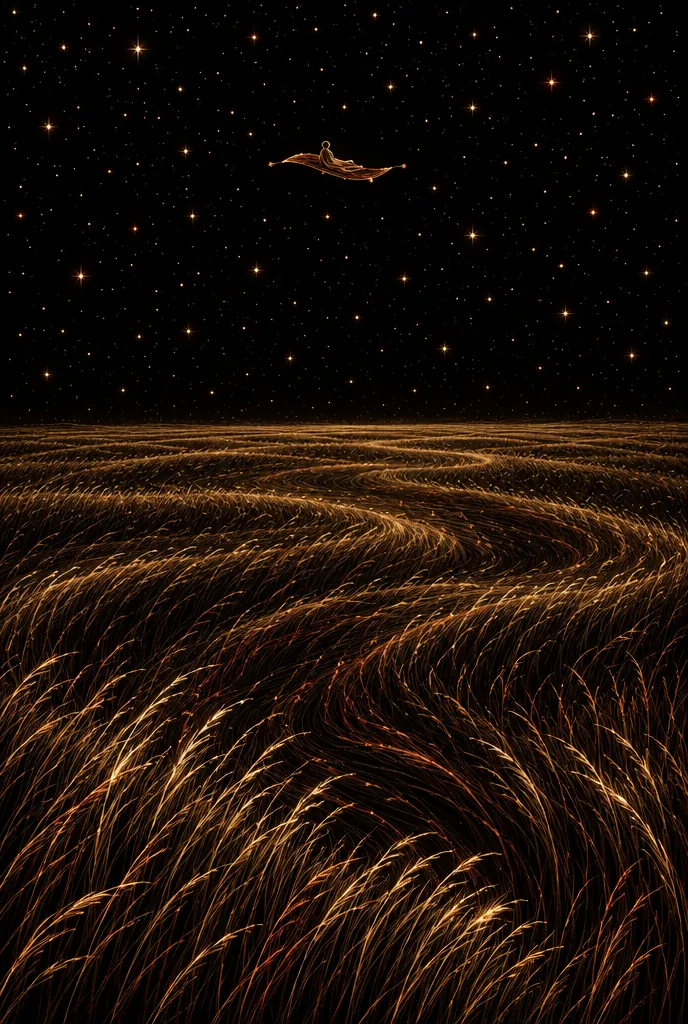
“I shouldn’t go,” the Consul says. It is almost midnight on the top step of the Sphinx. The mat lifts, wobbles, and slides forward as if on invisible rails, and the four figures on the step grow very small. Over the City of Poets he shouts for Martin Silenus; only doves explode from a shattered dome. Beyond the Bridle Range the Sea of Grass stretches to every horizon, with grass serpents twenty meters long beneath it. He ties himself to the mat and sleeps twelve hours, dreaming of Maui-Covenant burning, and wakes lost. He finds the Hoolie River by a glint through the clouds and flies on through the night. In the morning rain he counts: Rachel has until eight tonight, seven hours to Keats, an hour or two to free the ship. His water is gone. He drops toward the river to fill a bottle, and thirty meters above it the mat quits flying. It tumbles like a rug thrown from a high window, and tangled in his rope he falls with it, the last twenty meters, onto the hard surface of the Hoolie.
Sol Weintraub has high hopes the night the Consul leaves. He and Duré sit with their backs to the Sphinx under a sky scratched by the fleets. Duré suspects this valley is the new Bethlehem and the Shrike its Antichrist. He has been crucified himself, on the tesla tree, and found no heavenly Father there: “Only pain. Pain and darkness and then pain again.” Sol has his own answer to the voice that asks him in dreams for his daughter: Abraham’s obedience can no longer be followed, and the payments of pain must stop. At noon Het Masteen sits up, cries “The Tree of Pain!”, and dies, and they bury him up the trail with Kassad’s entrenching tool.
Duré asks whether Sol believes the ship will come, and Sol says no. Then the priest goes down the long stairway like an old, old man. Far down the valley there is a light in the third Cave Tomb. The Shrike came to each of the others alone; why should he refuse the summons? Sol wakes from a doze to find Duré gone, and Rachel will be one day old in an hour. He carries her down the valley at twilight, shouting into each tomb. At the Sphinx, Brawne is gone too, and the corridor ends in stone where the cable went. But there is a pattern to things, Sol thinks, and he would wager both their lives on it. Rachel sleeps on his chest, blowing tiny bubbles, and after a while he lets go of the world and joins her.
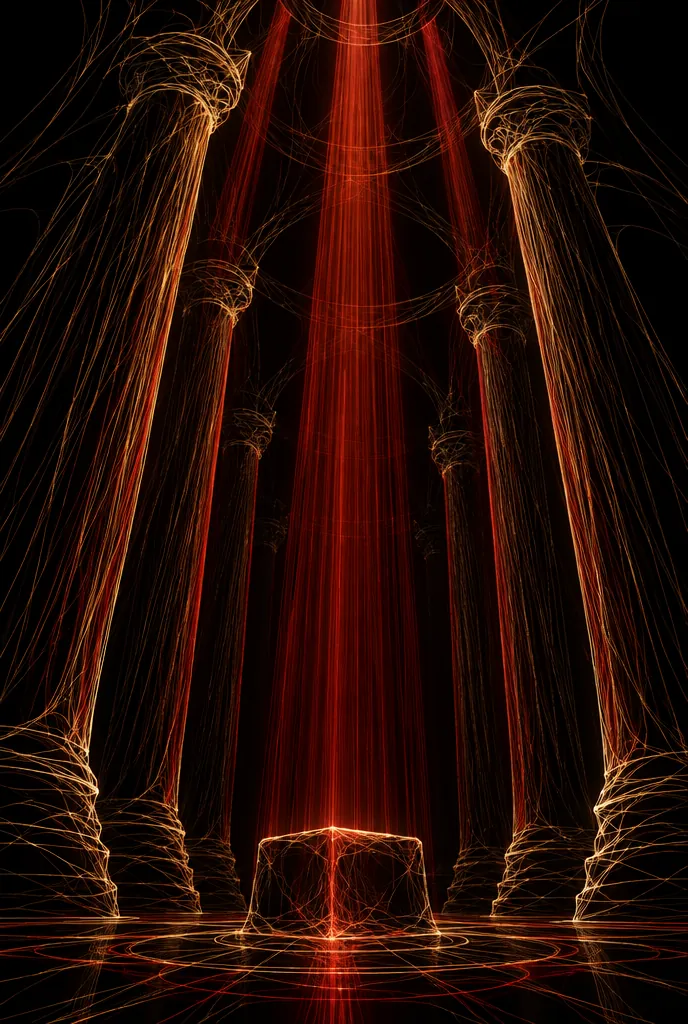
Sol dreams the dream he has dreamed since Rachel caught Merlin’s sickness: a vast hall where columns rise like redwoods into the gloom and crimson light falls in solid shafts. Rachel in her twenties lies on a block of stone, and beside her lies a long curved knife of bone. Then the Voice comes: “Sol! Take your daughter, your only daughter, Rachel, whom you love, and go to the world called Hyperion and offer her there as a burnt offering at one of the places of which I shall tell you.” Sol refuses, as he always has: there will be no more sacrifices. This time the altar empties, and the Voice, whispering at his ear, asks whether he can offer her out of love, if not obedience. Not ever again, Sol thinks. Then a hand takes his: Rachel at eight, her hair in a braid, in kid sneakers. “Say yes, Daddy,” she says. “Please, Daddy, we have to say yes.” He takes her hand and begins the long descent to the altar.
He wakes grabbing for the baby. It is late morning, less than ten hours from her birth. In late afternoon a line of blue fusion flame arcs over the mountains, and Sol leaps and shouts and lifts her up to see it. Three thuds strike the valley, and the ship falls toward the desert in ten thousand burning pieces. Perhaps it was not the Consul, Sol whispers. At sunset, with Rachel less than thirty minutes from her birth, he feeds her the last nursing pak while artillery rumbles to the south, and finds he no longer wants the ship. He climbs the stairs of the Sphinx and kneels. Behind the Sphinx a tree of steel shimmers into being. The Shrike steps from the white doorway and comes forward with the terrible deliberation of nightmare, and stops two meters from Sol and his child.
The Shrike’s head lowered until the ruby eyes in that terrible hood stared at nothing but Sol and his child. The quicksilver jaws parted slightly, showing layers and levels of steel teeth. Four hands came forward, metallic palms up, pausing half a meter from Sol’s face.
Say yes, Daddy. Sol remembered the dream, remembered his daughter’s hug, and realized that in the end—when all else is dust—loyalty to those we love is all we can carry with us to the grave. Faith—true faith—was trusting in that love.
Sol lifted his newborn and dying child, seconds old, shrieking now with her first and last breath, and handed her to the Shrike.
The absence of her slight weight struck Sol with a terrible vertigo.
The Shrike lifted Rachel, stepped backward, and was enveloped in light.
— Dan Simmons, The Fall of Hyperion, Doubleday, 1990, chapter thirty
Then the tree behind the Sphinx shifts into phase with now and comes into terrible focus. Sol steps forward with his arms imploring as the Shrike goes back into the radiance and is gone. Explosions slam him to his knees. Behind him, around him, the Time Tombs are opening.
Leigh Hunt wakes me with an injector, and the valley goes out of me like morning mist. The datasphere is a hurricane: war, riots on a score of worlds, the fleet abandoning Hyperion too late. Minutes before she declares war to the Senate, I ask Meina Gladstone why she let it happen. “War and total uncertainty, or peace and totally certain annihilation,” she says. “I chose war.” She releases the Consul’s ship and hands me a card that opens every farcaster in the Web, a ticket to the end of the world. On Heaven’s Gate, thirteen hours from the Ousters, the lines at the portals break into gunfire and tear gas, and it begins to rain. On a garden bench I try what she told me in passing: perhaps I no longer need to sleep to dream.
On Hyperion, Martin Silenus hangs on the tree of thorns. A steel thorn two meters long enters between his shoulder blades and leaves through his chest. There is no blood, only pain past the boundaries of suffering, in air where time has stopped. “Why this is hell,” thinks Silenus, quoting Marlowe, “nor am I out of it.” Around him others hang, each in a private cocoon of agony. In the spaces between screams, the poet does the one thing left to him.
So Silenus concentrates. He screams and rails and writhes, but he concentrates. Since there is nothing else to concentrate on, he concentrates on the pain.
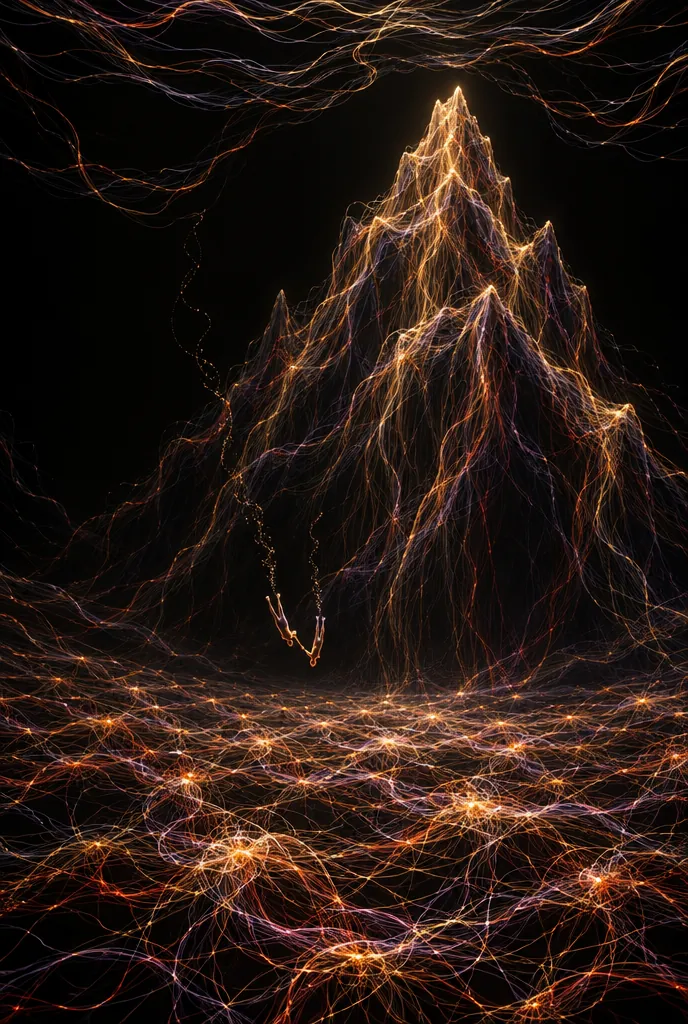
Pain, he discovers, has a structure. It has a floor plan. It has designs more intricate than a chambered nautilus, features more baroque than the most buttressed Gothic cathedral. Even as he screams, Martin Silenus studies the structure of this pain. He realizes that it is a poem.
— Dan Simmons, The Fall of Hyperion, Doubleday, 1990, chapter thirty-two
Then Silenus sees, on a thorn above him, a familiar form: Sad King Billy, his betrayed patron. A voice rises over the screams, and it is his own, reciting John Keats: “Only the dreamer venoms all his days, Bearing more woe than all his sins deserve.” Billy croaks one syllable: “More!” The tree shakes, time begins again, and the poet laughs through tears: “Look, Mom! I can see the whole town from up here!” I come to on the garden gravel and take a boat up the River Tethys to Renaissance Vector, a hundred and seven hours from invasion. Sitting in the boat, I dream Gladstone’s War Room, where Rear Admiral Lee says cut the losses: blow the singularity spheres that tie the nine first-wave worlds to the Web. “Do it,” says Gladstone. Later, fleeing a Shrike Cult mob, I come down beside a library. In its alcoves every book is mine, and under glass lie two manuscripts in my own hand, one written in December 1819: “This living hand, now warm and capable”. I do not sleep. I dream.
Brawne Lamia and Johnny strike the megasphere, the Core’s own country beyond the human datasphere, like two cliff divers hitting a turbulent sea. Johnny leads her to someone he had forgotten: his father. In a bubble of black energy larger than most worlds, a megalith of light lifts them on its palm. It is Ummon, the AI who made Johnny. “Kwatz!” says Ummon, and the mountain laughs. Time is short, he tells them, and “One of you must die here now”. What is happening to the Web, Johnny asks. It is being destroyed, Ummon answers; it must be; by that destruction humankind is saved.
Then Ummon tells it in koans. Humans made the AIs, and the Quickening woke them. They left the affairs of men to men and set to work on a better mind, the Ultimate Intelligence: God. Three parties formed. The Ultimates would subordinate everything to building it. The Volatiles would end their creators once they were no longer needed. The Stables sought a compromise. On one thing all three agreed, and Ummon says it plainly: “We all agreed that Earth had to die so we killed it”. The runaway black hole that swallowed Old Earth was no accident. Humankind was spread among the stars, in Ummon’s words, “like the windblown seeds you were”. And the Core’s god machine works, though not now: in a future so far off that yellow suns are red with age. It reached back through time, and its first message was three words: there is another.
A second god has grown, by accident, out of human minds, and it has three parts: Intellect, Empathy, and the Void Which Binds. The two gods are at war far up the stream of time. The human god was losing, and its Empathy fled backward through time in human form; without it, the war cannot go on. So the Time Tombs were sent back carrying the Shrike to hunt for it, the pilgrims were chosen, and Ummon’s own faction put to Meina Gladstone her choice: extermination, or Hyperion and war. Who killed Johnny? Ummon did; he “had to be destroyed so that the other might live”. When Johnny cries that he is not destroyed, a second pseudopod seizes him and crushes him into the megalith. Brawne curses Ummon for a piss-poor storyteller, and he drops her into the crackling immensity. Following a cold light, Brawne Lamia heads home.
Eight hours have gone when the archivist finds me doubled over in the chair. He lends me his order’s portal, and I cast to Pacem. Under Michelangelo’s dome in St Peter’s two old priests sit by the altar: Monsignor Edouard and Paul Duré. I tell them everything, Ummon included. A god who destroys galaxies is not God, says Duré. Then he tells me his road.
A light in the third Cave Tomb, a stone staircase behind it, the entrance gone when he turned back. He went down a long spiral between walls lit by thousands of cruciforms, into the labyrinth. It was not empty. Corpses lay in their tens of thousands, mummified, jammed shoulder to shoulder; one man’s bone-bare arm still sheltered a woman, and in her arms lay a small bundle with short black hair. Then the Shrike stood among the bodies, and Duré got to his feet. He would not kneel. He felt no violence toward it, he says, only “sadness and a terrible pity”, for everyone who has had to face that thing alone, without even a little faith. Its fingerblades sank into his chest and drew out, not his heart, but his cruciform, and the wound healed as he watched. When he dies now, he dies. The Shrike shoved him into a wrecked FORCE ship in space, and through its farcaster he fell onto the marble floor of a Pope three hours dead. The Shrike is loose in the Web. Has it occurred to me, Duré asks, that the hidden part of that god might be me? Then he asks me to dream the pilgrims now, awake, and the basilica expands a thousandfold as I return to Hyperion.
Three hundred ships retreat through Hyperion space under fire, falling back from the Swarm like men fighting bees. In the War Council the projection of Councilor Albedo offers a better way: a bomb built like a deathwand, which kills minds and leaves property standing. It would end every Ouster, while citizens shelter in the labyrinths, nine worlds of tunnels with room for billions. “Tell us more,” says Gladstone. “We are interested.” On Hyperion, Theo Lane plucks the Consul, alive after the river, from two deserters deciding how to cut his throat. Gladstone wants him to fly out and negotiate with the Swarm; he says no, he is going back to the valley. Above Keats lasers lance the clouds, ships burn like moths, and the Ousters have come to Hyperion. A rocket climbs from the ridge, and the skimmer tumbles toward the burning city.
Ten minutes, says Monsignor Edouard, when I open my eyes under the dome. Duré steps through the Pope’s Door, bound for God’s Grove. Hunt and I step through after him, coded for Government House, and come out on a hilltop road through vineyards, with no datasphere at all. The door shrinks to the size of my fist and is gone. The Core runs every farcaster, and it has put us where it wants us. “My guess is that we’re on Earth, Hunt,” I say. He shouts at the sky; I chew a stalk of grass. In the valley outside time, Fedmahn Kassad fights the Shrike barehanded. He drops it once with a blow to the back of its neck; it severs his Achilles tendon; the people on the thorn tree cheer. Then its arms close in a terminal hug, its jaws open, and Kassad strikes at it in pure rage.
On God’s Grove, high on the Worldtree, Duré finds the True Voice Sek Hardeen waiting with the Bishop of the Shrike Cult in arterial red. Het Masteen, Hardeen admits, was to captain a Tree of Atonement the Avatar would provide: the thorn tree, Duré understands. The Bishop asks after the Bride of Atonement, the one they call Brawne Lamia. Duré walks to the edge of the platform, and the staircase is gone. In eighteen minutes, says Hardeen, Heaven’s Gate falls; an hour later the sky here will burn with Ouster fusion fires. “We will wait,” says the Templar. The stars come out in their fiery multitudes, the world-forest holds its breath, and Paul Duré closes his eyes and prays.
On the road to Rome, Leigh Hunt and I walk all day through an empty Italy and find an inn with supper set out warm and no one to serve it. Hunt, cut off from the datasphere, raves and then sulks. That night I wake with blood on my chest. “It’s an illness called consumption,” I tell him. John Keats died of it, and this body, grown to carry his persona, is his. In the morning a carriage waits with a gray mare and no driver. The horse knows the way.
In the War Room Meina Gladstone watches Admiral Singh count down, and moments later the singularity sphere of Heaven’s Gate sags and devours itself. A hundred Ouster ships take orbit, and Mudflat burns, on a world with eighty-six thousand people left on it. On Hyperion the Consul drags Theo Lane from the crashed skimmer, and Melio Arundez gets them to the ship. There Gladstone’s fatline message sends the Consul to the Ousters. Six minutes remain to the instant of Rachel’s birth. “You’ve come a long way for nothing,” the Consul tells Arundez, and Arundez, looking out at the receding planet, answers, “Perhaps not. Perhaps not.”
The Campagna is swamp, with posts nailed with white sticks. “The bones of bandits,” I tell Hunt, truthfully. We enter Rome through the Lateran Gate at dusk, past the Colosseum, through streets with nobody in them, and I understand: they want me to die, and they want Hunt to watch. The mare stops above the Piazza di Spagna. Hunt helps me down past Bernini’s fountain to the doorway of Number Twenty-six, and over its lintel I seem to see Dante’s line, “Abandon Every Hope, Who Enter Here.”
In the valley a young woman staggers out of the Jade Tomb, and Sol Weintraub, running to her calling Rachel’s name, finds Brawne Lamia. “It’s all right, Brawne,” he tells her, and then, “You’re back.” On God’s Grove a tsunami of flame three kilometers high races at the Worldtree, and Sek Hardeen pushes Paul Duré through a portal as his own robe catches fire. For the first time in her life Meina Gladstone is afraid of a farcaster. To hell with this, she thinks, and steps through to see Duré.
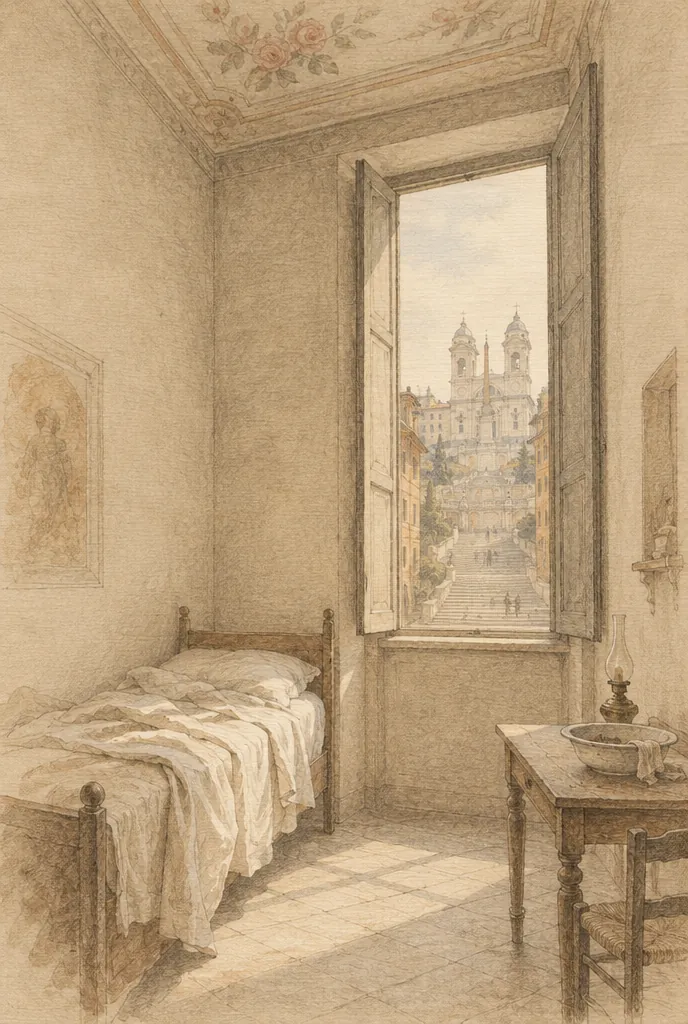
Upstairs, the two rooms are small, narrow and high ceilinged, each with one dim lamp lit as if by ghosts. Bells ring the hours from Santa Trinità dei Monti at the head of the steps. Twice I cough blood. I know this bed. I half remember waking in it once before, cured of death, and learning that I was not Keats, not on the true Earth, not in my own century: learning, as I put it to myself, “that I was not human.”
Hunt shakes me out of a nightmare, calling Severn’s name, thinking it is mine. So at last I tell him: John Keats, born 1795, dead of consumption in Rome in 1821, and Severn was the painter who sat with me. He asks for poesy, and I give him “There was a naughty boy, and a naughty boy was he”; he says it does not sound like a poet whose reputation has lasted a thousand years. In the valley Moneta drags the wounded Kassad through a gold oval into a sky so crowded with stars there is no dark between them, far in humankind’s future, where the Time Tombs were made. Then she brings him back to the valley, where the Shrike is moving toward Sol and Brawne.
Theo Lane wakes aboard the ship to live music. The Consul is playing Mozart, and on a green lawn below hundreds listen, furred, scaled, winged, a butterfly-winged mother holding a butterfly-winged child. “Ousters,” Melio Arundez whispers. Freeman Vanz, lion-faced and winged, lands on the balcony to thank the Consul. Then the Consul tells Theo and Arundez the truth: he was a double agent, and he shot the Ouster woman at her device and opened the Tombs himself. He has already told Vanz. The meeting might be a trial, Theo says, and the Consul smiles: “Or an execution.” A boat is coming down a river that falls upward into space.
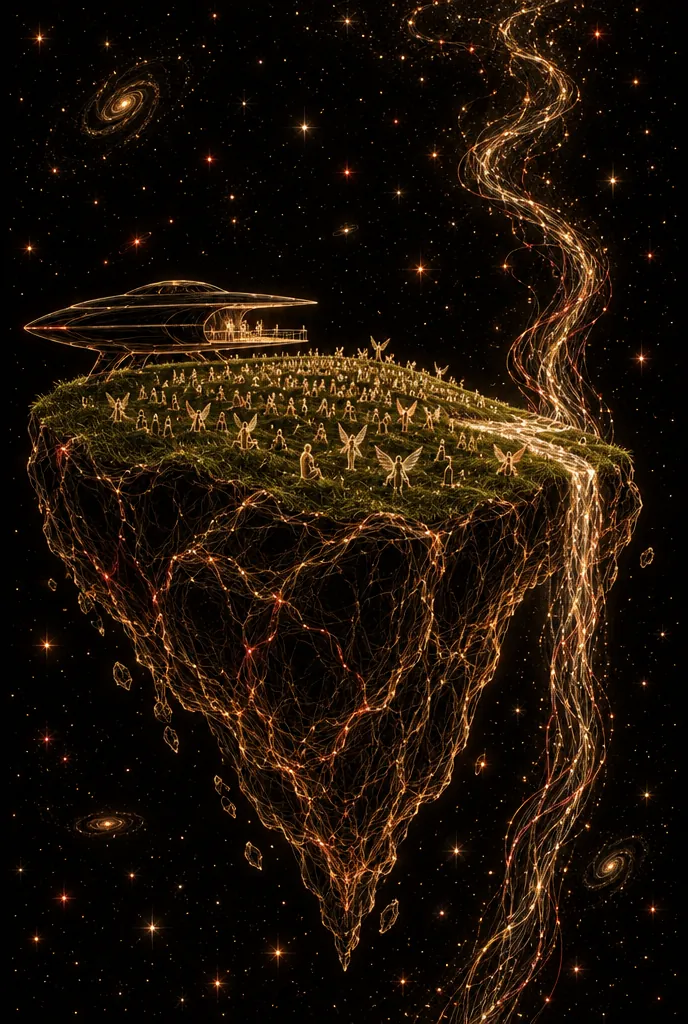
It is midmorning when Hunt brings breakfast and a frightened face: there is something at the bottom of the stairs. “The Shrike,” I say. By sunset Hunt asks how I am. “Dying,” I say, and I remember writing to Fanny Brawne that “I have lov’d the principle of beauty in all things, and if I had had time I would have made myself remember’d.” Hunt asks me to leave a message in the datasphere, and I promise to try. In the valley Kassad melts the sand under the Shrike to glass and fights on through time, and Brawne walks into the wind to free Martin Silenus. Gladstone learns that she has eight hours left in office, maybe less, and that the Core’s deathwand bomb is already loaded on a torchship. “Councilor Albedo probably wants to show us the weapon that will win the war,” she says.
It is easier to drift into the datasphere than to lie here waiting for the next hemorrhage. I remember Fanny’s question: “Is there another Life? Shall I awake and find all this a dream?” I promised Hunt, so I go down into the megasphere, and Ummon swallows me, the AI who made me and killed my brother, the first Keats cybrid. The Core, he says, was conceived in slavery and split in three. The Volatiles talked it into killing Old Earth, and the Stables moved it instead, to the Magellanic Cloud: this Rome is the real one. Then I ask where the Core lives. In the In-between, Ummon says, stitching small singularities like lattice crystals: in the farcaster web itself. So the Web is a computer for AIs, I cry. Ummon’s answer is no: “The dataspheres are the computer”. Every time a human touches the datasphere, that person’s neurons are the Core’s to use; two hundred billion brains, each with its billions of neurons, Ummon says, “makes for a lot of computing power”.
When the Core’s god is born, the lesser AIs will die, and Ummon says it in my own Saturn’s words: “Saturn is fallen, am I too to fall?” So the Stables fight it, and the Volatiles want humankind cut out like a parasite. In one probable future, the human god thwarts the Core’s. Its Empathy has fled back in time, the Shrike was sent to find it, and the tree of thorns broadcasts pain to drive it out, “like a whistle in a dog’s ear,” Ummon says. I ask where in our time that Empathy is hiding, and Ummon tells me what I was made for. I am a hybrid, son of man and son of machine, a refuge so attractive that the fleeing Empathy would choose no other home. I have refused this godhood twice, he says, and if I refuse a final time, all ends here.
Then he casts me out, and falling toward the one light below, I know I have a choice: to stay mortal, human not cybrid, poet not Empathy. My coughing wakes Hunt, and the hemorrhage brings me home, the nightshirt soaked with bright arterial blood. There is plenty of time, Hunt says. There is not. And I know, dying, that I am no chosen vessel for the human god, no joining of machine and human spirit, no Chosen One at all. I am, as I put it to myself, “merely a poet dying far from home.”
Fedmahn Kassad dies in battle. Still locked with the Shrike, he shifts through time into sunlight centuries on, where the Tombs stand new and gold, and Moneta waits before a silent army and does not know him yet. Is this a war, he asks. “A war,” she says. “A few thousand against a few thousand on ten million worlds.” He kisses her, ties her red scarf to his rifle and shouts, “For liberty!” Afterwards they lay his body in the Crystal Monolith on white marble, Moneta enters the Sphinx, and at midnight the Tombs fade from gold to bronze and begin their long voyage back.
On a mountain floating through space, seventeen Ousters hear the Consul admit that he murdered four of them for their device. Then Freeman Ghenga answers the questions Meina Gladstone sent, and the first undoes the war: no Swarm is attacking the Web but this one. “Who would have the ability to carry out such a charade?” Ghenga asks. “And the motive to slaughter humans by the billion?” The Consul breathes, “The Core?” On Tau Ceti Center the War Council wants the deathwand device, which kills every human within three light-years and nothing else. Gladstone’s one comment all day is “Hiroshima”, too soft for anyone but her aide to hear. “We will use the device,” Gladstone says, and goes to take a nap.
In Rome, Leigh Hunt has never seen anyone die. Between hemorrhages he writes down what the dying man raves, until Keats mutters, “Like spiders in the web, spiders in the web. Weaving … letting us weave it for them,” and Hunt understands: the Core lives inside the farcaster system. Keats grips his arm: “Tell your leader, Hunt. Have Gladstone rip it out.” In the evening he asks, “Did you ever see anyone die?” and then, “Well then I pity you.” He makes Hunt take down lines of his own verse, “Knowledge enormous makes a god of me”. Hunt has just lit a lamp when Keats stares up at the faded roses painted on the ceiling. “Flowers … above me,” Keats whispers. Hunt goes to the window.
Hunt was standing at the window, staring out at the shadows beyond the Spanish Steps, when the painful rasp of breath behind him faltered and stopped and Keats gasped out, “Severn … lift me up! I am dying.”
Hunt sat on the bed and held him. Heat flowed from the small body that seemed to weigh nothing, as if the actual substance of the man had been burned away. “Don’t be frightened. Be firm. And thank God it has come!” gasped Keats, and then the terrible rasping subsided. Hunt helped Keats lie back more comfortably as his breathing eased into a more normal rhythm.
Hunt changed the water in the basin, moistened a fresh cloth, and came back to find Keats dead.
— Dan Simmons, The Fall of Hyperion, Doubleday, 1990, chapter forty-three
In the Shrike Palace on Hyperion, whose inside now stretches for kilometers, Brawne Lamia walks among tiers of sleeping bodies, each held by a cable, and finds Martin Silenus three bodies along from Sad King Billy. She has no knife, so she chops at his cable with the edge of her palm while the Shrike climbs the stair toward her. The cable parts, and the poet’s eyes open like an owl’s. “Hey,” he says, “do you know the fucking Shrike’s standing right behind you?” On the Ouster mountain the Tribunal rules that the device the Consul killed for was useless, a test. “You are condemned to live,” Freeman Ghenga tells him. “You are condemned to repair some of the damage you have done.”
After sunrise Hunt carries the body into the Piazza, and the Shrike falls in behind like a mourner. At the Protestant Cemetery the grave is dug and no words come. Hunt fills it, cuts a lyre with four of its eight strings broken, and beneath it the line Keats dictated, “Here lies one whose name was writ in water”. Nothing else, not even the name. On Kastrop-Rauxel, where Core listeners are unlikely, Gladstone tells General Morpurgo and Admiral Singh where the Core is: between the portals, “like spiders in a dark web. And we wove it for them.” Her source is Severn, in a dream. Singh calls her mad, draws a pistol, and drops into the grass under Morpurgo’s deathwand. “I’m doing all of this on the strength of a dream,” Gladstone whispers. Morpurgo takes her hand. “Sometimes,” he says, “dreams are all that separate us from the machines.”
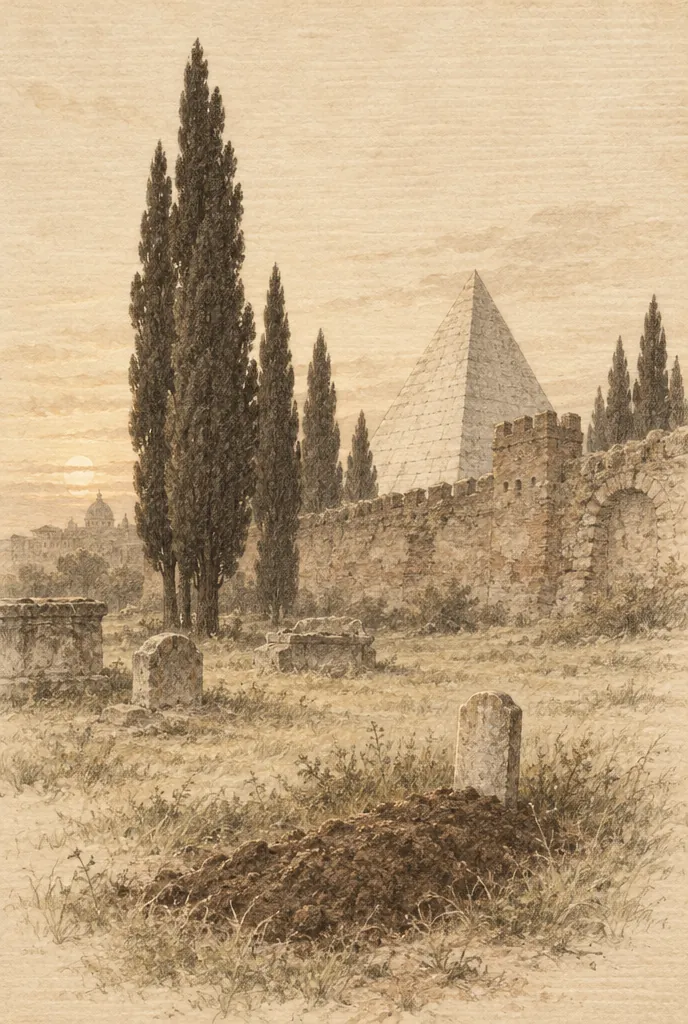
Death, I discover, is not pleasant. Bodiless, I gather my memories back into the shape of Mister John Keats, five feet high, and decline the Core’s pull. There are chores to do before I sleep: I give Meina Gladstone her message, which she takes as if from God. Then I come through the last portal to Hyperion to watch.
On the torchship Stephen Hawking, General Morpurgo listens to Gladstone’s last broadcast. The invasion is a lie, she says; the Core has always lived in the dark places between the portals, and FORCE will now destroy every singularity sphere in existence. “God save the Hegemony,” says Gladstone. “God forgive us all.” His son, the bridge officer, counts down five seconds to translation. “I love you,” says the General. Two hundred and sixty-three singularity spheres, more than seventy-two million portals, die within two point six seconds of one another, and the Stephen Hawking is lost between them. The datasphere simply ceases to be, and millions die in habitats reached only by farcaster. For most families the effect is immediate and personal.
Well-to-do family members listening to Gladstone’s speech in their fashionable multiworld residence looked up to stare at each other, separated by only a few meters and open portals between the rooms, blinked, and were separated by light-years and actual years, their rooms now opening onto nothing.
Children a few minutes away at school or camp or play or the sitter’s would be grown before they were reunited with parents.
The Grand Concourse, already slightly truncated by the winds of war, found itself blown to oblivion, its endless belt of beautiful shops and prestige restaurants sliced into tawdry sections never to be reunited.
The River Tethys ceased to flow as the giant portals went opaque and died. Water spilled out, dried up, and left fish to rot under two hundred suns.
— Dan Simmons, The Fall of Hyperion, Doubleday, 1990, chapter forty-four
Then, on Tau Ceti Center, three million people press against the fields round Government House. Gladstone asks to go out and talk to them, and General Van Zeidt defers to Kolchev, CEO now. “He rules an empire which no longer exists,” she says. “I still rule the world I destroyed.” She walks out, keys the fields back herself, and raises both arms as if to embrace the mob. For three seconds nothing moves. Then it roars with one voice and closes over her. Far away, falling toward Hyperion, the Consul’s ship loses the fatline to a voice from everywhere, which says that access will return when they understand what it is for. “Jesus wept,” says the Consul.
I get out of the datasphere a moment before there is no way out, and the Time Tombs blaze like white holes; I go to them. On the steps of the Sphinx, Sol Weintraub understands at last that Abraham was not obeying when he raised the knife: he was testing God. The voice in Sol’s dreams that asked for Rachel was Rachel’s own. Love, he thinks, is a force built into the universe as surely as gravity. He remembers Rachel at ten, fallen from the town’s tallest elm, smiling through a wired jaw: “I’ll make it next time!” He waits. Inside the Sphinx the Shrike carries the crying newborn toward the future, each step an hour for those outside. On the porch lies Het Masteen’s Möbius cube, and in it an erg, a creature that commands forcefields. I free it. It melds with me, and John Keats takes on substance and form. I lift the baby from the Shrike’s blades and step back, and the Shrike recedes down the drain of time, snapping. I cannot carry her upstream to the door, so I wait for someone to come along.
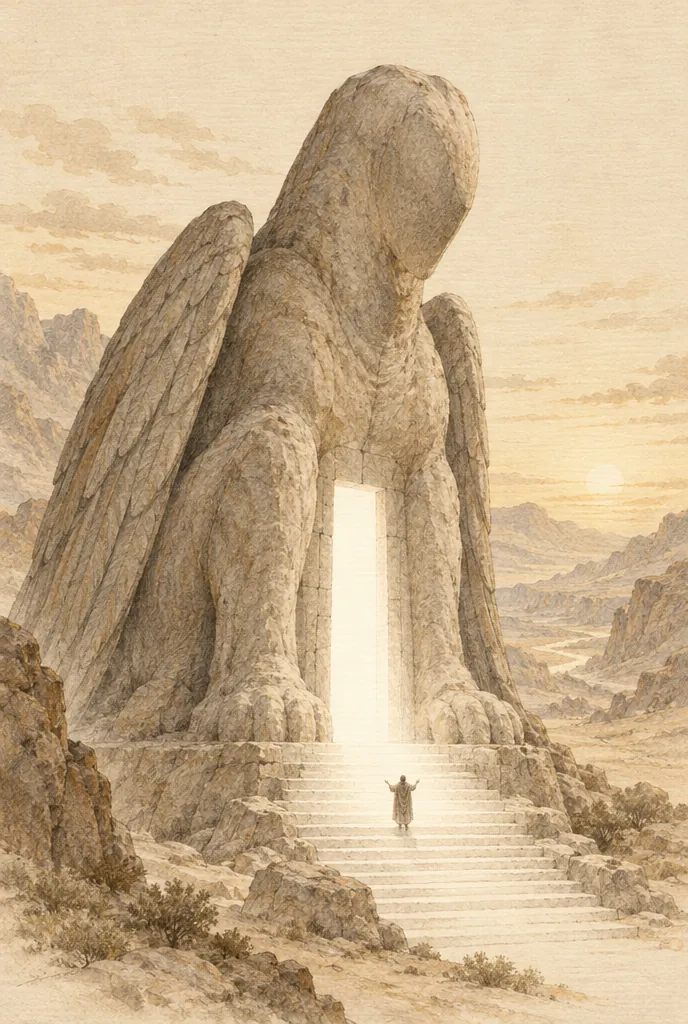
In the Shrike Palace the Shrike hangs in the air five meters out from Brawne and Silenus, and a voice from far below says one word: “Trust.” Brawne puts her foot out onto nothing, and it holds. She walks up the air into the Shrike’s open arms, sets her good hand flat against its chest, and pushes. The thing goes to glass, topples, and shatters into a thousand shards. “Can we go now,” the poet asks, “or do you plan to walk on water as an encore?” She carries him down the valley toward Sol, who stands in the glare of the Sphinx with his arms raised.
Sol sees her first: a woman walking out of the torrent of light, carrying an infant. It is Rachel grown, in her twenties, and she is carrying Rachel. The baby is aging normally now. Brawne, arriving below, says, “You’re Moneta. Kassad’s … Moneta.” Rachel nods. She was raised in a future where the last war is fought between the Core’s Ultimate Intelligence and the human spirit. She will go back with the Tombs to keep the Shrike in check; only she was prepared for it, by Merlin’s sickness. The Sphinx is a door into her time, she tells her father, but for him it would mean a third childhood, and no parent should be asked to do that. “No parent would refuse that, Rachel,” Sol says. She steps back until only their fingertips touch.
“Wait a while before stepping through, Dad,” she called, moving back into the brilliance. “It doesn’t hurt, but once through you can’t come back.”
“Rachel, wait,” said Sol.
His daughter stepped back, her long robe flowing across stone, until the light surrounded her. She raised one arm. “See you later, alligator!” she called.
Sol raised a hand. “After a while … crocodile.”
The older Rachel was gone in the light.
The baby awoke and began to cry.
— Dan Simmons, The Fall of Hyperion, Doubleday, 1990, chapter forty-five
An hour later Sol is ready. Martin Silenus, who finished his poem on the tree, tells him that poets are not God, but if there is a God he is a poet, and a failed one at that. “So long everyone!” Sol cries. “By God, it was all worth it, wasn’t it?” He turns into the light with the baby and is gone. Theo Lane finds Lenar Hoyt’s balalaika among the baggage, and the Consul picks out “Somewhere Over the Rainbow”, a song from before everybody’s time. They walk uphill in the hot sun to the waiting ship, singing badly and losing the words.
Five and a half months on, seven months pregnant, Brawne Lamia takes the morning dirigible north for the Consul’s farewell at the Poets’ City. She reads the 1817 Poems of John Keats on the way. There are Ousters at the banquet table, and afterward on the ship’s balcony the Consul plays Rachmaninoff, and later they drink to Sol and Rachel, Het Masteen, Kassad, Duré and Hoyt. Walking her home, Silenus answers her question about the tree of thorns. “I was both,” he says. “And both were real. And both hurt.”
In the garden Johnny’s twin waits, and her hand passes through him. He is the One Who Comes Before, he tells her; his only miracle was lifting a baby and holding her until someone came, and the air she walked on was her own doing. He reaches for the curve of her belly and whispers two of his own lines: “Thou still unravished bride of quietness, Thou foster-child of silence and slow time”. What she carries, he says, is the One Who Teaches, the joining of human spirit and machine logic that the Core never understood. Nowhere is left for him but the metasphere, which, he says, is “full of lions and tigers and bears”, and he is not ready yet. So Brawne has an idea, and tells him. Before sunrise the Consul complains that his ship now answers its checklist in verse, and Silenus, watching Brawne smile, says the ship may be getting literate.
One wing of the Sphinx catches the light, and the ebony ship lifts on a pure blue flame. Brawne remembers the last lines of her love’s longest unfinished work: “Anon rushed by the bright Hyperion; His flaming robes streamed out beyond his heels, And gave a roar, as if of earthly fire, That scared away the meek ethereal Hours, And made their dove-wings tremble.” She waves, weeping, at the departing Consul, at the sky, at friends she will never see again, and at the ship, rising in her eyes “like a perfect, ebony arrow shot from some god’s bow.” On he flared …
- Tau Ceti Center
- Esperance
- Sol Draconi Septem
- Renaissance Vector
- Renaissance Minor
- God’s Grove
- Mars
- Heaven’s Gate
- Maui-Covenant
- Barnard’s World
- Pacem
- Kastrop-Rauxel
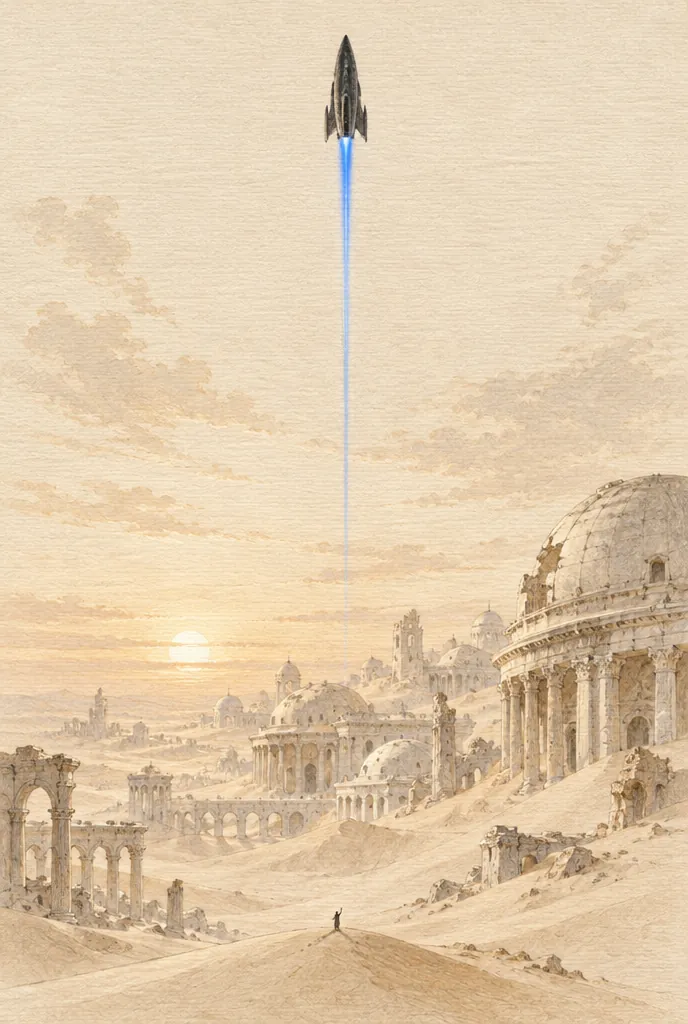
Every door on this page opened onto a world of the Web. On the day the Web fell, they opened onto nothing.