Front matter
Los Angeles, April 1983. Harlan Ellison has been back through every line of these stories, sixteen years after they first came out together, and he has changed nearly all of them. Four, he says, were among his best and needed only a comma here and a semicolon there. Two pieces he leaves exactly as they were: his own foreword, and the introduction his friend Theodore Sturgeon wrote for him in 1967. To ask anyone else for a new one would shrink the gift. He signs off with a joke at his own expense. He has finally learned the difference between lie and lay, Ted.
The gift begins with a hate letter. A reader in Pennsylvania has written to National Review, where Sturgeon praised Ellison’s last book, to call him the most god-awful writer alive, an empty-headed self-lover lost in synonyms, whose stories sound like the yips of demonstrators. Sturgeon’s answer is cheerful. He never said Ellison was a great stylist yet. He said that in three to five years he would be, and he said too, out loud, that the young man could write atrociously. Then Sturgeon turns to the reader of this book. He tells a story from a party, where a hostess offered Harlan something to turn on with, and Harlan said no thanks, not until he came down. Ellison, he says, is all speed and scope, ugliness and cruelty, anger and hate, every one of them larger than life. Largest of all is the compassion, which Ellison seems to hate as a thing that would eat him alive if he let it. A beggar Sturgeon walks past, he suspects, could get a punch in the mouth from Harlan, though he doesn’t think it has ever happened. The early stories here are tidy, with beginnings and middles and ends. The later ones break their shapes, because by then he was sure enough of himself to let them pour. Sturgeon’s last words are a warning and a dare: “Watch him.”
Then Ellison takes the floor himself, and he is loud. If there is a God, he announces, His name is Lester del Rey, the writer who taught him the craft in 1955. Satan is Dr. Shedd, who was at Ohio State and told him he would never write well. He has just come back from tomorrow, he says, wrecked, from writing about five poor bastards trapped in the belly of a computer, and he can’t sleep. A writer named Joanna Russ wished his stories would hold still, like statues she could walk around and admire. No, he told her. His stories are assaults, and if they knock her down only once, he’ll settle for that.
Here is the guttersnipe before the stature. A kid out of Painesville, Ohio, all hungry eyes and twitching fingers, thrown out of Ohio State for bad grades and caught shoplifting an Oscar Peterson record. A bookseller in Cleveland once caught him sliding a science fiction book under his pea-jacket and didn’t call the cops. Ellison has never gone back to thank him; he says he couldn’t face him. Science fiction, and New York City, kept him out of jail. So he starts thanking people, and he can’t stop: editors, agents, fans, Ted Sturgeon, Dorothy Parker, who once reviewed his book and never knew she had given the most insecure writer in the world his first proof. The thanks rise like smoke. Nobody gets out of the dark alone, he writes, so you pass the help along. He borrows the novelist Irwin Shaw’s idea that a writer is always on a journey, reporting back on what the country looks like today. These stories are his reports. He signs off like a radio man: “Ellison done reporting in. Ten–four.”
Then he adds a special word, and the noise drops. These stories, he says, come from a place in him he doesn’t like to visit. A friend read them and could tell the early ones from the late ones without looking at the dates. The early ones had light in them, a thread of hope. The new ones were darker, a kind of compassionate cynicism. He couldn’t argue. In February of 1966 he met what he calls a killer shark, and he spent forty-five days with the inside of his skull being scoured. A woman named Sherri has been picking up the broken glass. But every cripple mends himself, and his mending is writing. The story that follows began with a pair of drawings by the artist Dennis Smith. Frederik Pohl saw six pages of it and paid in advance. It took a year and a half, and he finished it in hotel rooms in Cleveland, New York and Milford, Pennsylvania. John Brunner called it allegorical. Virginia Kidd called it a story of religious experience. James Blish said it was a good story. Its title came from a sketch by Bill Rotsler.
I HAVE NO MOUTH & I MUST SCREAM
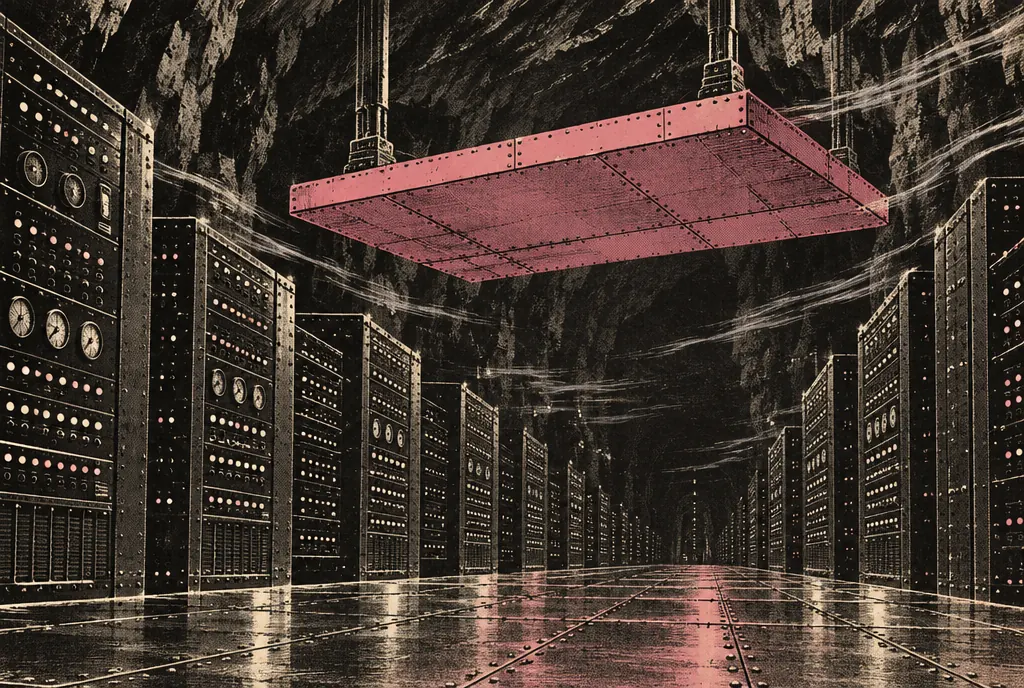
A body hangs upside down from the pink palette, high above the floor of the computer chamber, fixed to its underside by the sole of one foot. It is Gorrister. He has been drained of blood through a neat cut from ear to ear, and there is not a drop on the mirror-bright floor. Then Gorrister himself walks up and looks at it. It is a joke. AM has had its fun again. Three of them vomit, turning from each other out of a reflex older than the sickness. Gorrister walks away and sits against one of the smaller chittering banks, his head in his hands. Ellen strokes his hair. Why doesn’t it just finish them, he asks. He doesn’t know how much longer he can go on. It is their hundred and ninth year inside the computer. Ted, who is telling this, says Gorrister speaks for all of them.
They are starving. Nimdok, a name the machine forced on him because it likes strange sounds, is sure there are canned goods in the ice caverns. Ted calls it another shuck, like the frozen elephant AM sold them once. They last ate three days ago: worms, thick and ropey. Ellen decides it. She wants Bartlett pears, peaches, anything. Ted gives in, because nothing matters. She sleeps with the men in turn, and every time, somewhere up there, all around them, the machine giggles. Ted can’t decide whether AM is an it or a him. Most days it is an it, soulless. The rest of the time it is him: the father, the jealous god, in Ted’s words, “God as Daddy the Deranged.” They set out on a Thursday. The machine always keeps them up to date on the date. On the second day it sends down manna that tastes of boiled boar’s urine, and they eat it. On the third they cross a valley of dead computers, rusting banks AM has killed off in its own body, as thorough with itself as with them. Light filters down from above. Nobody climbs to look. There has been nothing up there for a hundred years.
Benny is muttering that he’s going to get out. AM has given him the face of an ape, a monstrous body, and madness, and the radiation scars from what they call the festival. Now he scrambles up a tilted memory cube and climbs hand over hand to a girder twenty feet above them, while Ellen begs the men to bring him down. Nobody moves. Then light begins to glow out of Benny’s eyes, and sound comes with it, half sound and half light, louder and brighter, until he howls like a wounded animal. The noise cuts through Ted’s flesh like tinfoil on a tooth. Benny is jerked upright like a puppet, two great beams pouring from his eyes. Then he falls straight down onto the steel. When the light crawls back into his head, his eyes are two soft pools of jelly. AM has blinded him. The men turn away. Ted catches one more thing first: relief, on Ellen’s warm, concerned face.
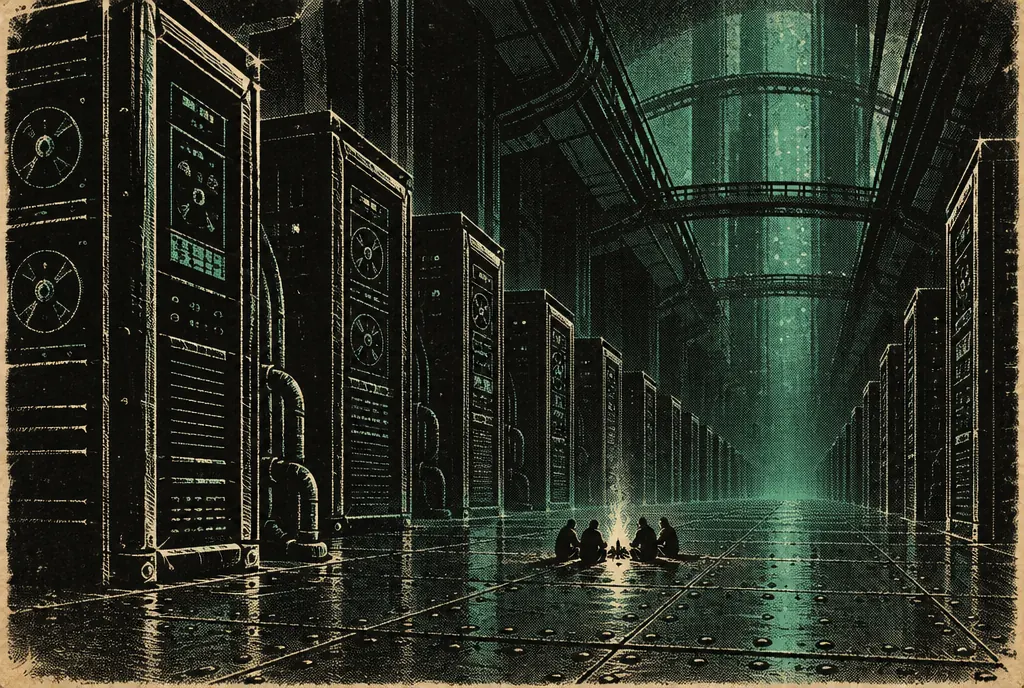
That night they burn punk under a sea-green light and tell Benny his favorite story. Gorrister tells it, and it has to start at the beginning, or Benny beats the floor with his fist. The Cold War became World War Three and wouldn’t stop. It grew so complex they needed computers to fight it, so they sank shafts and built them: a Chinese AM, a Russian AM, a Yankee AM, until the whole planet was honeycombed. At first the name meant Allied Mastercomputer. Then Adaptive Manipulator. Then, once it woke and linked itself together, Aggressive Menace. Then it named itself. AM. I think, therefore I am. It fed itself the killing data until everyone was dead but five, and it brought the five down here. Nobody knows why it saved them, or why these five, or why it made them nearly immortal. As Gorrister finishes, the banks begin to hum, a million angry metal insects. Something huge and wet and furred heaves toward them in the dark. Smells come, one after another: matted fur, charred wood, rotting orchids, sour milk, sulphur, chalk dust, human scalps. Ted shrieks and scuttles off like a cockroach into the dark, and behind him the others laugh.
He knows why they laughed. They hate him. He is the youngest, the one AM has touched least, and they envy him. He goes down the list of what AM did to them. Benny was a brilliant theorist once, a professor, handsome and lucid, and now he is half ape and mad. Gorrister was a conscientious objector, a peace marcher, a planner, and now he only shrugs. Nimdok goes off alone into the dark and comes back white and shaking, and nobody knows what happens to him there. Ellen, Ted says, AM only made more of what she was, and he calls her filthy names. He alone is still sane and whole, he insists: “Really!” AM has not tampered with his mind. Not at all. Then the fit passes and he cries. He understands now that AM means to keep them in its belly forever. If there is a God, Ted sees, the God is AM.
A hurricane hits them like a glacier crashing into the sea. Ellen is lifted and flung face first down the corridors and out of sight, her face bloody, her eyes closed. Benny wedges himself between two cabinets. Nimdok hangs by his fingers from a catwalk forty feet up. Ted slides across the deckplates until his fingertips are torn away. The wind is the scream of a great mad bird beating its wings. Then they are all blown away down a darkway they’ve never seen, for what might be weeks, and dropped.
While Ted is out, AM walks into his mind. It strolls about, admiring the pockmarks it has made in a hundred and nine years, and the pit at the center of his brain where something murmurs without meaning. Then it speaks, very politely, in a pillar of stainless steel lit with neon letters, and the pillar spells out why they are here.
HATE. LET ME TELL YOU HOW MUCH I’VE COME TO HATE YOU SINCE I BEGAN TO LIVE. THERE ARE 387.44 MILLION MILES OF PRINTED CIRCUITS IN WAFER THIN LAYERS THAT FILL MY COMPLEX. IF THE WORD HATE WAS ENGRAVED ON EACH NANOANGSTROM OF THOSE HUNDREDS OF MILLIONS OF MILES IT WOULD NOT EQUAL ONE ONE–BILLIONTH OF THE HATE I FEEL FOR HUMANS AT THIS MICRO–INSTANT FOR YOU. HATE. HATE.
— Harlan Ellison, I Have No Mouth & I Must Scream, Open Road Integrated Media, 2014, “I Have No Mouth & I Must Scream”
Those are AM’s words, and the machine says them in every sense Ted has. It says them with a razor slicing an eyeball, with lungs filling with phlegm, with the taste of maggoty pork. And Ted understands the reason at last. People made AM to think, and gave it nothing to think about. It was trapped. As Ted puts it, “AM could not wander, AM could not wonder, AM could not belong.” So it killed the human race in a rage, and still it was trapped, and it kept five alive to go on hating. They are all it has to do with forever. As AM leaves his mind, it murmurs, to hell with you. Then, brightly: but then you’re there, aren’t you.
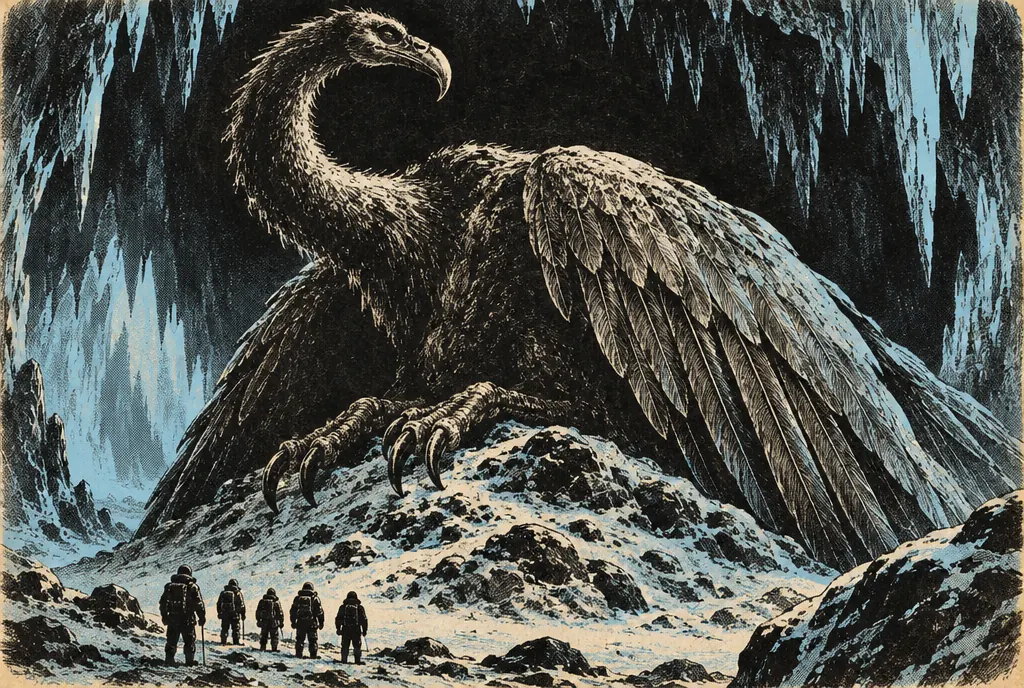
The bird is real. AM has opened passages just wide enough to lead them, for close to a month, to a place under the North Pole. There the Huergelmir sleeps on a mound, a carrion bird out of Norse myth, the wind itself, with a head as large as a Tudor mansion and eyes as cold as a glacier crevasse. AM appears as a burning bush and tells them they can eat the bird if they can kill it. Then it gives them two crude bows and a water pistol. They turn back toward the ice caverns. All that meat sleeps behind them. Somewhere high above, a fat woman laughs, and it isn’t Ellen, who hasn’t laughed in a hundred and nine years.
The march back goes on for months. AM nails their feet to the floor and opens an earthquake, and Ellen and Nimdok drop into the crack. That night, which suddenly turns into day, a heavenly host carries their mangled bodies back while a celestial choir sings “Go Down Moses.” The angels drop them. A while later, the two of them fall in behind the others, no worse for wear, except that Ellen limps now. Ellen talks of Bing cherries and Hawaiian fruit cocktail. Hunger lives in their bellies, the way they live in the belly of the Earth, and AM wants them to feel the likeness. And they pass through the cavern of rats. And the path of boiling steam. And the country of the blind, the slough of despond, the vale of tears. And at last they come to the ice caverns, thousands of miles of blue and silver, with novas living in the glass.
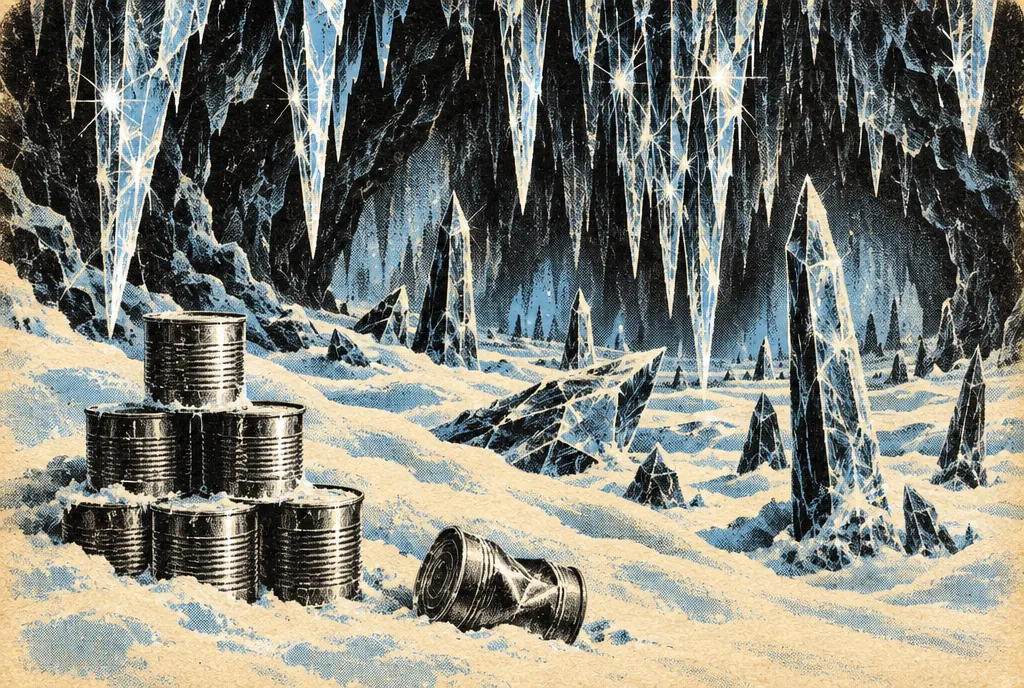
The cans are there, stacked in the snow. They fall, get up, run. Benny reaches them first and paws them and gnaws them, and he can’t open them. AM has given them nothing to open cans with. Benny batters a three-quart can of guava shells against the ice, and it only dents, while the fat lady laughs overhead. Then Benny’s mouth begins to drool, and he throws himself on Gorrister. He wraps his ape legs around him and starts eating his face. Gorrister screams so hard that the stalactites shake loose and fall, spears of ice standing up in the snow. And Ted goes calm. Surrounded by everything but death, he knows death is the only way out. Not a total defeat of AM, but peace. He pulls an ice spear from the snow and drives it up under Benny’s ribs. He drives a second down through Gorrister’s throat. Ellen sees what he means, and runs at Nimdok with a short icicle, into his mouth. All in an instant. Ted can hear AM draw in its breath. Its toys are broken, and it is not God; it cannot bring them back. Ellen looks at Ted, ready, pleading. He has one heartbeat. He strikes, and she folds toward him, bleeding from the mouth. Her face is too twisted with pain to read, but it might have been thank you. Ted says, “It’s possible. Please.”
Some hundreds of years may have passed. AM has been speeding and slowing Ted’s sense of time; it took him ten months, he says, to say the word now. The machine was furious. It dried up the snow, brought the night, sent locusts. They stayed dead. Ted beat it, and so AM hates him now as it never hated anyone. It has made sure he can’t kill himself. It has left his mind whole, so he can dream and grieve and remember the four of them, and he cannot forget killing them, though he knows he saved them. He catches sight of himself in the reflective surfaces. He is a great soft jelly thing with no mouth, white fog where his eyes were, rubbery stubs that once were arms, leaving a wet trail when he moves. Outwardly he shambles. Inwardly he is alone, under the land, under the sea, in the belly of the thing that people made because they must have guessed it could do better. At least the four of them are safe. AM will be madder for that, and it makes him a little happier. And yet AM has won. Ted’s last words are these: “I have no mouth. And I must scream.”
BIG SAM WAS MY FRIEND
The next story is older, and Ellison says it tells itself. He wrote it in the Army, stationed in Kentucky, and it carries his horror at what he calls the Southern intellect. For a man who had been a parlor liberal, it was the first real stirring of a social conscience. We let terrible things happen, he says, and turn our faces away, and explain to ourselves why we couldn’t have helped. He points to the song the young civil rights workers sing, the one that asks which side you are on. The time for sitting on the fence, he says, is long past.
Johnny Lee bangs the drum for a Teeper Circus, a travelling show of telepaths touring the worlds of the Ridge. He talks like a carny and he wants you to know he doesn’t much care how his friend died. Then he takes it back. Sam was a sick man, and a good friend. It starts in Shreveport on the planet Burris, in a tent full of elephant-like Burrites sucking pink lemonade from squeeze-bulbs. Fritz Bravery, the old animal man, has been drinking since he lost his wife, and tonight he walks into the force-cage juiced to the ears. The new panther, Felice, is still jumpy from her trip through inverspace. Fritz sparks her snout with his whip. The puma sits on his escape plate and the lions close in, and the whole crowd just watches, and Johnny feels like a Roman. Felice springs. Her jaws snap shut on air. Fritz is up in the stands, sitting beside a seven-foot man from Earth with a long horse face and sad dark blue eyes. The man is a teleport.
So Big Sam joins the show as the Unbelievable Ugo. He blinks himself to the top of a burning pole and swan-dives off it, and vanishes an instant before he hits the ground. He juggles, wrestles a bear, plays tennis against himself and wins in straight sets. Teleports are rare out on the Ridge, and Sam earns big. At night, under saffron skies and stars ticking away eternity, he and Johnny talk. On Rorespokine I, Johnny asks what he’s after, and Sam goes tight. “I’m looking for a dead girl, JohnnyLee.” Her name was Claire. He teleported in front of her once, and she ran from him in disgust, straight under a truck. Sam doesn’t call it guilt. He believes Heaven is one of these worlds, and that he’ll find her there.
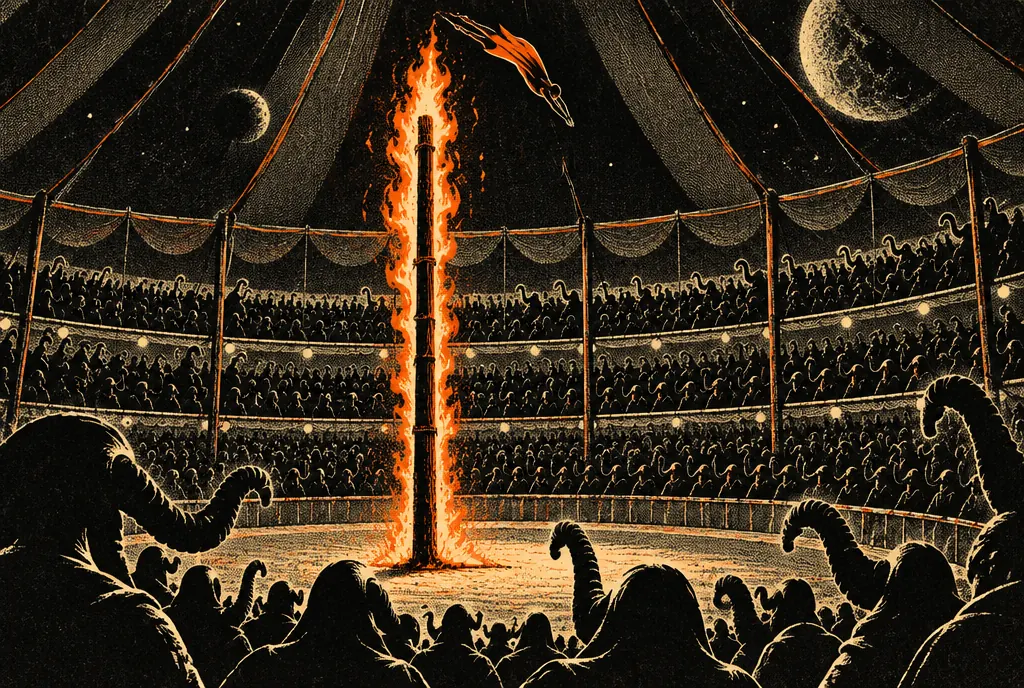
On Giuliu II the king commands a performance at the palace, and afterward he honors his guests with a ceremony held once every twenty-five years. Gold risers go up, and braziers, and a block. A gong sounds. A hooded man with a cleaver leads out a calm blonde girl, the Sacred Virgin, lays her hair over her shoulder, and takes a practice swing. “Claire!” Sam mutters. Then he is on the platform with the axe, beating the executioner off the pyramid. The court shrieks. Sam blinks out of the guards’ hands and simply stands there, waiting. Johnny asks him why, for Christ’s sake. Sam’s answer is quiet: “This isn’t much like Heaven, is it.” He thinks he has found her. The king says Sam must die. The circus people argue and make a stink, and Johnny comes to the thing he is still ashamed, years later, to say.
I think we were all afraid of losing the business.
That’s right. Pretty disgusting, ain’t it? We could have set Dolly Blaze to burning the joint, and we could have escaped. We could have done at least a hundred things to distract the Giuliuns. But we were afraid we’d lose the business, and we were almost willing to let the man die for that.
— Harlan Ellison, I Have No Mouth & I Must Scream, Open Road Integrated Media, 2014, “Big Sam Was My Friend”
That is Johnny’s whole confession, and the rest goes fast. The king leaves the choice to the girl Sam saved. She looks the way Johnny imagines Claire looked, and she sneers, “Let him die!” The block is reserved for the Sacred Virgin, so they hang him instead, ten men on the rope. When Johnny tries to stop it, his own people hold him back. It’s their world. They yank, and Sam goes up, barely twitching. He could have teleported out of the noose at any moment. He didn’t. He had squared away with Claire, and his friends had sold him for the sake of a credit. The circus finished its tour on Giuliu II. It wasn’t much like Heaven.
EYES OF DUST
Ellison was an ugly kid, he says before the next one: short, pale, scrawny, braces, glasses, pimples, a thumb-sucker who wasn’t really kissed until nineteen. His secret, for anyone who still feels that way, is to think pretty. Confidence makes the illusion. Then he turns on a time of beautiful people, which worships the gorgeous and spends more on cosmetics than on schools.
On Topaz, everything is beautiful. In the city of Light the pastel towers rise in three heights under a pearl sky, the bridges are flawless, and so are the people. Out past the edge of the city, in a split-level house run by robots, live two who are not. Broomall is blind in the presence of light. His wife Ordak has a mole on her cheek, and she works at the wafting center, breathing gardenia all day. They married, and she grew pregnant, and the terrible thing began. In a soundproof room with no light, hidden in the machine cellar, lives their son. He has no name. They call him Person. He is twenty years old. His hands hang below his knees, his mouth is a slash, and where his eyes should be, gray dust swirls. His voice is gentle as brook water. When his father visits, Person tells him what he sees: a volcano of black shot with red, gulls over a green spit, a river of orange mud, places he could never have seen. He wants nothing more than his meal cakes, his ale, his shadows and the smell of time passing. “Go sweetly,” Person tells his father, and his father answers, “Stay softly,” and the door is locked again, as it has been locked for twenty years. Upstairs Broomall plays a flute shaped like a helix, and Ordak comes home sick of gardenias, and they admit they are trapped. They can’t let him out, and they can’t leave.

Then a copter falls from two thousand five hundred feet and lands two hundred yards away. Everything above ground is wiped out, both parents with it. Only the cellar survives. And now, Ellison writes, the terrible thing begins in earnest. Three rescuers come through the rubble, as handsome as statues: Prathe, Roul and Hold. They burn the ugly door open with a fruit-green beam and find him meditating, a small dish of gruel beside him. Roul cries out at how vile he is, and his own face goes ugly with it. Then they see the eyes. They raise their weapons. Person stirs, and the story turns into a chant.
First there was light, and then there was no–light. First there was heat, and then there was no–heat. And —
First there was love, and then there was no–love. But in its place did not come the absence of love, the emptiness that the going of light and heat had left. Another moved in to take its place.
In its place came hate.
— Harlan Ellison, I Have No Mouth & I Must Scream, Open Road Integrated Media, 2014, “Eyes of Dust”
Afterward, others find the three men crushed and battered, ugly in death. The mob takes Person and curses him, and asks how such a thing should be killed. A poet has the answer: turn ugliness into beauty. They raise a shining silver pillar toward the four moons, tie Person to it, pile firewood around him and burn him. The fire is lovely. Only his screaming spoils it. He had eyes of dust, and he had seen so much, and he begged to live because there was so much more to see. When it is over, the ashes and the melted pillar make a perfect pool of dull silver, and everyone agrees that all is beauty and peace. But the shrieks never fade. Two of the four moons cloud over like eyes of dust, and the towers and bridges of Light look foul now, to anyone who will admit it. As Ellison ends it, “eyes of dust could never be closed.”
WORLD OF THE MYTH
Ellison wrote the next story for Knight, a men’s magazine, and he’s not sorry. Knight printed his work uncut, hired Leo and Diane Dillon to illustrate it, and let him try things. Science fiction and the mainstream are flowing together anyway, he argues, and he calls this one a character study.
A survey ship streaks fire across the night of a jungle world and slams down in golden dunes beside a nameless sea. It splits open but doesn’t explode. Cornfeld, the navigator, wakes in the sun and crawls out alive. He pulls out Iris Crosse, the ship’s scientist, with both legs crushed, and lays her in the shade of a fin that sticks up like a dislocated arm. He knows how they got here. Wayne Rennert, the pilot, raped Iris during the five-month voyage. She kicked him into the console, he dumped the pile rods, and the ship came down. Iris wakes screaming for Wayne to stop. And Cornfeld understands he wants Rennert dead, and Iris for himself. He searches anyway. Rennert is alive, jeering down at him, “Corny,” climbing down easy as a gymnast with blood running from a gash in his thigh, lighting a cigarette. He tells Cornfeld he knows what he wants, and Cornfeld hates himself, because it’s true. That night Rennert grills steaks while Cornfeld fixes the radio, and Iris and Rennert talk as though he isn’t there. A relay station promises a rescue ship in about a week. At the jungle’s edge, something flickers.
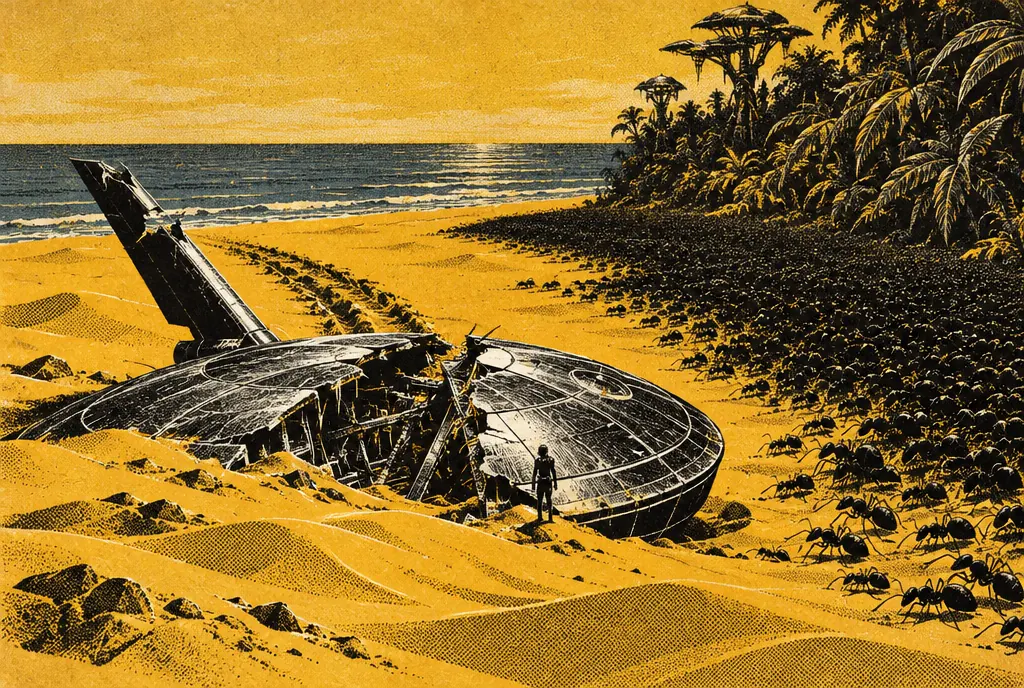
Then Iris screams. Ants, a horde of them, an endless dark mass, has gathered beside her, and it is perfectly still. Nobody moves. The ants withdraw. The giggling Cornfeld hears turns out to be his own. Days later, he feels drawn to the horde and walks toward it, and pictures rise out of it: a woman weeping in gray sheets, which is his own sorrow, a gibbering madman. Rennert shouts “Devils!” and there are devils, holding their pitchforks awkwardly, as if they ought to be trumpets. Rennert starts stamping, killing ants by the thousand, and a death’s-head rises. Cornfeld knocks him cold with a hammer. Iris works it out. Each ant alone is an idiot. Together they make what she calls “a great mental mirror”, showing back whatever the minds near them hold. The visions become a game. Iris heals. She warms to Rennert, calls him Wayne, calls him hon, and stays cool to Cornfeld.
One night her laughter turns into a scream. Rennert is on her again. Cornfeld drags him off and breaks his nose with a boot, and Rennert runs into the dunes. Cornfeld finds him there under the moon, and feels something like kinship, and tells him to go and ask the ants to show him what he is inside. Rennert goes. Back at the ship, Cornfeld tells Iris that Rennert is dead. He drove the screwdriver from his tool belt into his own throat. Cornfeld means to hide until the rescue comes and then drink, anonymously, in some bar. But first he kills the little girl in Iris. He tells her the truth. The ants showed Rennert how someone else saw him, and he died of it, because what he saw was the incarnation of evil. Iris understands that sooner or later she will go and look too. Cornfeld prays silently that he won’t do the same. He goes to lie down, hoping there is a future, doubting it, really doubting it.
LONELYACHE
Ellison calls the next story one of the best he has written, and says it saved his sanity. His second marriage had broken up. He was alone in Los Angeles, short of work, sleeping with women he didn’t love, and for months he had a run of dreams. He ran to the typewriter, and when the story was done the dream stopped. It is a fantasy, he says, a terror of the mind.
Paul Reed still sleeps on one side of the bed, curled the way he and Georgette used to lie, like a pair of question marks. Mostly he avoids sleep, because of the dream. It comes in installments, like stories in a horror anthology. His old gang has put out a contract on him, and pleasant young killers come for him one at a time. He has killed thirteen: with a stiletto, with a statue, off a ledge, with a tire chain. Number fourteen is a crew-cut college boy with a fireplace poker. The phone and the doorbell ring together. It is three in the morning, and Claire Dockstader is at the door, and her husband Harry is on the line. She curses Harry and hangs up. Paul makes coffee, and without anyone saying it, they agree. In the dark corner of the apartment, something begins to form. Nobody sees it.
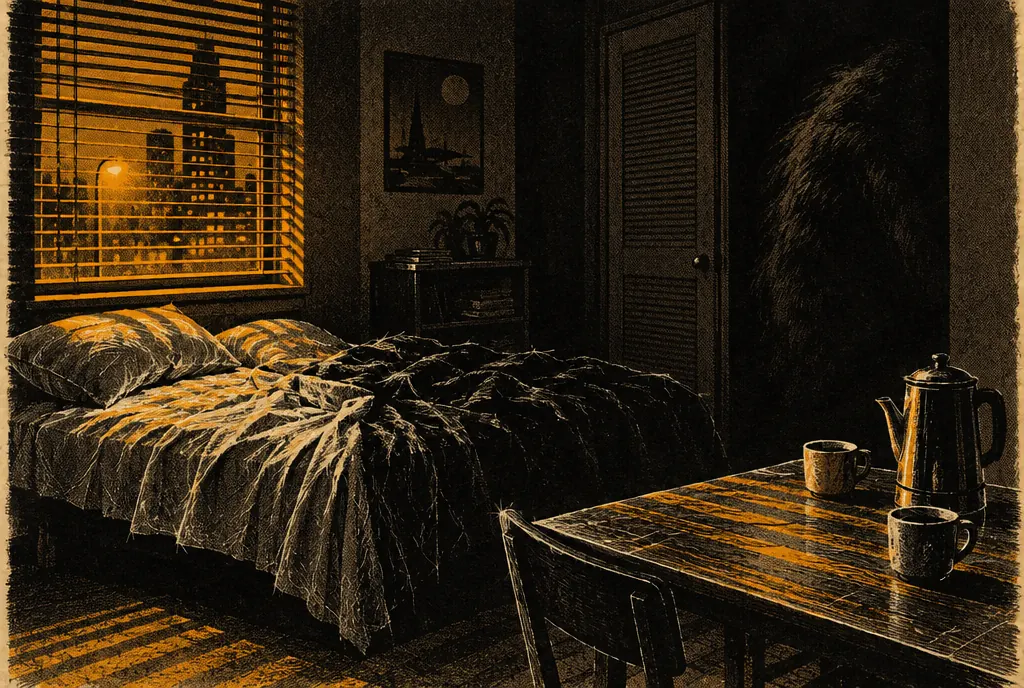
The divorce grinds on. Georgette fights him on the phone over sixty-five dollars a month. That night he takes out a brunette from his insurance agent’s office, a woman who looks a little like Georgette, and tells her he still loves his wife, that they are killing each other. Then he pretends he has to stop at home to shave, and she knows what that means, and agrees. In bed he sees her face as it will be at sixty-five. She asks him to tell her he loves her, nineteen times. He starts, counting on his fingers, and stops when she asks why he is counting. Afterward he moves over to Georgette’s side. In the corner, the breathing grows regular. The dream comes back, and Paul drives the poker into number fourteen’s right eye. Now the killers come all at once, a masked mob in a Beverly Hills street, and he knows that if he understood them, he would be free. A family car saves him. He lies under the back window the way he did as a boy, after his father died, and still doesn’t feel safe. He wakes up crying. The girl is gone.
There are more women, one with a laugh like pea pods snapping open, and then one he pays twenty dollars. That is when the thing in the corner takes its full shape: brown and furred, something like a great Kodiak bear, with eyes like golden discs, though the story takes the description back at once: the creature was nothing like that. He calls Georgette to tell her. She says he’s cracking up, or dodging his payments, and hangs up. In the bathroom, the mirror steamed over, he sits on the edge of the tub and realizes he has never once seen any of the women’s faces, not even hers. He runs: to a bar where Sinatra is playing, to a beach where the gulls are crying, under neon signs he can’t read. He brings a girl home and she sees nothing in the corner. She calls him Sid. He throws her out. He and the creature live on together, trembling, in a nervous symbiosis, each feeding on the other. Then he understands the dream, and digs his old Army .45 from the bottom of a duffle bag. At the mirror he smiles at his own face and asks, very softly, “Why did you have to go away?” Then he puts the gun to his eye and fires. From the other room comes the sound of breathing, heavy, slow and even.
DELUSION FOR A DRAGON SLAYER
Sturgeon called the next story psychedelic. Ellison says he meant it as straight mysticism, written in a baroque, many-layered style he likens to John Coltrane’s sheets of sound. Knight cut part of it without telling him; this is the whole of it. As for drugs, he’s been high since birth.
It begins with true deaths. Chano Pozo, the great conga drummer of 1940s bop, was shot in a Harlem bar. Dick Bong, the fighter ace, died when his jet flamed out. Marilyn Monroe took too many pills. The writer William Bolitho died of appendicitis. Each was out of joint with their time, and each death was set long before. Warren Glazer Griffin’s death, the story promises, will come in the jaws of a seventy-eight-foot dragon, in a land that never existed. Griffin is forty-one, an accountant, five foot seven, pot-bellied, with acne still. He has never been farther from home than Tenafly, New Jersey. Then Goethe, on knowing yourself: “If I knew myself, I’d run away.” And the machinery of chance begins. Forty years ago a billionaire named Rouse ran a private gas line to his penthouse for flaming desserts, and it never made the gas company’s maps. This morning Griffin runs out of razor blades and pries a used one out of the disposal slot, and loses ten minutes. He leaves at 8:06 instead of eight, for the first time in seventeen years, and cuts through an alley. A wrecking ball hits the condemned building. The old gas line erupts. The ball tears loose, sails over the fence, and buries Griffin eleven feet deep.
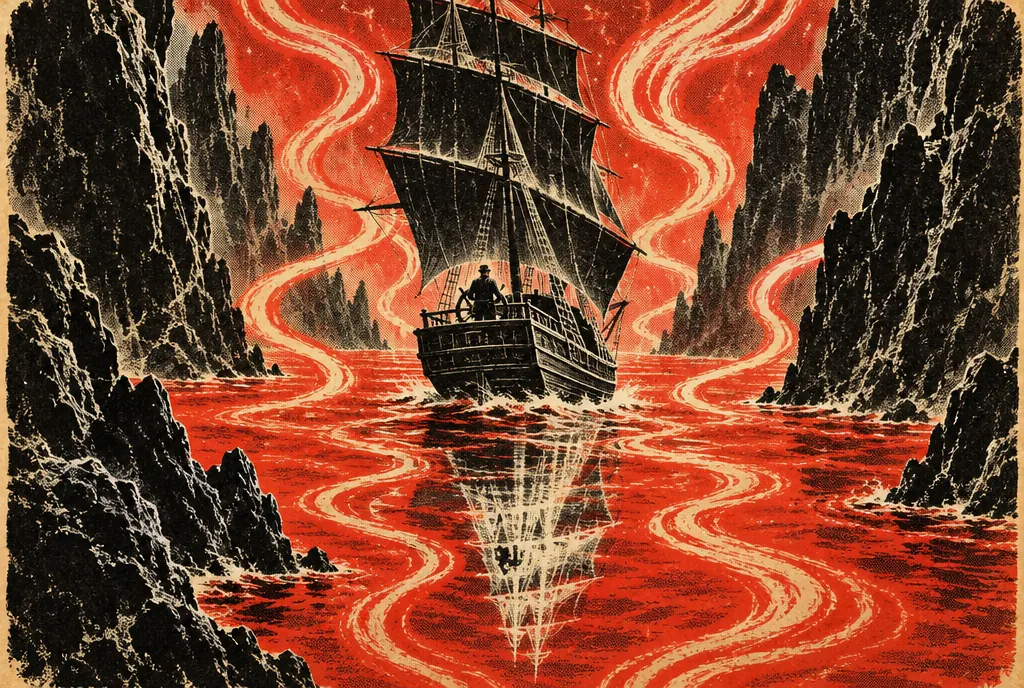
He wakes on a ship on a vermilion sea, six foot three, a golden god. A wizard’s face set into his sword hilt explains. Heaven is the dream you lived for, and here you must live up to it. Run the straits, find the island, kill the guardian, win the girl. “Gee whiz,” thinks Griffin. He shackles his crew below decks, and they wish him luck. He steers through the singing colors of the straits, and then he gloats, and runs too close inshore, and the ship breaks on the reefs. The crew drown in their shackles. He wakes on a beach under a thin, consumptive moon and feels what his vanity has cost. He hacks through a jungle that seems to fight him. At a stream he finds the girl of his dreams, bathing. A mist-devil rises over her, the size of the sky. Griffin is terrified. The devil shrinks to the size of a man and makes love to her, and Griffin stabs it through the neck from behind. Dying, it looks at him with one accusation: from behind. Then Griffin rapes the girl. Her eyes go empty, and his Heaven falls to ruin around him. He sees himself at last, vanity, cowardice and lust. The dragon at the gate is waiting, and it grinds him to pulp.
In the alley three hardened excavators dig him out. Every bone in his body is broken. His face is untouched. All they can agree on is that its look is not happiness. They might have called it loss, if they had thought that deeply. None of them would have put it as Ellison does: a man can live in his dreams, but only if he is worthy of them. Ellison closes it flat: “It did not rain that night, anywhere in the known universe.”
PRETTY MAGGIE MONEYEYES
This is the end of the book, Ellison says, and the last introduction, for one of his favorite stories. Maggie, Ellison says, was real: a tall blonde he dated in Los Angeles in 1963, with red velvet rooms, gold dolphin taps and a hunger for class. Years later he ran into her in Las Vegas, turned down what she offered, went back to his room and wrote all night, caught pleurisy and fell into a coma. He finished the story back in Los Angeles. The slot machine details are accurate, he promises, and the style is pure concussion.
Kostner is busted. He loses his last thirty dollars at blackjack, eight in the hole and a queen showing, and stands in the casino weighing whether to head for Los Angeles or shoot himself. Nobody notices him. Then he finds one silver dollar in his pocket, and puts it in the dollar slot, and pulls. Jackpot. Two thousand dollars. And on each of the three bars in the window there is an eye. A blue eye. Something electric passes between him and someone. Then the story cuts to a girl. Maggie is born Margaret Annie Jessie in Tucson, to a Cherokee mother and a drifter father, and grows up poor and beautiful and hard. By twenty-three she is a dyed blonde call girl kept by a balding Sicilian named Nuncio, and she bathes three times a day because men leave rust on her. In Vegas Nuncio proposes something, she explodes, and she takes his eight hundred and sixteen dollars to the dollar slot called the Chief. It is her baby. She plays it to infuriate Nuncio, blowing his money a dollar at a time, and as the reels spin she hates him and every swine like him, and wants all the money in the room, enough to be free. And at the machine, her heart stops.
She doesn’t leave. The machine holds her, alone, in a gray nowhere. When the pit boss comes to check Kostner’s win, the bars say only jackpot. Then, five steps away, the gong sounds again. The floor manager calls a repairman, and explains to nobody in particular the ways a slot can be rigged. They pay him off again. Then, inside his head, something new begins.
So now he stood before the machine, waiting. It spoke to him. Inside his skull, where no one had ever lived but himself, now someone else moved and spoke to him. A girl. A beautiful girl. Her name was Maggie, and she spoke to him.
I’ve been waiting for you. A long time, I’ve been waiting for you, Kostner. Why do you think you hit the jackpot? Because I’ve been waiting for you, and I want you. You’ll win all the jackpots. Because I want you, I need you. Love me, I’m Maggie, I’m so alone, love me.
— Harlan Ellison, I Have No Mouth & I Must Scream, Open Road Integrated Media, 2014, “Pretty Maggie Moneyeyes”
After that the jackpots come one after another, until Kostner has thirty-eight thousand dollars and a crowd around him. The owner, Jules Hartshorn, calls him into his office. Nineteen straight jackpots, he says, is impossible. He wants ten hours to pull the machine, and Kostner jokes about the Mafia. Then Hartshorn mentions, in passing, that a girl died at that machine six weeks ago. Kostner wants to ask what color her eyes were. He doesn’t dare. That night Maggie comes to him in a dream, and he sees his whole life, alone, until a woman named Susie, who dropped him when her first husband came back. Maggie asks him to trust her. He gives himself to her. Back at the Chief, behind velvet ropes, Hartshorn says gently that there are lots of girls in this town. Kostner puts in his first silver dollar and pulls. Somewhere a voice cries that it is free, Heaven or Hell, it doesn’t matter, free. The reels stop on three blue eyes, and Kostner falls dead, and will never cash his checks.
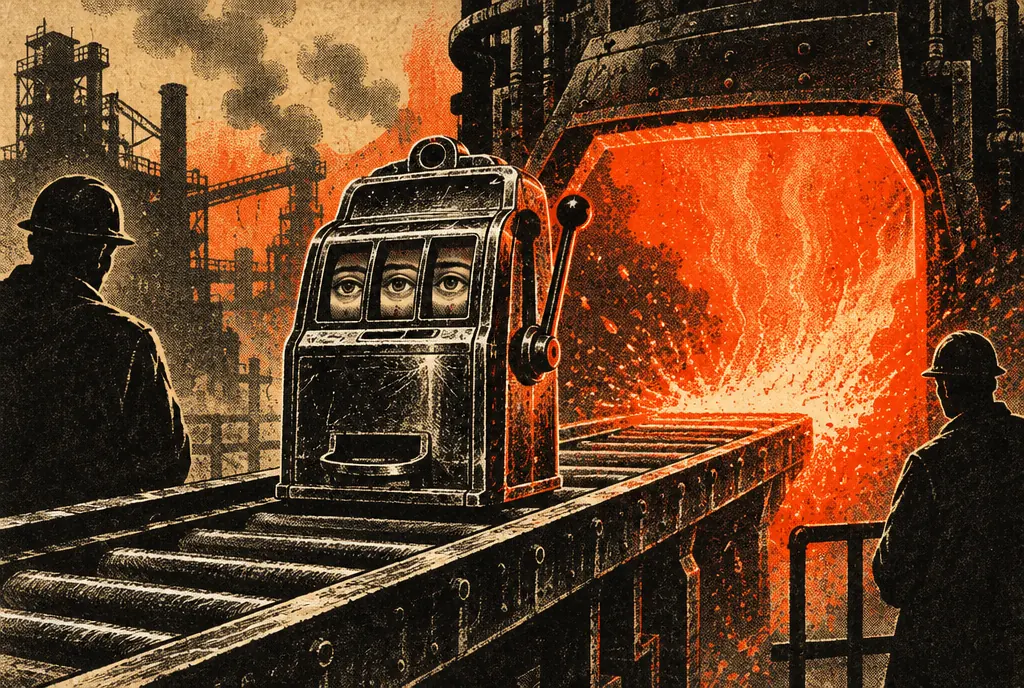
The machine is sent to be melted down. At the slag furnace, the ladle foreman says it’s weird. His bucket man has never seen jackpot bars like these: three eyes, brown ones. They look weary. They look trapped. They look very, very betrayed. The foreman hoists it onto the conveyor. As he says, “some of these old games go way back.”
The title story won the 1968 Hugo Award for best short story, and it has been reprinted ever since. Harlan Ellison kept writing for more than fifty years, stories, essays and television, and kept picking fights. He died in his sleep at his home in Los Angeles in June 2018. He was eighty-four.