The Consul sits on the balcony of his ebony spaceship, playing Rachmaninoff on an old Steinway, while great green saurian things bellow in the swamps below. A storm is building over a forest of giant gymnosperms. The fatline chimes: a burst of tachyons that carries a message across light-years in moments. The Consul swears, goes in, and pours himself a Scotch.
The voice is Meina Gladstone’s, the old CEO of the Senate of the Hegemony, humanity’s government of worlds. He has been chosen, she says, to return to Hyperion as one of seven pilgrims to the Shrike. On Hyperion stand the Time Tombs, ruins caught in tides of time no one understands, and around them roams the Shrike, a creature of blades that defies physical law. Now the Tombs show signs of opening. An Ouster swarm of at least four thousand units is closing in: the Ousters are the barbarians who live between the stars. To fight them the Hegemony would need a farcaster at Hyperion, a portal that lets you step from one world to another. But a farcaster could let Ouster troops walk straight into the cities of the Web, the worlds the portals join. And at least one of the pilgrims is an Ouster spy. The ship asks for his response. The Consul says no.
He lies awake under the storm, thinking of the solitude he earned through pain on Hyperion, and of the Shrike’s tree of steel thorns and its ruby gaze. In eleven years as Consul he watched a dozen pilgrim barges go north. No one came back. Just before dawn, the ebony ship rises on blue plasma toward the rendezvous.
He wakes from fugue, the cold sleep of star travel, aboard the Templar treeship Yggdrasill, a living tree a kilometre long. Its captain, the hooded Het Masteen, leads him up a walkway with a six-hundred-metre drop and no railings. A treeship carries thousands. This one carries six. At the captain’s table, under wheeling stars, they wait. Father Lenar Hoyt, a young Catholic priest, looks as if he has been ill for years. Colonel Fedmahn Kassad, once called the Butcher of South Bressia, is lean and dressed in soldier’s black, his face carved from cold stone. Martin Silenus, a ruddy, demonic poet, may be a century and a half old. Sol Weintraub, a grey-bearded scholar, holds his infant daughter Rachel. Brawne Lamia, a detective, has a stare the Consul feels after she looks away. The baby does not count as a pilgrim, so who is the seventh? Het Masteen’s answer is: “I am the seventh.”

Over dinner the talk turns dark. Kassad says the Ousters will burn Hyperion and salt its land. Ships have tried flying straight to the Tombs for four centuries, the Consul says. They land and return perfectly, Weintraub adds, but their passengers are never seen again. Silenus drinks and swears. Then Sol Weintraub proposes that each of them tell their story, since each may hold a piece of Hyperion’s puzzle. They vote four to two, Kassad abstaining, and draw lots from the Consul’s tricorne. The Consul draws seven, and the tension drains out of him. Hoyt draws one. He fetches two small notebooks, stained and charred, and says that to tell his tale he must tell another man’s.
The Priest’s Tale
The Man Who Cried God
Father Lenar Hoyt
Years ago, newly ordained on the Catholic world of Pacem, Hoyt escorted the Jesuit Father Paul Duré into exile on Hyperion. Duré had come home from a dig on the world of Armaghast under a cloud. The trip cost Hoyt a time-debt: months in fugue for him, eight years gone at home. Duré wanted neither the Shrike nor the ancient labyrinths that tunnel through nine worlds. He wanted the Bikura, a legendary tribe on a plateau ringed by flame forests. Then Duré vanished. Hoyt went back, and learned the truth. Now he opens the journals.
In Keats, the capital, Duré stumbles on a ruined cathedral. Out of forty-six years of habit, he steps behind the bare altar and begins the Mass. An old woman in black, seemingly blind, kneels in the fourth pew. When he calls to her, she is gone, and a single red votive candle burns where she was. He writes that “Hyperion is a poet’s world devoid of poetry.”
He goes south by dirigible, and at sunset he confesses to his old friend Monsignor Edouard. On Armaghast he falsified the evidence, to make the ruins seem Christian and older than humankind’s departure from Earth. His deeper sin, he thinks, was believing the dying Church could be saved. In Port Romance he sees three dead men in eight days. Up the river, at Perecebo Plantation, he burns with fever, nursed by a quiet widow named Semfa, and the plantation lends him a guide called Tuk.
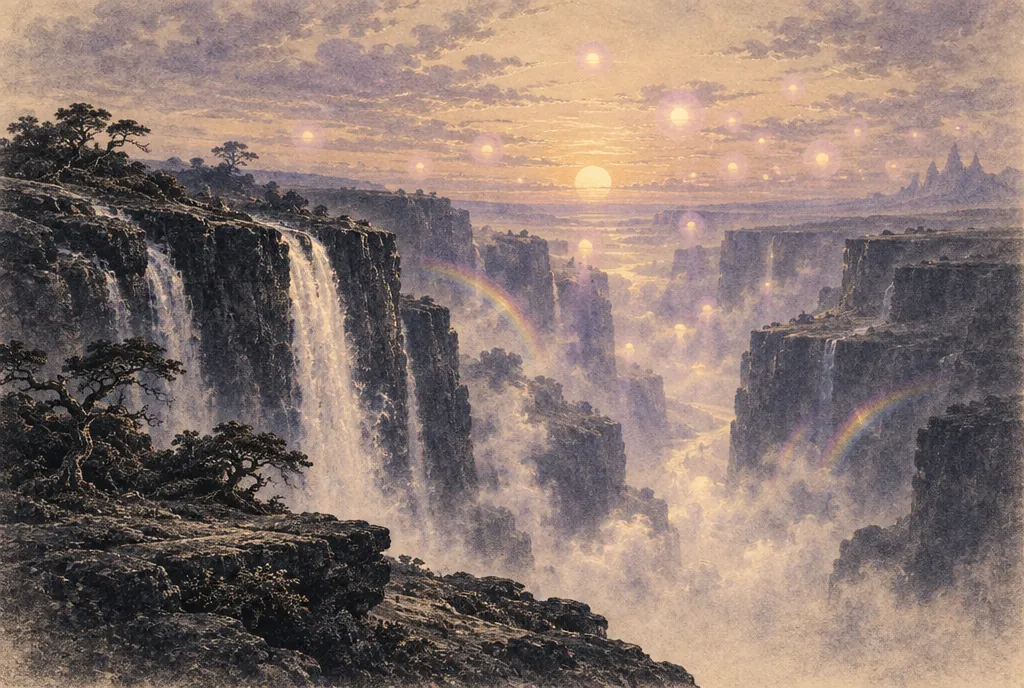
They climb into the flame forest. On the first night the tesla trees discharge, a hundred arcs of lightning in ten seconds, and only a ring of arrestor rods keeps them alive. They come out at the Cleft, a canyon nearly three thousand metres deep, whose sunset winds sing like church organs the size of palaces. Next morning Tuk lies dead, his throat cut, and the arrestor rods are gone. Without them there is no way back for a hundred and twenty days.
The Bikura find him: some sixty small, bald people in dark robes, placid, their sexes impossible to tell. Through his translator they ask if he belongs to the cruciform, their word for the cross shape he wears. When he says yes, they all kneel. They admit calmly that they killed Tuk. Duré cannot die, they say, because he belongs to the cruciform. They call themselves the Three Score and Ten, and they are always seventy, the number aboard the shuttle that crashed here four centuries ago. They have no names and no children. Each evening they climb down the cliff on vines. He asks what they would do if he followed. They would cut his throat, says the one he calls Alpha, and then adds: “we would have to kill you again.”
While they forage, Duré goes over the edge. Below the overhang a path is worn centimetres deep into solid stone; someone walked here for millennia. It leads to carved doors and windows of stained stone twenty metres high. He compares the hall within to St Peter’s, and writes: “This space was larger.” On its altar stands a jewelled cross four metres high, set there almost certainly before Christ taught in Galilee. Duré kneels in exultation. He has found proof of God.
They catch him, burn every record he made, and at sunset lead him down a stair cut in the cliff, all night, to the river. There, in the canyon wall, opens a tunnel thirty metres square, a mouth of the labyrinth. When the torches go out, its walls glow pink with living crosses, warm as coral. Then something enters among the kneeling Bikura, and Duré sets it down in his own words.
It was vaguely man-shaped but in no way human. It stood at least three meters tall. Even when it was at rest, the silvered surface of the thing seemed to shift and flow like mercury suspended in midair. The reddish glow from the crosses set into the tunnel walls reflected from sharp surfaces and glinted on the curved metal blades protruding from the thing’s forehead, four wrists, oddly jointed elbows, knees, armored back, and thorax. It flowed between the kneeling Bikura, and when it extended four long arms, hands extended but fingers clicking into place like chrome scalpels, I was absurdly reminded of His Holiness on Pacem offering a benediction to the faithful.
I had no doubt that I was looking at the legendary Shrike.
— Dan Simmons, Hyperion, Doubleday, 1989, the Priest’s Tale
His journal goes on. In an instant the thing is beside him, blades around him like a fence, and he feels exaltation more than fear. Then it is gone. Alpha breaks a small cross from the wall and hangs it around the priest’s neck. Two days later, Duré tries to lift it off. It does not come off; his flesh has sealed around it. He runs a medical scan and sits with the results a long time. Fine filaments spread from a knot above his breastbone, out through his body like roots, and end deep in his brain. His temperature, his metabolism and his white cells are all normal. There is no foreign tissue in him at all. The cross is made of his own flesh, and its DNA is his. Duré sets down the verdict in five words: “I am of the cruciform.”
Hoyt reads on, and the entries shorten. The cruciform will not let Duré stray ten kilometres from the Cleft; when he tries, it brings pain like a heart attack. When Alpha falls eighty metres to his death, the tribe lays him on the altar, and over three days the corpse breaks down, rebuilds, and breathes, duller than before. Duré tries to cut his own cross out with a stone, and faints each time. “It does not like pain,” he writes.
So pain becomes his ally. The Bikura, he writes to Edouard, have bought immortality with their souls, and he has found again a blind faith he has not felt since boyhood. He turns sixty-eight, and builds a chapel by the Cleft. Quarrying stone, he finds the stolen arrestor rods. On his last evening he says Mass with chalma bread and water for wine, blood red in the sunset. His heart is at peace. Tomorrow he will go into the forest.
Hoyt closes the book. Hyperion fills a third of the sky. He came back eight years later, he says. The Bikura told him Duré died in the forest, his body and his cross destroyed by lightning, and the plantation boss razed their village with nuclear charges. Hoyt is grey and sweating. Silenus asks if that is all, and Hoyt says yes.
The Consul goes to fetch him for the drop. He finds the priest writhing on the grass floor of his cabin, his painkiller injector broken. The Consul loads his own with ultramorphine, and holds it out of reach. First, the rest of the story. In fragments, Hoyt tells it. The Bikura killed Semfa and two men, spared him, and showed him the Son of the Flames. Duré had climbed a tesla tree, sharpened the arrestor rods, and nailed himself to the trunk. He hung there seven years in the lightning, dying and forced back to life, until the pain beat the cruciform. When Hoyt lifted the pouch from his neck, the cross fell away on long bloody roots, and the ruined face looked up. Hoyt says, “He smiled at me and died.”
The Consul injects the drug and opens the priest’s shirt. Under the skin of his chest lies a great raw cross. Between his shoulder blades is a second, smaller one, and it stirs at the Consul’s touch. He dresses Hoyt as gently as one dresses the dead, and carries him out into the blue-green light of the world that fills the sky. The body weighs nothing. Once a parent to a child now dead, the Consul walks on, remembering how it felt to carry a sleeping son to bed.
After a day of rain, the Consul’s black ship comes down on its fusion flame over Keats, Hyperion’s capital. He has been away eight local years. In his day one ship a week landed here; now more than twenty crowd the field, and shacks and mud streets ring the fence. Thousands of people press against the wire, held back by Marines. “Progress,” the Consul murmurs. Colonel Fedmahn Kassad answers with one word: “War.” The crowd wants only one thing, and that is to get off the planet.
Theo Lane, the Consul’s shy, red-haired former aide, meets them in a battered skimmer. He is acting Governor-General now. Three million frightened people are packed into Keats, he says, and at least twenty thousand are dead or missing to the Shrike. He begs the Consul to stay and govern in his place. The Consul cannot. They land beside the Shrike Temple, three centuries old and three city blocks wide, and find it a heap of black stone. Kassad kneels in the rubble and says it was shaped plasma charges. A mob burned it, Theo says, and his own council wanted to shoot the pilgrims’ ship out of the sky. He lifts off without a word, and the rain comes harder.
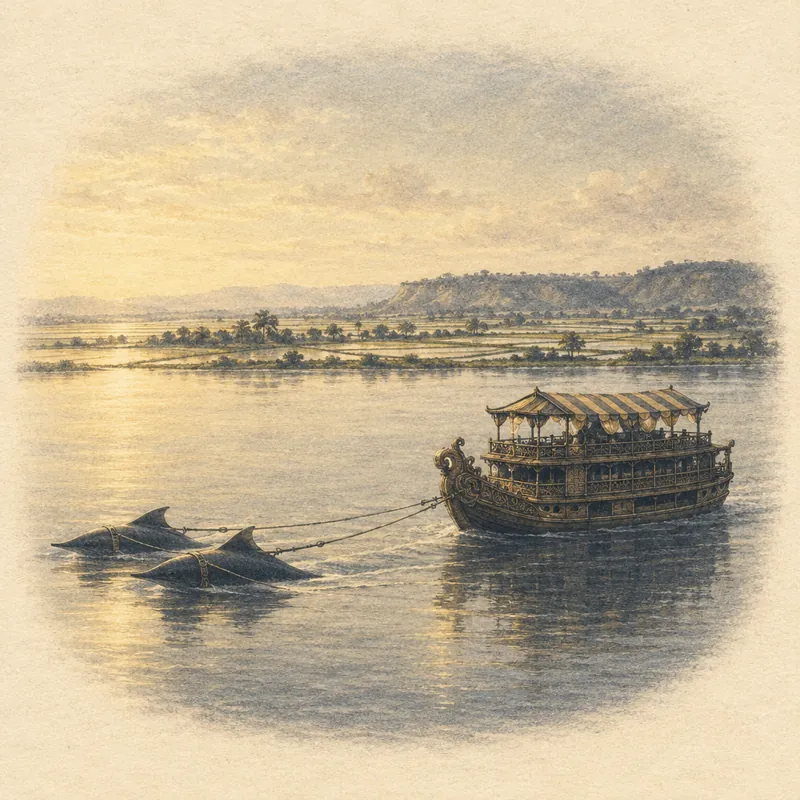
They shelter at Cicero’s, the Consul’s old bar on the Hoolie River, now jammed with refugees. A hooded figure finds them there: an android with blue skin and blue eyes, of the kind the Shrike Temple once used. By morning they are aboard the Benares, a centuries-old barge from Old Earth, hauled upriver by river mantas past flooded periscope-bean paddies. Over breakfast Kassad draws a slip of paper from his tunic with a large number two on it.
The Soldier’s Tale
The War Lovers
Colonel Fedmahn Kassad
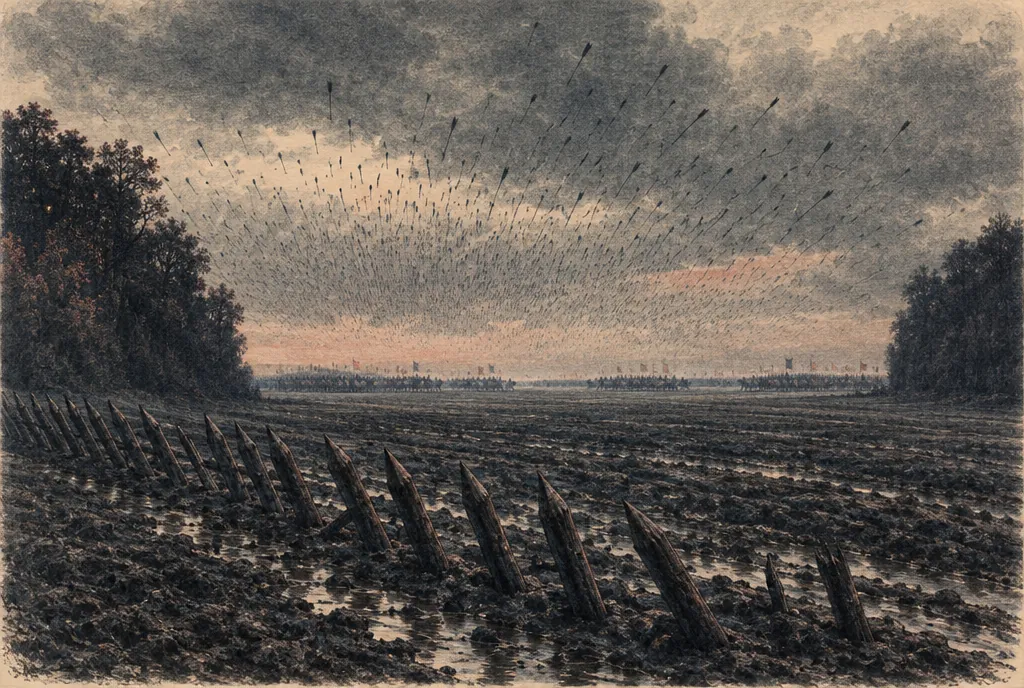
It is 25 October 1415, and Kassad is an archer at Agincourt. Seven thousand Englishmen, sick and starved, face twenty-eight thousand French across a kilometre of mud. None of it is real. The battle is a simulation run by Olympus Command School on Mars, and Kassad is twenty-three, a cadet. It feels completely real. He drives a sharpened stake into the ground and waits. The French do not charge. When the arrows finally fly, more than six thousand in four great waves, he looses them every ten seconds until his forearm is raw. Then the horses come, and he is out among the fallen riders with a mallet and a knife. One French knight lifts his visor and asks for honourable single combat. Kassad fetches his bow and puts an arrow through the knight’s left eye.
He chases another knight into the woods and loses the fight. He is down in a tangle of fallen branches, knife against sword, when a figure strikes the knight from behind. Together they kill him. His rescuer is a woman, tall and dark-haired, a few years older than Kassad, and plainly not from the fifteenth century. She never says a word. They become lovers there among the leaves. When he wakes, she is gone and the light has turned to evening. The simulation ends, and no one else saw anything. Nothing existed beyond that battlefield, an instructor tells him.
She returns, always near the end of a simulation. He meets her at Gettysburg and Borodino, in a jungle patrol in Vietnam, and in a wrecked armoured carrier on Mars while a dust storm shrieks at the hull. She will not tell him her name. When he asks if she is real outside the simulation, she nods. He calls her Mystery. Then, in his last year, she stops coming. He graduates sure he will never see her again. He is wrong.
His career is built in blood. He is a Palestinian boy from the Martian slums who had killed by sixteen, and FORCE, the Hegemony’s military, makes him a hero. On Qom-Riyadh, when a self-proclaimed prophet seizes twenty-seven thousand hostages, Kassad turns a ring of obsolete satellites into sixteen thousand X-ray beams. They kill the rebel clerics in a single instant, and the prophet dies on live broadcast in mid-sentence. Then the Ousters invade a world called Bressia. FORCE fights by the New Bushido, a code of small, honourable wars that spare civilians, and on Bressia Kassad sees at once that the code is dead. He wins by trading lives for time. By the end, after ninety-seven days, he is the Butcher of South Bressia. Even then she comes to him: once in a pale blue dress, walking among dead plants on a hillside while bombs bloom below.
Wounded, he is shipped home on a hospital ship. In orbit around a planet he does not recognise, an Ouster warship tears it apart. He fights his way into a dead Marine’s spacesuit, rigs the surgical lasers of an operating room into a trap, and kills the boarders who come for him. Then he takes one of their boarding craft. He cannot fly it. It drops into the atmosphere and burns, and at the last moment he finds an ejection handle under the seat and pulls.
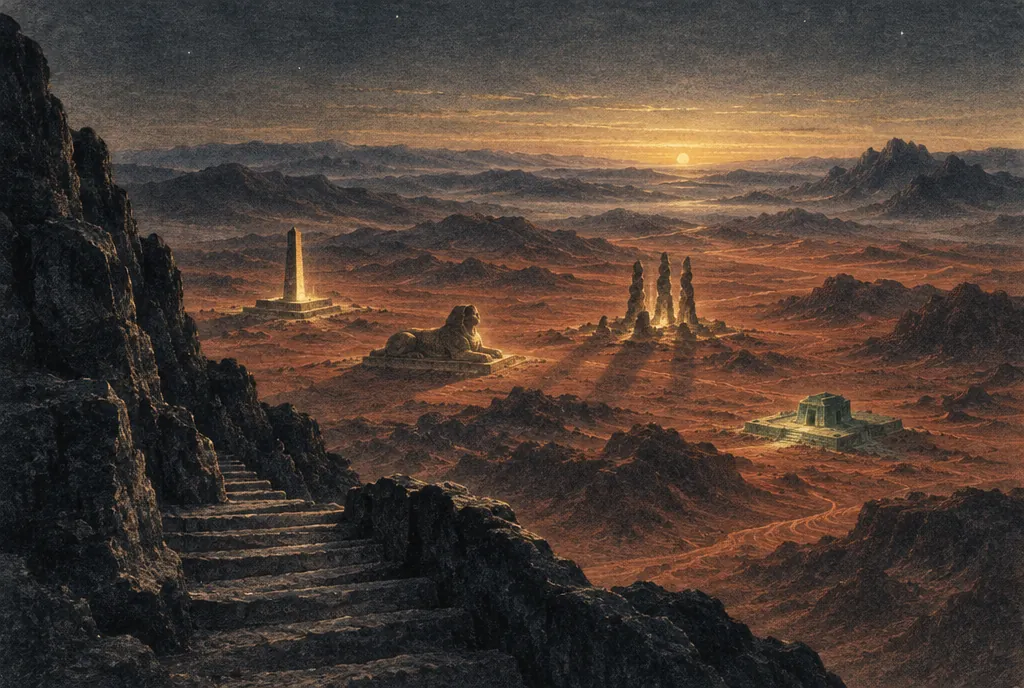
He wakes to a woman bending over him, and this time it is her. He asks if he is dead, and for the first time she speaks: no. Is she real? Yes. In the morning she gives him her name. “Moneta,” she tells him, “or Mnemosyne, whichever name pleases you more.” The planet is Hyperion. They are in the City of Poets, abandoned for a century, and beyond the hill lie the Time Tombs. Kassad believes force fields keep the Tombs from ageing. No, Moneta says: the time tides drive them backward through time. She tells him to look.
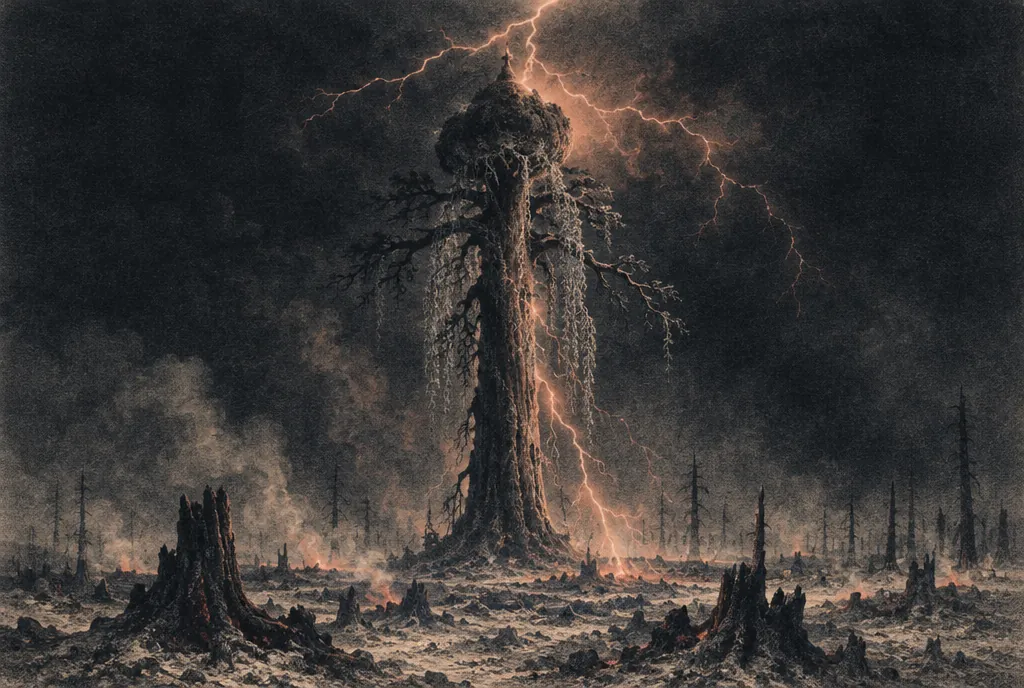
Shimmering, miragelike, a tree of steel thorns appeared out of the haze and a sudden dust storm of ochre sand. The thing seemed to fill the valley, rising at least two hundred meters to the height of the cliffs.
Branches shifted, dissolved, and reformed like elements of a poorly tuned hologram. Sunlight danced on five meter-long thorns. Corpses of Ouster men and women, all naked, were impaled on at least a score of these thorns. Other branches held other bodies. Not all were human.
The dust storm obscured the view for a moment and when the winds subsided the vision was gone. ‘Come,’ said Moneta.
— Dan Simmons, Hyperion, Doubleday, 1989, the Soldier’s Tale
In a stone room in the cliff, Moneta explains why she has haunted him for years. “Your past. My future,” she says. She touches him with a golden rod, and both their bodies turn to living chrome. Waiting at the city’s edge is the Shrike: four arms, blades for fingers, thorns everywhere, and red eyes like a thousand-faceted jewel. It stops time around the Ouster troops who followed Kassad down. For a moment he hesitates: killing frozen men is the final betrayal of honour. Then time restarts, and the three of them destroy the Ousters in their trenches and their boat. One boat is let go, Moneta says, to carry the message to the swarm.
The message is what comes next. Afterwards, among the dead, Moneta and Kassad become lovers again, and his mind fills with a vision of war: troops marching into fire, fleets burning, whole worlds aflame, suns exploding. He opens his eyes to find her turning to steel, with thorns and bladed teeth. He tears himself free, bleeding, and runs across the corpses without looking back.
Hyperion’s militia find him two days later, naked and near death on the moors. He swears he remembers nothing. Back in the Web, he resigns and speaks against the war, and nobody listens to the Butcher of South Bressia. After that he disappears.
On the Benares, the Consul turns over what Kassad has told them. If the tree travels backward in time, its victims come from the future. He asks Kassad whether he saw any of them on it. Kassad is silent for a full minute before he says yes, and he will not say who. He believes the creature wants to use him to start that war. What will he ask of it? Kassad gives his first smile, and it is very cold. “I will ask nothing of them. When I meet them this time, I will kill them.”
The Benares reaches Naiad an hour before sunset and finds a city of twenty thousand in embers, the manta pens open to the Hoolie. With no fresh mantas, the two in harness must keep pulling, and A. Bettik calls it a crime. After dark, pale gossamers the size of small children dance over the prairie. The Consul has been drinking since before noon. So has Martin Silenus, who holds up slip number three.
The Poet’s Tale
Hyperion Cantos
Martin Silenus
In the beginning was the Word, Silenus says, and then came the word processor, and then the death of literature. He was born on Old Earth, and he dares Brawne Lamia to doubt it. It was after the Big Mistake, when a runaway black hole was eating the planet’s core in spasms. His tutor, don Balthazar, glowed blue-white from crude longevity treatments, chased the maids, and had the boy reciting the whole Odyssey by six. His own verse was dreadful, and nobody told him.
His mother died with Old Earth. The family was deep in debt, so she banked a quarter of a million marks and shipped him frozen in a slow ramship, among cattle embryos and orange juice concentrate, to Heaven’s Gate, a poisoned world circling Vega. Silenus sums it up: “For the first and last time in her life, Mother figured wrong.” The accounts were seized. The long sleep gave him a stroke. He woke to dig acid canals with a vocabulary of nine words, nearly all of them unprintable.
Heaven’s Gate made him a poet. Bent double in the slop canals under acid rain, his mind fled upward. He tried to tell his friends, in his nine words, that the true poet becomes God, and they smiled and walked away. “Great poets are rarely understood in their own day,” Silenus says. Slowly the words came back, and at night he wrote his Cantos on leechweed toilet paper by a hissing ghee lamp. When a bully scattered the only copy in the mud and beat him nearly to death, a manager’s wife named Helenda took him to hospital and read the poem. He woke with five new teeth and a publishing contract.
His editor, Tyrena Wingreen-Feif, kept only the sentimental pages about Earth’s last days and called it The Dying Earth. It sold billions. Helenda married him, and he lived in a house of thirty-eight rooms on thirty-six worlds, joined by farcaster arches instead of doors. He tried the rich man’s drug, Flashback, which replays a memory whole. The second time he was four, crying, and opened his mother’s sewing room. She sat slack and white-eyed, a stim wire in her elegant hair, an empty syringe by her hand. He woke screaming.
Helenda left. The full Cantos, ten months of agony, sold twenty-three thousand copies. Tyrena explains: “The AI loved it. That’s when we knew for sure that people were going to hate it.” So he wrote hackwork, sequel after sequel, until he realized his muse had fled. He handed Tyrena one sentence and two hundred and ninety-nine blank pages, sold the house to repay his advance, and left for the court of Sad King Billy.
King William the Twenty-third looked like a wax candle left on a hot stove. He stuttered, and his laugh sounded like sobbing, but he was the finest critic Silenus knew, and he had ordered twenty thousand copies of the Cantos. Ten years on, Billy planned a colony of artists on Hyperion. Why that name? Silenus needed ten seconds. Keats. Then pack your bags.
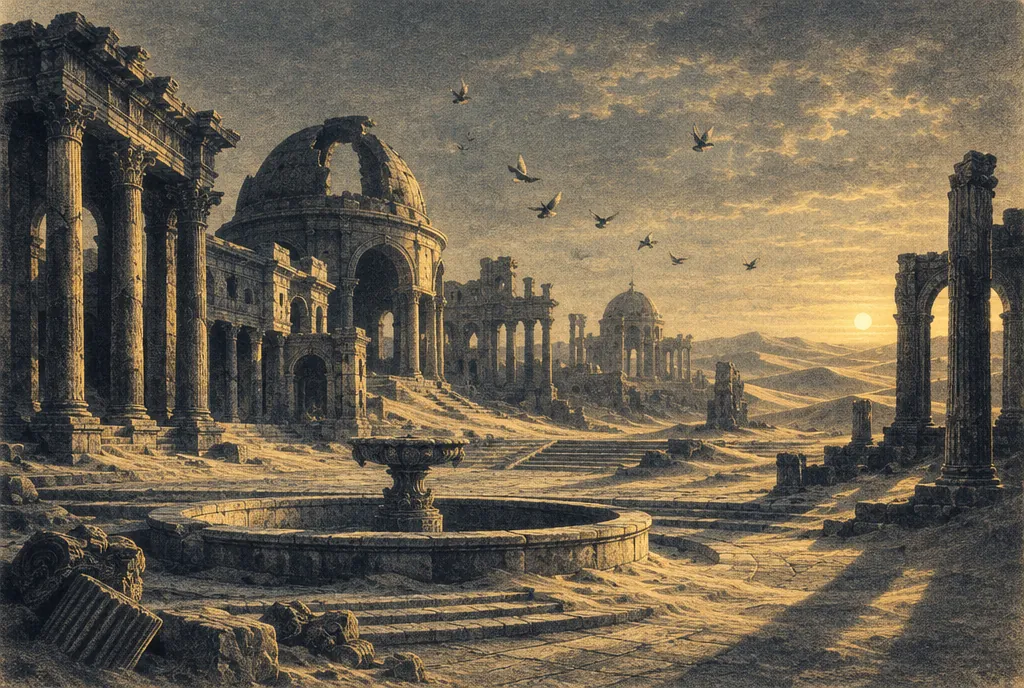
The white City of Poets rose, and no muse came. Silenus decided to kill himself, but first spent nine years as the colony’s goat-legged libertine. On the night he had set aside to shoot himself, Grendel came. People vanished, then died. Sissipriss Harris, once his lover, was found only as a head, upright in Lord Byron’s Plaza, like the mouse heads his childhood cat left on the patio. And Silenus was writing again.
Billy showed him a hidden recording from a murdered novelist’s bedroom, frozen on a head of steel and chrome, ruby eyes, a blade rising from the brow, the whole thing over three metres tall. Silenus had searched the Shrike legend three months before the first disappearance. At the door, he told Billy: “It’s my muse.” He had summoned it with the Word. He renamed the poem The Hyperion Cantos, the fall of a race that killed its home and carried its arrogance to the stars.
The city emptied, and in a dozen years only Silenus and the Shrike remained. One night Billy came back, read the poem, and saw the last stanzas dated to the week the last other resident died. He stunned Silenus and burned the pages in a dry fountain. The Shrike was simply there. It lifted the king on steel thorns, the Cantos still burning in his fists. Destroy it, Billy cried, meaning both. Silenus threw the kerosene at the man and the monster, and the embers caught. What he saw, he tells this way.
For a second the pyre was a perfect sculpture of flame, a blue and yellow Pietà with a four-armed madonna holding a blazing Christ figure. Then the burning figure writhed and arched, still pinned by steel thorns and a score of scalpeled talons, and a cry went up which to this day I cannot believe emanated from the human half of that death-embraced pair. The scream knocked me to my knees, echoed from every hard surface in the city, and drove the pigeons into wheeling panic. And the scream continued for minutes after the flaming vision simply ceased to be, leaving behind neither ashes nor retinal image. It was another minute or two before I realized that the scream I now heard was mine.
— Dan Simmons, Hyperion, Doubleday, 1989, the Poet’s Tale
Silenus took a year to recopy the scorched pages, and still could not finish them: his muse had fled. He stayed on, mad, screaming at the silent Tombs, then walked fifteen hundred kilometres out of the desert with nothing in his pack but the poem. Two and a half centuries have passed, two cold sleeps among them. He is still waiting. Silenus ends where he began: “In the end will be the Word.”
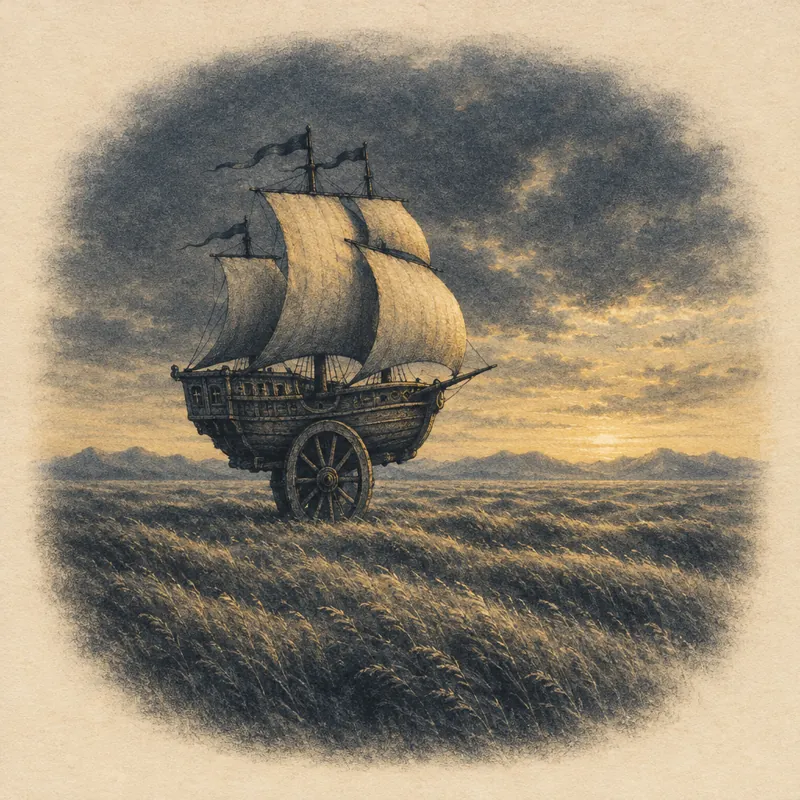
At Edge the town is empty and the inn has burned. Beyond the wharves the Sea of Grass runs to every horizon, rippling like surf. At dusk a windwagon arrives, a wooden galleon on one great wheel, with no crew at all. Over supper Martin Silenus recites verses about sacrifice until Brawne Lamia aims a pencil laser at his head. Sol Weintraub speaks from the bunk, where a ship’s drawer has become a cradle: there is a child present. Lamia lowers the weapon. Silenus asks the old man for his story.
The Scholar’s Tale
The River Lethe’s Taste Is Bitter
Sol Weintraub
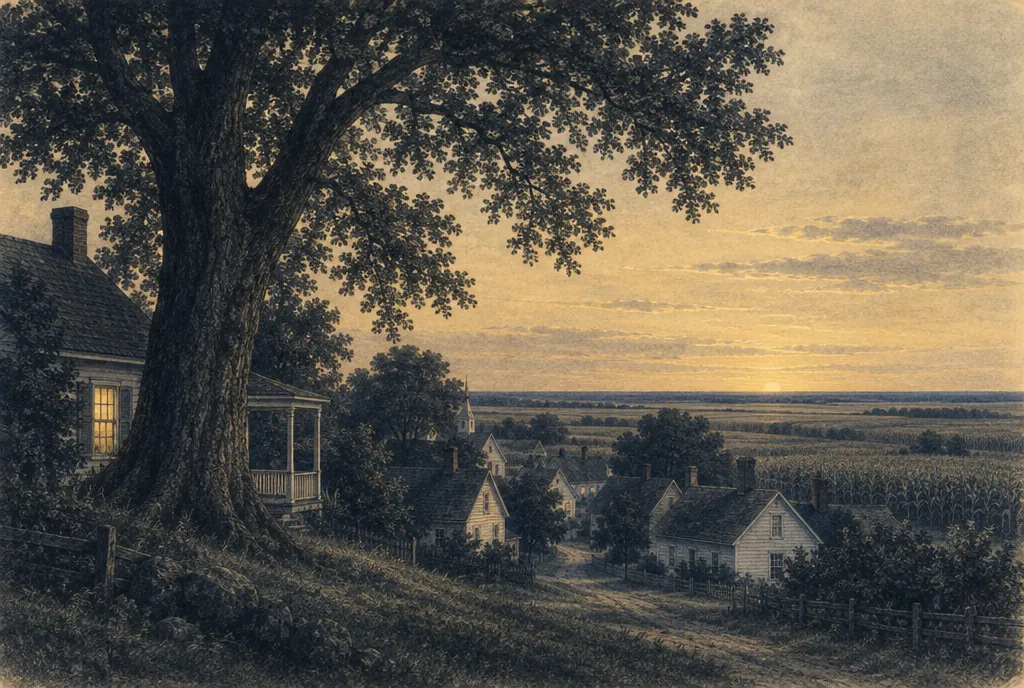
Sol and Sarai Weintraub live on Barnard’s World, in Crawford, a town of white houses under elms, three thousand flat kilometres of corn from the capital. Sol teaches history at Nightenhelser College and studies how ethics evolve. Their daughter, Rachel, comes after five years of waiting. At ten she climbs the town’s oldest elm on a dare, falls, and tells her father through a wired jaw that she was fifteen feet from the top. Next time she will make it. Grown, walking home under the elms, she asks what she has asked since she was two: does he believe in God? Sol gives his usual answer: “I’m waiting to.”
Rachel becomes an archaeologist, and her fieldwork takes her to the Time Tombs on Hyperion, with a scholar named Melio Arundez. While she is gone, Sol dreams of a hall of columns like redwoods, lit by two red ovals. An immense voice speaks in the words once spoken to Abraham. He is to take his only daughter Rachel, whom he loves, to Hyperion and offer her there as a burnt offering. Sol says no. Below him Rachel lies on a block of stone, and in his hand is a knife of bone. He throws it into the dark, and wakes half laughing, half chilled.
On Hyperion, Rachel and Melio become lovers and map the tomb called the Sphinx, a maze of corridors that lead only back on themselves. Alone beneath it at a quarter past two one morning, she hears her instruments scream. Feet drag in the corridor above. Every light dies, even the ones that cannot. The stone ceiling begins to come down. Something breathes with a metallic rasp a metre away, and something sharp and infinitely cold closes on her wrist. Rachel screams at last.
In a hospital on Renaissance Vector, doctors tell her parents she is unhurt. A surge of the Tombs’ time-bending field has washed through her, and they call the result Merlin’s sickness. Rachel is aging backward. Each time she sleeps she loses everything since the accident, and one more day before it. So she records herself. One morning she presses her comlog and hears her own voice explain it all, admit she is terrified, and sign off as yesterday’s Rachel. Sol sits with her while she cries, for the twentieth night in a row.
She comes home, and her birthdays run downward. On the night she turns twenty-one, she and Sol get drunk together for the only time, laughing until whiskey nearly comes out her nose. Then she tells him the Rachel who fell in love on another planet was someone else. Her request is simple: “Don’t let me tell me. It just hurts.”
When she is thirteen, Sol asks a young rabbi about Abraham. The rabbi says God stayed Abraham’s hand; the point was obedience. Sol answers that the text says Abraham took the knife to slay his son. God must have seen he truly meant it. So what if Abraham had loved his son more than God? That autumn Melio stands under the elm outside the house, an hour without the courage to knock. Rachel comes home in a red jacket, thrilled to meet a doctor from Reichs University. At the door she calls good-night to the two men, later, alligator. Sol answers in a while, crocodile, and hears Melio whisper it with him.
A Shrike bishop in arterial red hears the word Sphinx, calls Rachel the most blessed and cursed of people, and has Sol thrown into the street. The newsteeps come next, reporters with cameras for eyes, crowding a weeping seven-year-old. Before her sixth birthday the family moves, in the rain, to a kibbutz on the desert world of Hebron. Clutching her teddy bear, Rachel says it is not fair. Sol agrees.
On Hebron, at night, he finds himself arguing with God, whom he does not believe in. How could a faith grow from a command to slaughter a son? It does not matter that the order was withdrawn, or that it was a test. That obedience is what made Abraham father of the tribes is exactly what enrages him. Fifty-five years of studying ethics have left him one certainty: any loyalty that ranks obedience above decency toward an innocent person is evil. A dry voice asks who is innocent. A child, Sol says. Isaac was; Rachel is. And Rachel at twenty-four? Yes. Then perhaps that was part of the lesson Abraham had to learn, says the voice, and is gone.
When Rachel is four, Sarai confesses she has had the same dream for years. They must go to Hyperion, she says, and offer themselves instead. Sol walks into the mountains for three days. Half-delirious, he asks whether that was Abraham’s answer, and is told it cannot be his. He sees the ovens, mothers hiding children under coats, and hears the voice: “The parents have offered themselves. That sacrifice already has been accepted.” He shakes his fist at the sky and falls on the rocks. Lying there, he reasons it through. Obedience was the right answer for Abraham, who was ethically a child. The right answer for Abraham’s children was to grow up and offer themselves instead. What the answer is now, nothing tells him.
He tells Sarai it is the wrong solution, and urges her home to Barnard’s World for a week of rest. After sundown on the Sabbath the phone rings. Joyriding teenagers in a stolen aircar have struck her sister’s car. For three mornings Sol tells Rachel her mother is dead. On the ridge above the village he understands that his people’s long quarrel with God never ended, and that the three of them are part of it. The next morning he tells her Mommy is with Aunt Tetha today.
Her teeth recede and her words go. Her last word, at five months, is Mamma. Sol carries her onto a talk show and says she is twelve weeks old, the voyage takes six, and any more delay will kill her. On the torchship Intrepid, they are the only ones awake through the jump. They sleep at last, and Sol is in the red hall again, this time with Rachel in his arms. The voice repeats its command. His reply is set down in full.
Sol hesitated and looked back to Rachel. The baby’s eyes were deep and luminous as she looked up at her father. Sol felt the unspoken yes. Holding her tightly, he stepped forward into the darkness and raised his voice against the silence:
‘Listen! There will be no more offerings, neither child nor parent. There will be no more sacrifices for anyone other than our fellow human. The time of obedience and atonement is past.’
Sol listened. He could feel the pounding of his heart and Rachel’s warmth against his arm. From somewhere high above there came the cold sound of wind through unseen fissures. Sol cupped his hand to his mouth and shouted:
‘That’s all! Now either leave us alone or join us as a father rather than a receiver of sacrifices. You have the choice of Abraham!’
— Dan Simmons, Hyperion, Doubleday, 1989, the Scholar’s Tale
In the dream, the stone floor rumbles, the red light winks out, and huge footsteps boom far off. Sol wakes and smiles at his seven-week-old daughter. She smiles back, and Sol’s tale closes on one line: “It was her last and her first smile.”
No one speaks. Silenus, eyes closed, recites Yeats’s prayer for a daughter. On deck, coloured fireballs bloom among the stars: an Ouster raid, Kassad says. Then the grass glows orange, and the Consul watches the treeship Yggdrasill burn, its kilometre-long trunk breaking up like an ember. Het Masteen draws his cowl forward and goes below. Kassad calls it a target of opportunity, hands the Consul his deathwand for the first watch, and leaves him at the rail with the wind and the wheel.
Sunrise turns the Sea of Grass to gold for a few minutes, and then the storm front shuts the light away. The Consul has not slept. Brawne Lamia and Martin Silenus join him on the aft deck with coffee, and Sol Weintraub follows with Rachel in a sling on his chest. A single cry rises from the deck below. Someone has found blood.
Het Masteen’s cabin is strangely neat. The bed is unslept in, the Templar’s robe folded over a chair. Blood covers the deck, the bulkhead and the ceiling. The porthole is bolted from the inside. Lamia runs a finger through a smear, tastes it, and says it is blood. When Silenus mocks her for taking charge, she lifts him off the floor by the neck with one hand. An hour later they have found nothing. Masteen’s luggage holds a sealed metal box, a Möbius cube, and Colonel Fedmahn Kassad guesses what sleeps inside: an erg, one of the forcefield creatures the Templars use to drive their treeships. Masteen meant it as his weapon against the Shrike. In his robe pocket is a slip of paper with the number five. When Silenus hints that the killer wanted his turn, Lamia shows her own slip, number six. She will tell her story, she says, once they are off this ship that stinks of death.
Pilgrims’ Rest, at the foot of the Bridle Range, is a huddle of burned-out hovels under falling snow. One tramcar waits at the station, its cable climbing into cloud. Kassad climbs to the operator’s cabin to start it. The car lurches out of the station while he is still in the operator’s cabin. He slides down the ladder and runs for it across the ice.
Fedmahn Kassad was moving at an incredible speed when he reached the edge of the platform. The Consul was reminded for the second time of the Old Earth jaguar he had seen in a Lusus zoo. He half expected to see the Colonel’s feet slip on a patch of ice, the long legs flying out horizontal, the man falling silently to the snowy boulders below. Instead, Kassad seemed to fly for an endless moment, long arms extended, cape flying out behind. He disappeared behind the car.
There came a thud, followed by a long minute when no one spoke or moved. They were forty meters high now, climbing toward the first tower. A second later Kassad became visible at the corner of the car, pulling himself along a series of icy niches and handholds in the metal.
— Dan Simmons, Hyperion, Doubleday, 1989, chapter five
Lamia flings open the door, and ten hands haul the colonel inside. He rigged the dead man’s brake with a sandbag. At dinner the car breaks above the clouds into sunset: a sea of cloud with an island chain of peaks, the pilgrims suddenly glowing gold. As the sun sinks, the Consul asks Lamia to tell her story now. She sets down her empty glass, pulls her feet up onto the bench, and begins.
The Detective’s Tale
The Long Good-Bye
Brawne Lamia
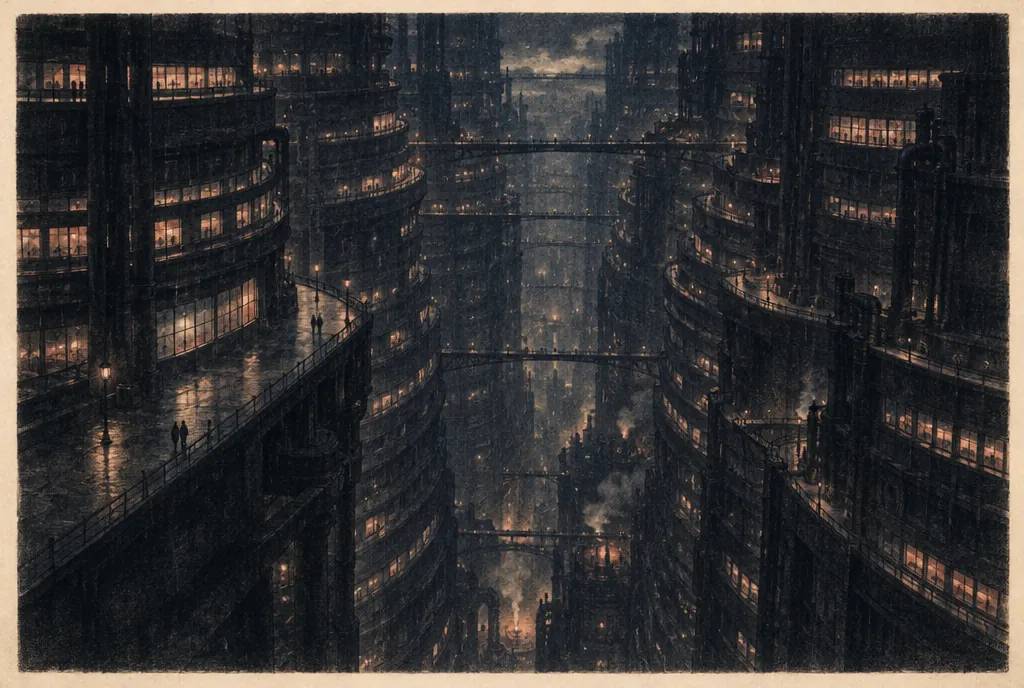
I knew the case was special the minute he walked into my office. He was beautiful. My office is on the twenty-third level of an old industrial hive on Lusus, looking out on a trench where it is always dark and always drizzling. He was short, my height, with reddish-brown curls, large hazel eyes and an accent I could not place. He said to call him Johnny, and he wanted me to investigate a murder the police knew nothing about. I asked who had been murdered. Johnny sat up straight like an attentive schoolboy, and his answer was: “I was.”
Johnny was a cybrid. His mind lived in the TechnoCore, the civilisation of artificial intelligences that had quietly seceded from human control three centuries before. The AIs still advise our government and run the datasphere, the vast network every world lives on. A cybrid is a body grown from human stock and worn by an AI as a remote, one appendage among ten thousand. A virus had turned his own defences against him. An AI cannot truly die; his backup came online within a minute. But five days of his memory were gone, and to him that was murder. To prove what he was, he moved a million marks into my bank account while we talked. I told him my fee was five hundred a day.
He took me to the murder scene, a stinking grey plateau on an unlisted world. His personality, he explained, had been rebuilt from the letters and verse of an Old Earth poet, and among the AIs he was less a poet than a poem. As he was leaving I grabbed his arm and asked the poet’s name. Keats, he said. John Keats, dead of tuberculosis in 1821. BB Surbringer, an old college friend who lived with wires in his skull, told me such rebuilt minds always go mad; the Keats one had died a simulated death of tuberculosis.
Over dinner at a Cantonese place, Johnny said I reminded him of a woman named Fanny. When I suggested he was Keats, he was shocked. He said: “Having a persona based upon a retrieval template no more makes me Keats than having the name Lamia makes you a monster.” He had never heard of Hyperion. He took my hand and told me to close my eyes. I was flying through datumplane, the shared space of all the world’s data, along chrome-yellow highways and past red towers sheathed in black ice. Above it all hung the AIs, like weather.
A witness had seen Johnny in a bar with a Templar and a hard Lusian with a pigtail, a queue. When the man I called Queue tailed Johnny to the Templar world, I braced him. He knifed an old guard and ran through a chain of open portals, one into a blizzard where he shot at me. I caught him on a floating island on Maui-Covenant and beat him to the sand. Then blue fire lit him from inside, and within a minute he was a charred thing. I fled on a flying carpet; Johnny, on my comlog, steered me down into the sea to a hidden military portal. It opened onto Rome, on an Old Earth the Core had rebuilt in the Hercules Cluster. Johnny led me to the house where Keats died.
He told me that night about the poet’s death in that room, Fanny’s letters he could not bear to open, the friend who nursed him, and about waking afterwards among cybrid copies of them all. He called the whole charade evil, because it deceived. Queue, he realised, had been a cybrid too; another AI had tried to kill him. He suspected the Core was trying to build an Ultimate Intelligence, a god. Then he lit a candle and kissed me, and we became lovers. At first light five hired toughs in the pay of the Shrike Temple’s bishop broke in to take him, and I left them broken on the floor.
The bishop of the Shrike Temple showed us a recording: eight days earlier Johnny had offered to go on the Shrike Pilgrimage, and Queue had been his Core bodyguard. The Core has no contact with Hyperion. To go there he would have to pour himself wholly into his cybrid, and what was left could only be the man he was built to be. He had chosen it once, and been killed for it. “And I never have been happier!” Johnny said, and he asked me to go with him.
I went to Meina Gladstone, the head of the government, who had known my father. On a world with no datasphere she told me the Time Tombs on Hyperion had been flung backward through time from the future, that they would open soon, and that war with the Ousters was coming. Soon after, BB and I rode Johnny’s suicide into the Core. As Johnny’s AI self destroyed itself, the walls opened for an instant; BB grabbed the data and died at his console, and I was hurt. When I woke in a dripping hole at the bottom of the Hive, the man holding me was John Keats, human.
BB had died for this: the Core has three factions: one wants partnership with humankind, one wants us extinct, and one cares only for building its god. Hyperion is the one thing the Core cannot predict, and Johnny and I were both part of it. While I slept he had a surgeon fit a socket in my skull holding a Schrön loop, a memory store I could carry but never read. We armoured up and made for the Shrike Temple, the only refuge left. Thirty metres from its stairs they hit us from every level of the mall. Johnny went down and told me to run. I told him: “I’m still getting paid to be your bodyguard.”
I carried him up the Temple stairs step by step, my left leg dead, and shot the two men who blocked the way without lifting my father’s pistol from under his body. Inside, on the cool floor, he touched my cheek and said “Fanny,” and died. As he did, everything he was surged through the socket into the loop. I am pregnant now, twice over: with his child, and with him. As I was led away the priests chanted, blessing me as mother of their salvation. I don’t understand it. But when the Shrike comes, “Johnny and I will face it together.”
It is long after dark. The tramcar creaks between stars and ice. Father Lenar Hoyt tells Lamia, “You also carry the cruciform.” Kassad asks whether she killed Masteen, and she says no. The others sleep, and three of them sit at the windows watching the stars burn cold and distant.
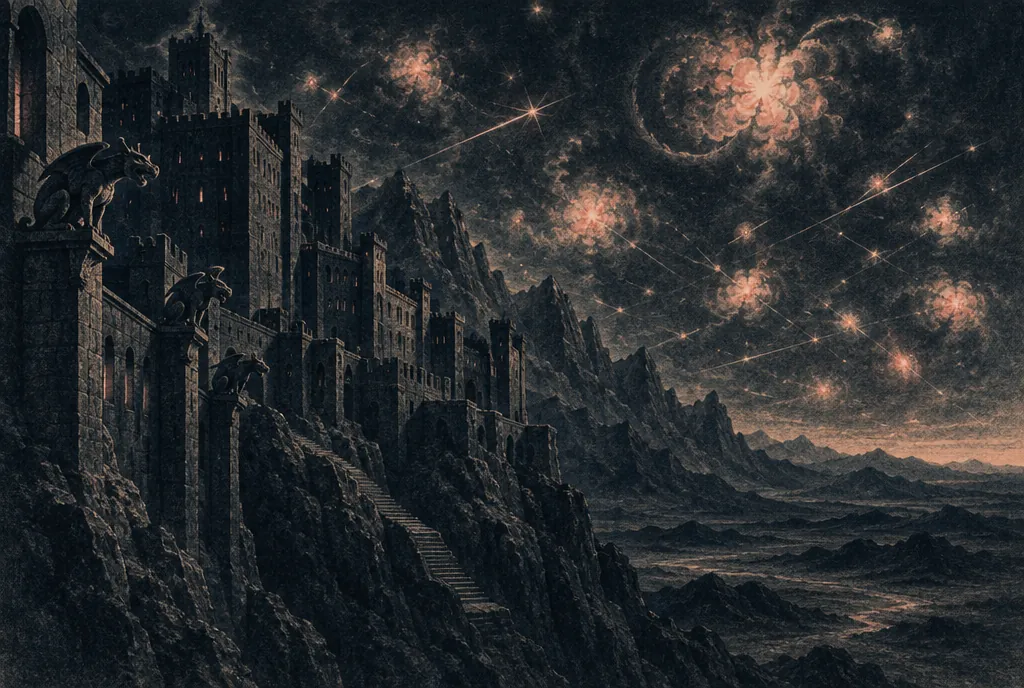
Chronos Keep juts from the eastern rim of the Bridle Range: three hundred rooms of sweating stone, more than a thousand gargoyles whose shadows crawl the walls like the hours of a sundial. Statues of the Shrike step out of the rock of dark stairways. Blood is spattered along the halls in patterns that almost mean something, a meal abandoned weeks ago rots in the dining hall, and everywhere there is the sound of flies.
Over the last rations and a stale cake Sol Weintraub saved for their final evening, Father Lenar Hoyt brings out a balalaika and the Consul wishes for a piano. He has one, Martin Silenus says: his ship, waiting at Keats Spaceport, if he would only call it down. Brawne Lamia guesses how. A portable fatline could reach it, and only the Ousters are rumoured to build those. The Consul smiles. Then he crumples his slip of paper marked seven. The Shrike grants a wish only to a prime number of pilgrims, and with the Templar Het Masteen gone they are six.
Lamia points to the balcony. The sky is full of silent explosions, plasma blooms curling inward like flowers closing for the night, warship tails like diamond scratches on blue glass. The war has begun, Fedmahn Kassad says flatly. The Consul finds that he is weeping and turns away. Far out on the moors a robed figure strides toward the Tombs. When Hoyt asks whether they will hear the Consul’s story, he decides: yes.
Inside, lit only by the battle, he takes out an antique comlog from the years of the Hegira. When Silenus sneers, the Consul pins him to the wall by the throat and promises to kill him, until Kassad parts them. The recording is fifty years old. There is only a young man’s voice, wind in grass, and far off, the surf.
The Consul’s Tale
Remembering Siri
The Consul
On the day the islands return to the shallow seas, Merin Aspic climbs the hill to Siri’s tomb and hates the day for being perfect. Willowgrass ripples like the fur of a great beast. Below, a procession a kilometre long waits on him: his balding son Donel in Council robes, a granddaughter, Lira, and a grandson of nine. Merin’s legs are young and ship-trained, and he jogs ahead. Here, one night, moonlight caught a hawk’s wings, and Siri, not quite sixteen, quoted Juliet to a boy of nineteen who knew only the stars.
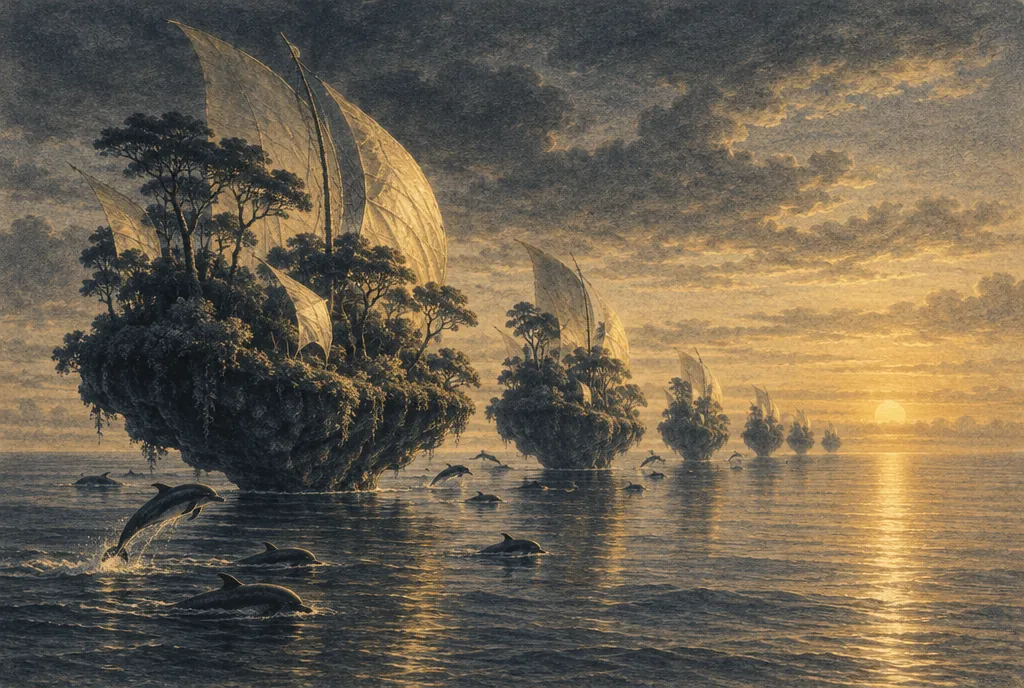
He was a Shipman on the spinship Los Angeles, building the farcaster that would join her ocean world, Maui-Covenant, to the Web. In his words: “It was five years ago for me. It was more than sixty five years ago for us.” His friend Mike Osho, Buddha-faced and irreverent, had bought an outlawed hawking mat, a flying carpet with flight threads bright as new copper. They flew north by night in Harlequin costumes, over the motile isles, living islands under treesails, herded by dolphins the colonists rescued from Old Earth’s dying seas. Firstsite blazed for its Festival. In a feathered mask, with auburn hair and green eyes, Siri was dancing.
At dawn on the second day her cousin Bertol, a Separatist in crimson silk, calls Mike out with a sword. Mike plays the drunken fool and scorches Bertol’s shirt with a laser pen. Merin steps between them; Bertol lunges past him. Mike sits on a stone step, blood running down his belly. Wait a minute, he says, as if he has forgotten something, and dies. Merin turns the pen to maximum and walks into a haze of screams and scorched flesh. Siri flies him out, and he sends her away. Under the boulder where they hid it, the hawking mat is gone.
There are Reunions after that, as her people call them. At the first, Siri is twenty-six and Merin still nineteen. She takes him deep beneath her drifting island with a translation disk, and they make love among the circling dolphins, while the disk buzzes one answer to his questions: they miss the Shark. He does not understand. At the second she has a son, Alón, with Merin’s curls and sardonic smile, and tells him he knows very little. At the sixth she is seventy and he not quite twenty-three. Fishing through a storm, she asks what follows the farcaster. Oil geologists, he says, developers, twenty or thirty million newcomers in the first year. And if it were destroyed? The ship would return with troops in nine months. Eleven years, says Siri.
Now the tomb is empty. Siri was cremated, her ashes scattered on the sea. There is only a box with Merin’s name on it: a powerful handlaser wired to a fusion cell, an antique comlog, the translation disk, and, rolled neatly, Mike’s hawking mat. Merin swears at her fondly and begins to smile.
The comlog holds what she kept of her diary. Siri at seventy says, “My days were but heartbeats to you. I hated you for that.” Siri in her forties, on the day their son was killed, says it was no accident; Alón chose to stay with the Separatists, and the day will come. Siri at twenty-six is pregnant. Siri at sixteen is furious that he left without saying goodbye. A soft chuckle, of no age at all: adieu.
He comes out smiling. The Ambassador promises that space and time will no longer be obstacles. Merin rises on the mat above the tomb and sees hundreds of islands returning from the south. The ceremonial laser pulses to the zenith, and he looks up in time to see a new star born. It is the farcaster, the work of his whole career, collapsing into a small nova. Merin set the charge himself. The band stops; the crowd runs. Merin’s verdict is short: “There will be strange tides tonight.” He sets course for the farthest isle, to tell the Sea Folk the time has come for the Shark, and later, when the world is theirs, to sing to them of Siri.
Under the flashing sky the Consul pockets the disk. He is not Merin, he says. Merin died in Siri’s Rebellion. He is their grandson, the boy of nine on the hill. The Hegemony came back within five years. At fifteen he watched islands burn, and in the morning the waves were grey with dead dolphins. His sister Lira died with the rebels. He became a diplomat, efficient, smiling, waiting, and helped the Web erase whatever lived on the worlds it took. On Bressia, where the Hegemony tested the Ousters, his wife and ten-year-old son were killed.
Meina Gladstone sent him to the Ousters to bait a trap at Hyperion. He told them everything, and they told him that Old Earth’s death was no accident: the TechnoCore and the young Hegemony planned it, and the Ousters were next. He kept back their promise of a device to open the Time Tombs. Years later, in the shadow of the Sphinx, the Ouster agent Andil told him that once it began there was no turning back. He shot her and her three technicians, threw Siri’s laser into the dunes, sobbed, and switched the device on himself. Then he lied to both sides. “Events no longer obey their masters,” he says. He asks them to think of the dolphins rotting in the sun, and ends: “I remember Siri.”
He is the spy Gladstone warned them of. Weintraub calls him an agent of retribution, chosen because the planners knew he would betray both sides. Siri’s comlog, modified, still reaches his ship and its fatline. Kassad lifts his deathwand, then sets the safety: they go on together. Lamia holds the Consul, and Weintraub puts an arm around them both. He will ask the Shrike for something after all, the Consul says, touching Rachel’s head: for her. Hoyt raises his hand over all of them, himself included: “Ego te absolvo.” The Consul curls a fist against his cheek and sleeps.
Before dawn a balalaika wakes him, Hoyt playing against the wind while the gargoyles turn the Keep into a vast cold bassoon. They go down six hundred and sixty-one steps without a railing, out onto vermilion sand, Lamia leading in red silk and the Consul in his gold tricorne. Ahead, the Time Tombs glow, each a different colour, as no one has ever seen them. Dread comes in on the wind. The Consul asks what Weintraub is humming to Rachel: a song from a film so old it is dust. Who is the wizard, Kassad asks. Never mind, Lamia says; sing it again. Hoyt plays, Silenus throws an empty bottle onto the sand and joins in, and the rest follow.
Fedmahn Kassad pushed up his visor, shouldered his weapon, and joined in the chorus. The Consul started to sing, thought about the absurd lyrics, laughed aloud, and started again.
Just where the darkness began, the trail broadened.
The Consul moved to his right, Kassad joining him, Sol Weintraub filling the gap, so that instead of a single-file procession, the six adults were walking abreast. Brawne Lamia took Silenus’s hand in hers, joined hands with Sol on the other side.
Still singing loudly, not looking back, matching stride for stride, they descended into the valley.
— Dan Simmons, Hyperion, Doubleday, 1989, the Epilogue