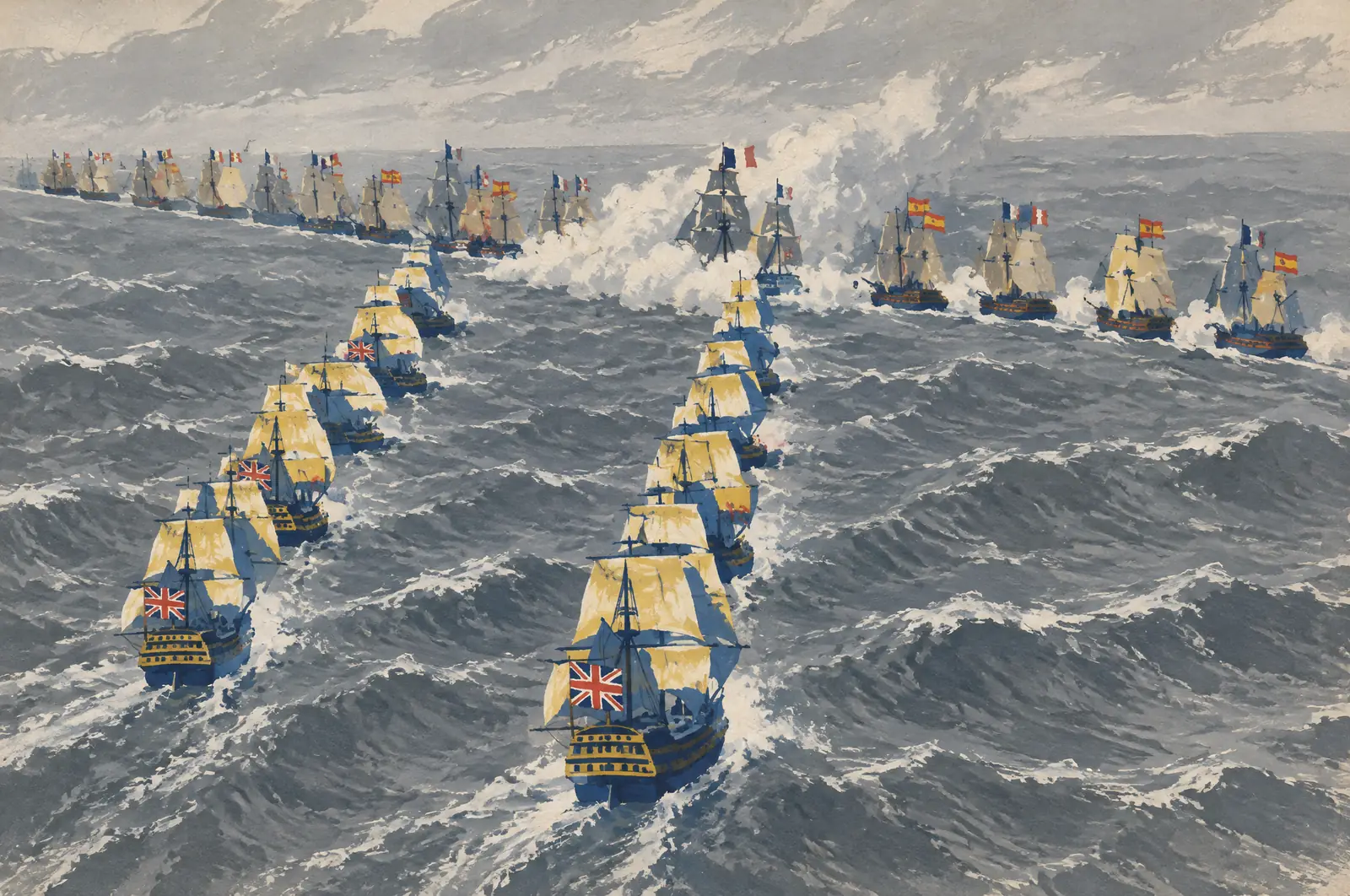
It is 1805 and Napoleon needs the sea. Off the southwest coast of Spain, thirty-three French and Spanish ships meet twenty-seven British. The rule of the day is to stay in line and trade broadsides, but Nelson breaks his fleet into two columns and drives them straight at the enemy line, betting that less practised gunners cannot cope with the day’s heavy swell. By evening the combined fleet has lost twenty-two ships and the British none; Nelson is dying, and Britain owns the sea for a century and a half. Rumelt holds this up as what good strategy looks like: not a thick deck of slides, but a leader finding the one or two pivot points in a situation and concentrating effort on them. Then he lays out four scenes of what passes for strategy now. A company retreat in a hotel ballroom ends with a release of balloons and no strategy. Lehman Brothers in 2006 answers a cracking housing market by raising its “risk appetite” on three percent equity. An Iraq occupation has goals but no plan for the insurgency until Petraeus arrives in 2007 and turns the army from patrolling to protecting the populace. And at a Web 2.0 lunch a CEO declares that strategy is never quitting until you win. Against all of this he sets his key idea. A good strategy honestly names the challenge and offers a way through it, and it has a kernel: a diagnosis, a guiding policy, and coherent action. Bad strategy is not merely the absence of this. It is a thing with its own logic, built on goals, slogans and the avoidance of choice, and it is spreading.
Exhibit 1Case 01
Part IGood and Bad Strategy
Cases 02–06
The first advantage of having a strategy is that almost no one else does, so no one expects it. In 1997 Apple is two months from bankruptcy; BusinessWeek has run its logo under a headline about the fall of an American icon, and Wired has printed 101 ways to save it. Steve Jobs comes back and does something both obvious and unexpected: he shrinks the company to what can survive. Fifteen desktop models become one, the laptops become one, printers and peripherals go, five of six national retailers go, manufacturing moves to Taiwan, inventory falls by more than eighty percent. He takes $150 million from Microsoft, which fears what a dead Apple would mean for its own antitrust case. Rumelt, who has just interviewed twenty-six European electronics executives and heard nothing but busywork, asks Jobs in the summer of 1998 what the long-term strategy is, since Apple cannot beat the Wintel standard. Jobs only smiles and says he is going to wait for the next big thing. The same surprise greets the Gulf War ground campaign of 1991. The press has been predicting trench warfare in Kuwait; Schwarzkopf instead feints up the middle, keeps eight thousand marines floating offshore as a diversion, and swings 250,000 soldiers west through the empty desert in a left hook that ends the ground war in a hundred hours. The manoeuvre was envelopment, the Army’s own Plan A, printed in a field manual anyone could buy for twenty-five dollars. The surprise was not secrecy. It was that a huge organisation actually focused, which meant saying no to the air force, the marines, the Saudis and the secretary of defense. Strategy is at least as much about what you do not do.
Exhibit 2Case 02

The second advantage comes from seeing power where others see none. When David drops Saul’s armour and runs at Goliath with a sling, the listener discovers only after the stone flies that the boy’s speed and reach were strengths and the giant’s bare forehead a weakness. Rumelt teaches this discovery with a Wal-Mart case from 1986, writing the conventional wisdom in a box on the whiteboard: a full-line discount store needs a town of at least 100,000 people. The class lists everything Walton did: big stores in small towns, everyday low prices, satellite data, trucks that swing out from a distribution centre past 150 stores and pick up pallets from vendors on the way home, managers who fly out of Bentonville on Monday and return Thursday. Then the question that stops the room: if it was all in the case, why did Kmart keep losing for the next decade? The answer arrives like corn popping. Walton did not break the rule about a store; he broke the definition of a store. The unit was the network of 150 stores with its data and trucks, and a decentralised Kmart, where each store chose its own vendors and prices, could not copy one piece without copying the whole. Rumelt then visits Andy Marshall in his small suite at the Pentagon in 1990, who hands him a thin 1976 paper arguing that the United States should stop matching Soviet weapons and start imposing costs: quieter submarines and more accurate missiles that force the other side to spend on counters that add nothing to its offence. A shift in viewpoint, nothing more, and by 1990 the Soviet Union is faltering under exactly that weight.
Exhibit 3Case 03

Bad strategy has four hallmarks, and Rumelt coined the term in 2007 at a Washington seminar where former secretaries of defense agreed that national security “strategies” since 1989 had been lists of goals. The first hallmark is fluff: a bank’s fundamental strategy of “customer-centric intermediation” means that the bank is a bank. An Arthur Andersen presentation in the summer of 2000 wraps Enron’s bandwidth-trading plan in evolution diagrams and knowledge spaces, when the incremental cost of bandwidth is zero and no spot market exists; fourteen months later Enron is bankrupt and takes its auditor with it. The second is failing to face the challenge. International Harvester’s 1979 strategic plan, a thick sheaf with a hockey-stick profit chart, never mentions the elephant in the elevator: work rules that let seniority trigger cascades of job transfers, and the worst labour relations in American industry. A six-month strike follows, then three billion dollars of losses and the closure of thirty-five of forty-two plants. DARPA, by contrast, names its problem precisely and builds policies around it, rotating programme managers every four to six years so that no empires form. The third is mistaking goals for strategy. Chad Logan, a college football hero who inherited a graphics company, has a 20/20 plan: twenty percent growth, twenty percent margin, and a Jack Welch quotation about reaching for the impossible. Asked what has to happen for it to come true, he offers the will to win, and Rumelt hears Passchendaele, where Haig’s one last push through flooded clay cost seventy thousand lives for five miles of mud. Logan hires someone else, who runs a visioning session. The fourth is bad objectives: a small-city mayor’s plan with forty-seven strategies and 178 action items, number 122 being to create a strategic plan; and the Los Angeles school district’s blue-sky call for transformational leadership at its thirty-four worst schools, with no theory of why they have failed for decades.
Exhibit 4Case 04

Why is there so much of it? Not miscalculation, but avoidance. Choice is painful. In early 1992 Rumelt sits in on DEC’s senior executives, simplified to three voices: Alec wants Boxes, Beverly wants Solutions, Craig wants Chips. Any two can form a majority and one of them is always tempted to defect, the cycling Condorcet described and Arrow proved no cleverer vote can fix. Ken Olsen asks for consensus and gets a statement about being a leader in data processing. He is replaced in June; his successor chooses Chips; it is five years too late, and DEC is sold to Compaq in 1998. Eisenhower, by contrast, wins in 1952 promising to roll back the Soviets, studies the problem, and quietly chooses not to. Andy Grove at Intel needs a year after asking Gordon Moore what a new CEO would do, get out of memories, to walk out the door and come back and do it. The second path is the template: charisma, traced from Max Weber through two 1985 books, reduced to a formula of vision, mission, values and “strategies” that are only goals. The Children’s Crusade of 1212 shows vision without strategy, its children sold into slavery at Marseilles; Gandhi shows vision with one. Dow, Enron, Cornell, a Sacramento campus, the CIA and NEC all publish the same charisma in a can. The third path is New Thought, the 1889 doctrine that thoughts are things, flowing from Prentice Mulford through Napoleon Hill to The Secret, and seeping into management as shared vision, until executives are told to suspend disbelief. Rumelt would not fly in a plane designed by people who only pictured it flying.
Exhibit 5Case 05

The kernel is the bare-bones centre of any good strategy: a diagnosis that names the challenge, a guiding policy for dealing with it, and coherent actions that carry the policy out. A doctor does it: symptoms, disease, therapy, prescription. Diagnosis first. John Mamer, sitting in on Rumelt’s classes, notices that every case asks only one question: what is going on here? Starbucks in 2008, with flat traffic and returns down from fourteen to about five percent, could be a problem of expectations, of growth platforms, or of eroding advantage; none can be proved, and each opens a different field of action. George Kennan’s long telegram of 1946 diagnoses the Soviet Union as a power that cannot be charmed but can be contained, and that one word shapes forty years. Lou Gerstner arrives at IBM in 1993 as it is being prepared for break-up and changes the diagnosis: IBM is not too integrated, it is failing to use its integration, so it will sell customer solutions. The guiding policy is the guardrail, not the destination. Wells Fargo’s vision of satisfying every financial need says nothing about how; its real policy is cross-selling and the knowledge that comes with it. Stephanie, who owns a corner grocery, faces a thousand small questions, from green ceilings to alley parking, until she chooses to serve the busy professional with little time to cook, and suddenly the second checkout, the prepared meals and the sensible closing hour all line up. Action comes last, and action is the hard part. In a London town house west of St James’s Park, the president of a consumer-goods company’s European business has committees, rotations and bonuses for a Pan-European product line and nothing to show for it. Rumelt asks what he would do if it absolutely had to happen in eighteen months. Close a development group, he says; maybe both; start fresh in the Netherlands. It takes him nine months to decide it matters that much. Coherence means actions that reinforce rather than cancel: Ford buys Jaguar and Volvo for their brands, then puts them on one platform for scale. Strategy is coordination imposed on a system by central power, which is costly, so it should be imposed only where the gains are large.
Exhibit 6Case 06

Part IISources of Power
Cases 07–16
Archimedes said that with a long enough lever he could move the world; the lever would have to be billions of miles long and would shift the earth by the width of an atom, so he had better pick a spot where that tiny movement matters. Leverage is anticipation, a pivot point and concentration. Toyota spends a billion dollars on hybrids while the SUV craze peaks, anticipating both fuel pressures and that rivals will license rather than build. Pierre Wack at Shell tells Rumelt in 1980 that a storm in the Himalayas means a flood in the Ganges plain: the storm he read in 1970 was the ambitions of Iran, Iraq and Venezuela, and the flood was OPEC. In 1981 at Runnymede he warns that the real risk is not high oil or low oil but high then low, which suckers you into useless assets; within a decade the price goes from thirty-six dollars to twenty. In Tokyo in 2008 Noritoshi Murata of 7-Eleven explains that Japanese consumers bore easily, two hundred soft-drink brands and seventy percent turnover a year, so the company turns store-floor observation into private-label products in weeks. Reagan at the Brandenburg Gate in 1987 is not talking to Gorbachev but to Western Europe, pressing on the gap between a liberalising claim and a wall. Concentration pays because of thresholds: a little advertising does nothing, and turning two schools around moves opinion more than improving two hundred by two percent. Harold Williams, handed the Getty Trust and sixty-five million dollars a year that must be spent, refuses simply to buy art and bid up prices; he aims instead to transform the study of art, an objective scaled to the money in hand.
Exhibit 7Case 07

A proximate objective is one close enough to be hit. Kennedy’s moon speech of 1961, now a staple of charisma manuals, is in fact a decision-maker talking to adults: von Braun has written a month earlier that the Soviets will win any near race, but a landing needs a tenfold jump in rockets, which favours the richer nation. Two years later Rumelt is an engineer at JPL, where the Surveyor team cannot design a lander because no one knows whether the moon is powder, needles or boulders. His boss, Phyllis Buwalda, writes a specification: hard, grainy, slopes under fifteen degrees, scattered two-foot boulders. It looks like the Southwestern desert, he complains. If it is much worse than that, she says, we will not be spending much time on the moon anyway. Five Surveyors land, and Apollo 12 sets down two hundred yards from one of them. A leader’s job is to absorb ambiguity and hand the organisation a solvable problem. The more dynamic the situation, the nearer the objective must be, like a chess master improving position rather than hunting for mate. A small business school, asked to pick one feasible objective, replaces its list of initiatives with ten target firms that should be hiring its graduates and a course in media management. On a hilltop in Baja, watching grey whales slap the Sea of Cortez, a former rescue pilot called PJ explains that you cannot handle an engine failure until flying itself is automatic, and you cannot fly in formation until you can fly at night. Skills stack like rungs, which is why a start-up that has not yet learned to fly should not be opening offices in Europe.
Exhibit 8Case 08

A chain is as strong as its weakest link, and on 28 January 1986 Challenger’s is a rubber O-ring. In a chain-linked system nothing is gained by strengthening the other links, which is why such systems get stuck: no manager invests in a better link when the others will not. GM’s transmissions mean little while knobs fall off dashboards; development economics is a tangle of roads that overload ports and skills without jobs. Over a risotto at Savini, beside the Milan duomo, Marco Tinelli describes unsticking his family’s machine company: a year on nothing but quality, then a year building a sales force able to explain the better machines, then nine months on cost, last, so that cost-cutting serves the design rather than defines it. He absorbed the losses of the first campaign himself and set aside local measurement until the chain was rebuilt. The same logic makes IKEA, with its catalogues instead of salespeople, flat packs, suburban warehouses and own designs, impossible to copy one policy at a time; fifty years on, no one has.
Business is more a dance contest than a battle, yet the oldest lesson in design is still Cannae, 2 August 216 BC. Hannibal bulges his centre of Gauls and Spaniards toward eighty-five thousand Romans and lets it fall back; the legions pour into the bow, his cavalry circles two miles round, his heavy infantry closes the sides, and the Romans are squeezed so tightly that many cannot raise their weapons. Fifty thousand die, more than on any single day of battle since, a quarter of Rome’s elected leadership among them. Three things show in pure form: premeditation, anticipation of an opponent shaped the night before by a raid that shames the impetuous Varro, and coordinated action in time and space. A strategist is a designer, not a chooser among four options on a slide. Rumelt learned design at JPL sketching two Jupiter spacecraft, one for a 1,200-pound Titan budget and one for 3,000 pounds on a Saturn; the heavy one bolts together, the light one is a web of trade-offs where a smaller power unit means a 35-watt radio means a tighter dish means better sensors and more fuel. Voyager 1 flies fourteen years later at 1,588 pounds and is still out beyond the solar system. The rule he draws: resources and tight integration substitute for each other. Xerox, with its plain-paper patents, needs no clever design and grows lax, letting Canon learn paper handling; the upstarts, the young Wal-Mart, Dell, FedEx and Nvidia, win with tight designs and then loosen in their turn. Paccar, holding a quarter of the heavy-truck market with Kenworth and Peterbilt, has not lost money since 1939 because every piece, from dealers with 3-D configurators to engineers who stay for decades, is tuned to the owner-driver for whom the truck is home and office.
Exhibit 9Case 10

A bright April morning, a room of executive MBAs, and one of the oldest cases in the collection: Crown Cork & Seal, taken through 1989, a can maker that has returned nineteen percent a year for thirty-five years in a terrible industry. Rumelt draws Miller Brewing as a box with a captive supplier on either side and asks why anyone would invest in such a business. Todd says Crown is a low-cost producer; it is not, and Rumelt writes it on the board anyway. Martin recites the case: hard-to-hold applications, aerosols and soft drinks, technical help, fast response. Rumelt gathers his notes as if the class is over, until Melissa, who rarely speaks, observes that putting soda in a can is no great feat. So they do their own analysis, policy by policy, asking what each unusual policy is aimed at. Technical assistance: smaller customers without their own engineers. Rapid response: rush orders, a hot summer, a new product. Smaller plants with several customers each and lines standing ready: less production per customer, higher prices. Twenty seconds of silence, and then Julia sees it: Crown does short runs. The majors have made themselves captive to avoid changeovers; Crown embraces changeovers, pays more per can, and in return is never a captive. It has several customers per plant instead of one customer with several suppliers. That is focus in both senses, policies that reinforce one another and power applied to the right target. The logic was never secret. It was simply hard work that neither Wall Street nor the company’s own description had done, and most large organisations never do it, chasing many goals without the resources to break through on any.
Exhibit 10Case 11

In 1989 John Connelly, in poor health, hands Crown to William Avery, who says the company’s growth had slowed and he has to light a fire. He hires deal-makers from Salomon and Lehman, doubles the company with Continental Can, buys Constar’s plastic bottles, Van Dorn and Tri-Valley, and spends eighteen months taking CarnaudMetalBox in Europe; by 1997 Crown is the largest container maker in the world after twenty acquisitions. In 1998 the trouble arrives. Growth in PET bottles was substitution, and substitution has a ceiling; consolidation does not firm up prices because no one in Europe will close a plant. The shares fall from fifty-five dollars to five. Connelly’s slow-growing Crown had paid shareholders eighteen and a half percent a year; Avery’s fast-growing one pays two and a half. Growth in a commodity is an industry event, and its profits go straight back into capacity, a black hole that swallows cash. In Milan in 1998, retained by Telecom Italia, Rumelt asks a Morgan Stanley managing director why a merger with Cable & Wireless makes sense. Economies of scale, in different continents. Then traffic, which a contract could carry. Then “economies of mass”: the combined company would have more cash flow, and with more cash flow you can do a bigger deal. The banker closes his briefcase and leaves. Two days later the board kills the deal and accepts the chairman’s resignation. Healthy growth is not engineered; it is the reward for superior products and skills, showing up as market share gained alongside profit.
Two equal chess players, two identical armies: neither has an advantage, because advantage lives in asymmetry. A start-up with a clever microporous fabric wants to become a clothing company; its venture backer Susan tells the founders they have won the 1,500 metres and now want to wrestle gorillas, and they listen. The United States in Afghanistan is wrestling the gorilla, its million-dollar-a-year soldiers against an enemy with more patience. In business an advantage is sustained only by an isolating mechanism, a patent, a reputation, a network, hard-won know-how. Stewart Resnick, visited at his sculpture-filled West Los Angeles headquarters, has built Teleflora, the Franklin Mint, the world’s largest nut orchards, POM and Fiji Water, and says a business is “interesting” when he can see ways to raise its value: large enough to pay for yield research and to stimulate demand for pistachios, with the seven to ten years a new tree needs giving him time to build processing no small grower can match. That unlocks a puzzle Rumelt and Steven Lippman set in 2002, a silver machine left by a UFO that makes ten million dollars a year at no cost and sells for a hundred million. It has an advantage, but not an interesting one, because nothing can increase its value, which is also eBay’s condition, dominant and stagnant. Value grows on four fronts: deepening advantage the way Frank Gilbreth doubled bricklaying by raising the pallets to chest height; extending it the way DuPont went from explosives to nylon and Disney’s three rules let Pirates of the Caribbean wear the brand; raising demand, as the Resnicks planted six thousand acres of pomegranates and then had to invent a category to avoid a red tide of unsold juice; and strengthening the isolation, from the martial law that stopped forty-four wells on one Kilgore block in 1931 to Windows as a moving target.
Defenders want the high ground, and a wave of change makes new high ground while flattening the old. Rumelt sets the fifty years from 1875 to 1925, electricity, streetcars, cars, planes, telephones, against his own fifty and finds the earlier more momentous; perspective is the first tool. On a wet winter day in 1996 he drives from Fontainebleau to Paris to see Jean-Bernard Lévy at Matra, who cannot understand how Cisco, started by two university staff members, broke through the scale barrier that defines telecommunications. The answer is a hundred thousand lines of very skilful code written by perhaps five people. Transcribing his notes that night, Rumelt feels a chill: success is shifting from armies of engineers to single combat, from scale to skill, from Japan to Silicon Valley, and it will reach toasters and cars. The cause is the microprocessor, which Intel first sold in 1971 after buying back the rights from a calculator maker, and which took Intel ten years to see as more than a sideshow. Software wins because mistakes are cheap to fix. Computing deconstructs because every component gets its own processor and becomes smart, so IBM’s systems engineers lose their jobs and the vertical industry turns horizontal. Cisco rides four waves at once, software, corporate networking, the vendor-neutral IP protocol no incumbent would embrace, and the public internet of 1993, and takes two-thirds of corporate networking. Luis Alvarez told his Berkeley physics class the course was called advanced because nobody understood it; waves of change are harder than that, but you only need to see ten percent more clearly than your rivals. Five guideposts help: rising fixed costs, which shrank colour film to Kodak and Fuji; deregulation, after which former monopolists do not know their own costs; predictable biases, the forecast that never peaks, the battle of titans that drops AT&T and IBM through the floor, the advice to copy whoever is winning now; incumbent response; and the attractor state, the way an industry should work if efficiency wins, Cisco’s “IP everywhere” or a newspaper unbundled into a local daily, a weekly of analysis and online headlines.
A supertanker takes a mile to stop even in hard reverse. Inertia comes in three kinds. The inertia of routine: two years after airline deregulation, Rumelt tells Continental that long-haul fares will fall and short-haul rise, and is told the planning model says the opposite. The model is the Boeing Fleet Planner, which takes costs, adds a twelve percent return at a fifty-five percent load factor and calls the result a fare; it was built to tell the regulator what to charge, and it is still running. The old rules of thumb, go long haul, reequip when everyone does, bankrupt the majors; in August 1981 Continental’s CEO Al Feldman, facing a hostile bid from tiny Texas Air, shoots himself at his desk. The inertia of culture: at AT&T in 1984, Bell Labs quotes three million dollars and two years for a demonstration program that Rumelt writes himself in three weeks, because a research culture that produced the transistor cannot make a product and will not be told. His strategy work there is a waste; breaking culture takes simplification, fragmentation and triage, replacing each group’s alpha. Inertia by proxy: a Philadelphia savings bank in 1980 does not offer money-market accounts because its retired depositors are the last pool of five-percent money on the planet, and in 1998 the telephone companies will not sell DSL at a thirtieth of a T1’s price, so new carriers boom until the incumbents finally respond and not one survives. Entropy is the other force: order decays unless someone weeds. For Denton’s, a garden-supply chain with twenty-eight outlets, Rumelt builds a hump chart of gain to operating; the best store earns more than the whole chain, and the worst fourteen cancel the rest. Closing five and fixing eight doubles profit, with no insight at all, just management. Alfred Sloan’s 1921 product policy gave each GM brand its own price band, a design so clear that a street’s parked cars told you who lived where; by 2008 GM sells nine different sedans at $25,500 to Toyota’s two, and in June 2009 it is bankrupt.
All of it comes together at Nvidia. The ideas of 3-D graphics come from Utah, through Silicon Graphics, whose 1992 Reality Engine stood four feet high and cost over $100,000. In the summer of 1994, at a friend’s house in Fontainebleau, Rumelt watches Paul, a teenager, click through the still pictures of Myst; two weeks later Paul is dodging red blobs in Doom in real time, and his computer-scientist father cannot believe a PC can render that fast. Online Quake makes graphics a matter of life and death for teenage boys, and 3dfx’s Voodoo board, with its own Glide language, grabs the demand first. Nvidia, founded in 1993 to be the Sound Blaster of multimedia, ships the NV1 in 1995 and it flops. Jen-Hsun Huang rewrites the strategy with a technical advisory board. Diagnosis: the market will absorb all the graphics power anyone can make, and graphics can advance three times faster than CPUs by putting more of the SGI pipeline on one chip and spending transistor density on parallel processors rather than cheaper chips. Guiding policy: a new chip every six months instead of the industry’s eighteen, on Microsoft’s unproven DirectX rather than a rival’s Glide. Coherent action: three overlapping development teams; heavy investment in simulation and emulation so that bugs are found before silicon comes back; a unified driver architecture that takes drivers away from the board makers; emulators that let driver work start months early. RIVA 128 keeps the company alive in 1997, TNT hits its stride in 1998, and GeForce 256 in 1999 carries twenty-three million transistors and the whole Reality Engine on a $100 chip. When Diamond Multimedia refuses to give up its margins, Nvidia goes to Dell, which agrees to boards built by a contract manufacturer. The rivals fall as the strategy needs them to: 3dfx chases the mass market and overreaches, closing in 2000 and selling its patents to Nvidia, enticed like Rome at Cannae; Intel cannot bend its eighteen-to-twenty-four-month cycle for a sideline; SGI’s new chief orders fifty percent growth and buys workstation firms until bankruptcy in 2006. Only ATI, after buying ArtX, which Nvidia should have bought first, keeps pace. By 2009 the wave has crested, and Nvidia tries a pincer: Tesla for desktop supercomputing and Tegra, a system on a chip aimed at phones.
Part IIIThinking Like a Strategist
Cases 17–19
Thinking about your own thinking is the most useful shift of viewpoint. In a hangar at Hughes Electronics, before an eighteen-thousand-pound satellite that gleams like a cathedral, an engineering manager named Barry says the strategy stuff is nonsense: engineers want to know what happens if we do A versus B. Rumelt, once an engineer himself, reaches for science. A strategy is a hypothesis, an educated guess about what will work at the edge of the known, tested first against principle and then by trying it. Asking for a guaranteed strategy is asking a scientist for a hypothesis guaranteed true. Deduction, winding the crank, produces nothing new; a thousand years after Rome, inquiry woke only when Galileo’s trial made refutation the test of belief, with Newton born the year after Galileo died. Anomalies are the frontier: stars at the edges of galaxies orbit as fast as those near the core, so either most of the universe is dark matter or gravity is wrong. In Milan in 1983 Howard Schultz sees an anomaly in an espresso bar, expensive coffee as a mass product, fast and social, where America drinks cheap robusta from plastic foam. His hypothesis is that the Italian bar can be recreated in Seattle. Starbucks’ owners decline, so he opens Il Giornale: seven hundred square feet, no chairs, opera, bow ties, Italian on the menu. Then he learns from the customers. The opera goes, the ties go, chairs arrive, then paper cups, and after much soul-searching nonfat milk. In 1987 he buys Starbucks; by 2001 there are 4,700 outlets. Hypothesis, data, anomaly, new hypothesis: this is scientific induction, and it generates privileged information every day. Joe Santos, once chief of Segafredo, explains why the big European roasters never responded: Starbucks was a retailer called a coffee company, and seen from Europe, mostly a milk company.
Summer 1967, Los Angeles, twenty-five and nervous, a yellow legal pad and a ballpoint pen: Rumelt’s first strategy interview is with Fred Fletcher of Fansteel, who at the end of three hours calls it the most useful conversation he has had all year. It takes fifteen years and a story told over lunch in Republic Steel’s dining room to understand why. In 1890 Carnegie offered Frederick Taylor ten thousand dollars for anything about management worth hearing; Taylor told him to list the ten most important things he could do and start on number one, and the cheque came a week later. The list is not the point; constructing it is, because attention is a flashlight beam and the mind forgets its larger purposes. Being strategic is being less myopic than your undeliberative self. On a rainy fall day in 2005 Rumelt asks seventeen managers not what they recommend for TiVo but how they arrived at it. Each had seized the first insight, manufacturing cost, the cable segment, TiVo as the industry’s Napster, and spent the rest of the time justifying it. Quick closure is a relief from choppy water, and it is a dodge we are not conscious of making. Three habits counter it: tools against myopia, the discipline of attacking your own judgment, and recording judgments so that they improve. The kernel reminds you that an insight lands in one of its three parts and has to be worked out into the other two. Problem-solution works backward from what is done to why; for TiVo it suggests a legal attack on cable bundling rather than more marketing. Create-destroy means trying to break your own alternatives, for which Rumelt keeps a panel of experts in his head: his dissertation chair asking why anyone should listen; Alfred Chandler speaking of scale and scope; David Teece noting that TiVo has no lock on DVR technology; and Steve Jobs, who joined the panel in 1997 by asking which Silicon Valley entrepreneurs UCLA had produced and, told none, pronouncing the school a failure. Judgment improves only if you commit it to writing before the discussion and then see where you were wrong.
Exhibit 11Case 18

Kipling’s line about keeping your head when all about you are losing theirs opens two stories of the crowd. The first Atlantic cable clicked in 1866; the first telephone cable, in 1956, carried thirty voice circuits. In 1997 two former AT&T managers and a Los Angeles financier form Global Crossing, lay the 8,886-mile Atlantic Crossing-1 for $750 million, and sell its capacity at eight million dollars per STM-1, well under the consortium price; thirty-five percent of it repays the whole cable, and within a year the stock market values the company at $38 billion, more than Ford. In Cambridge, David Cleevely draws two circles on his whiteboard and explains the economics of the fat pipe. In the taxi back to London Rumelt works out that the cost of carrying one more call, or a year of calls, under the ocean is nearly zero, fat pipe or thin, and that with competition nothing stops prices falling to cost. His 1999 MBA class walks through the Five Forces, each one “not good”: a perfect commodity, non-proprietary technology, overcapacity certain, sunk cables that keep running. A student answers that the market is saying otherwise, and in 1999 that is the trump card; consultants compare stock charts instead of logic. Rumelt reaches for Gödel: a system fed only its own signals cannot decide the question, and you have to step outside it. The final interview for his case is cancelled on the day in December 2001 when Global Crossing files for bankruptcy; by 2002 an STM-1 sells for $325,000, four percent of the original asking price. The second story is 2008, the largest credit bubble in history, Bear Stearns at thirty-two to one, household debt risen from sixty to 130 percent of income since 1984. Five errors compound: engineering overreach, the smooth-sailing fallacy, risk-seeking incentives, social herding, and the inside view, the belief that this case is different. The outside view was plain: twenty-eight housing boom-busts in twenty-one rich countries in fifty years, and America’s own crashes of 1819, 1837, 1873 and 1893, each born of easy credit for land, along with Melbourne’s in 1891, and a century of home-ownership campaigns from Hoover to Clinton to Bush loosening the rules. Paulson praises deep and liquid markets as the crisis begins; Bernanke names a Great Moderation in 2004; Greenspan and Geithner bless the new instruments. Pride goes before destruction. The book ends with its defence against the crowd: real-world data that refutes the chanting, and the lessons of other times and other places.
Exhibit 12Case 19