In 1977, at Kardamyli in the Mani, in southern Greece, Patrick Leigh Fermor writes a letter to his old friend Xan Fielding. They met in 1942 on the slopes of Mount Kedros in occupied Crete, both dressed as Cretan shepherds, in black turbans and cloaks of goat hair. In the long idle spells in the mountains they told each other about their lives before the war. Now Fermor has finally pieced together the story of a walk he took at eighteen, and he dedicates it to Xan, the way a bullfighter tosses his cap to a friend before the bull. The walk was meant to end in Constantinople. It ran so long in the telling that it has had to be split in two, and this first half stops in the middle of a bridge over the Danube.
The boy who set out was nobody’s idea of a scholar. During the First World War his mother and sister sailed to join his father in India. He was left behind as a baby with a farming family in Northamptonshire, so that one of them would survive if a U-boat sank the ship. For four years nobody scolded him once. When his mother came back, she found a small savage who fought her off in a broad country accent. School after school gave up on him, including a progressive one for difficult children where the pupils danced country dances naked. At the King’s School in Canterbury he loved the ancient stones, the languages and Gibbon, and broke every rule there was. A housemaster’s report called him “a dangerous mixture of sophistication and recklessness”. The end came when he was found in a greengrocer’s back shop, sitting on an upturned apple basket, holding the hand of the greengrocer’s daughter. Her name was Nellie, and she was twenty-four. His schooldays were over.
He crams for the Army in London, passes, and then decides that peacetime soldiering is not for him. Two of his poems are accepted, and he decides instead to be a writer. By the autumn of 1933 he is lodging in Shepherd Market, Mayfair, with a one-legged landlady, Miss Beatrice Stewart, who once sat for Sargent. The parties never stop, and his money is down to a pound a week. Then, one wet evening at the end of November, with a gramophone playing downstairs, the answer arrives all at once. In Fermor’s words, the plan “unfolded with the speed and the completeness of a Japanese paper flower in a tumbler”. He will cross Europe on foot, like a tramp, a pilgrim or a wandering scholar of the Middle Ages, sleeping in barns and haystacks. He will follow the Rhine and then the Danube, all the way to Constantinople. And he will go alone, so that every new language reaches him with no English in the way.
The arrangements are few. His father in India will be told by letter, and his mother, frightened at first, ends up laughing with him over the atlas. A pound a week will follow him, four pounds at a time, by registered letter to the post offices of the cities ahead, Munich first. He borrows fifteen pounds and buys an old Army greatcoat, puttees and hobnailed boots. A friend leaves him a rucksack. In go a sleeping bag, a stock of pencils, the Oxford Book of English Verse, and a volume of Horace from his mother. A walking stick of ash costs ninepence near Sloane Square. At the passport office the clerk asks for his profession, and his mind goes blank. The clerk suggests “student”, so student it is. On the ninth of December, 1933, after a farewell lunch, the rain sets in for the day.
Three friends take him across a drowned London by taxi, past a thousand umbrellas over a thousand bowler hats. They wave from the balustrade of Tower Bridge as the little Dutch steamer Stadthouder Willem pulls out. He is its only passenger. The rain stops, the sun sets over Wapping as they slide downriver, and in the saloon, under a pink-shaded lamp, he writes the first entry in a handsome new journal. He will not see England again until January 1937. Two hours before dawn the ship anchors at the Hook of Holland in falling snow. A train carries him, still alone, towards Rotterdam, and he feels that he is slipping into Europe “through a secret door”.
Entered Holland at the Hook, 10 December 1933, before dawn, in falling snow.
The streets are white and empty. Snow lies on the shoulders of the statue of Erasmus, and a belfry strikes five. Then a waterside café opens. A man in clogs puts the cat out onto the snow, the cat walks straight back in, and the boy follows it. He orders fried eggs and coffee by signs and writes his second entry. When the landlord wants to know where he is going, he gives a one-word answer: “Constantinople.” The landlord’s eyebrows go up. They drink two glasses of Bols together, and the journey has formally begun.
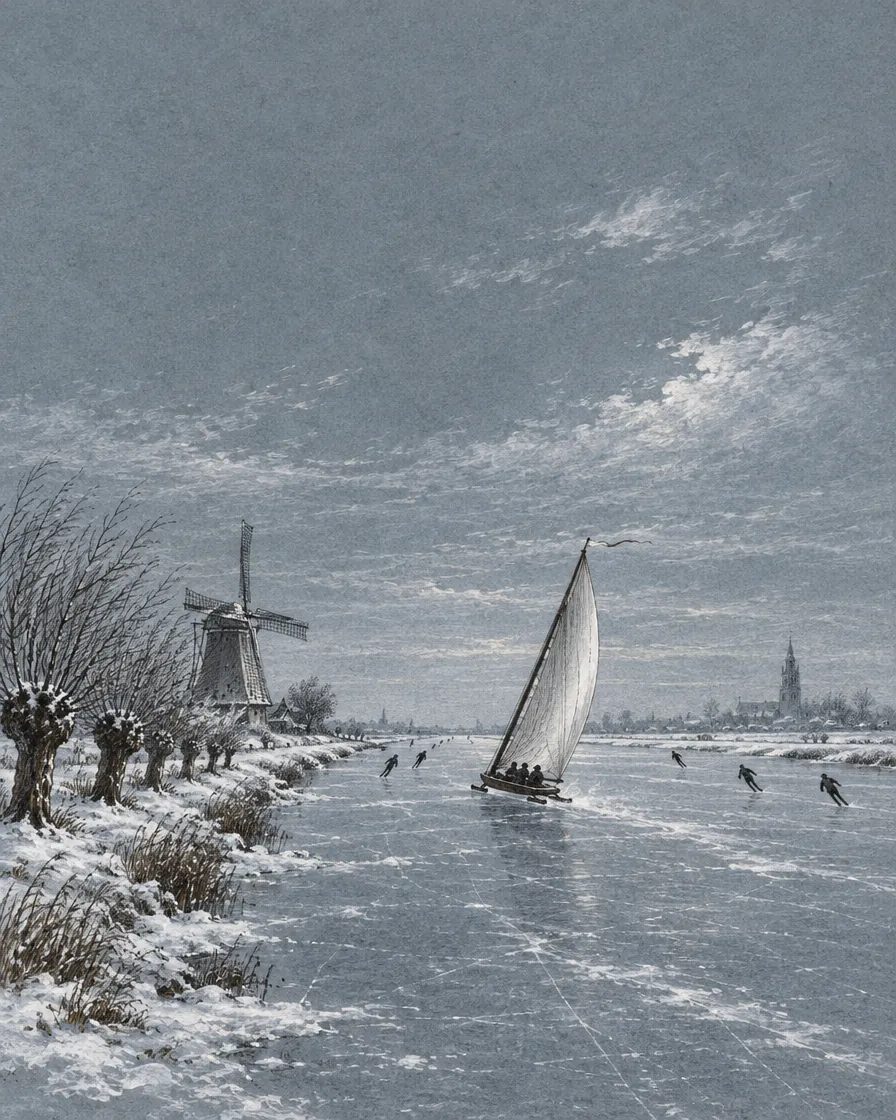
He walks south along the dykes, refusing the ear-pads the cyclists wear. On the ice a yacht crewed by three wild boys scatters a crowd of skaters, as if a Brueghel had come to life. At Dordrecht he falls asleep in a bargemen’s bar and is led upstairs to an eiderdown like a giant meringue. In the morning the landlady charges him for supper but not for the bed, the first of countless kindnesses on the road. At Gorinchem he sleeps on a plank bed in the police cells, and the word student in his passport opens every door. Near Zaltbommel a white ship hung with pennants seems to sail straight across solid meadows, on a river he cannot see. From a belfry between Tiel and Nijmegen he can see the whole of Holland, and as he climbs down, eight bell-ringers in clogs spit on their palms and set the bells going. His last sight of the country is two nuns waiting for a bus, with snow in their coifs. Then comes the German frontier post, and above it a swastika flag that has been flying for ten months.
Crossed into Germany below Nijmegen; the date is approximate.
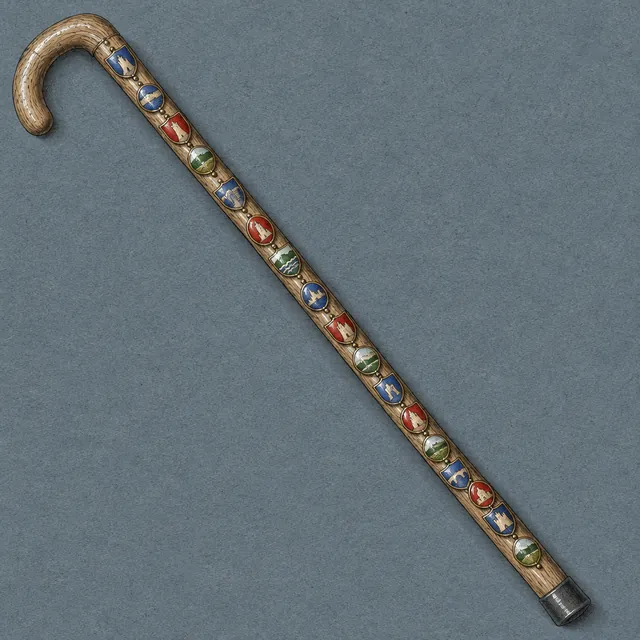
In the first German town, Goch, a tobacconist sells him a Stocknagel, a little metal badge of the town to nail onto his stick. Soon the stick is barnacled with them and flashes like a silver wand. A shop window is full of Nazi photographs, and women stop to admire Hitler’s looks. Then a column of Brownshirts marches in, singing, and answers its commander with a roar of “Heil!” in the falling snow. That night at the inn a dozen Brownshirts sing soft Westphalian songs over their beer. He cannot make their charm fit with the bullying and the burning of books. Germany has carried a shadow for him since childhood. He was four on Peace Day, 1919, when the villagers in Northamptonshire burned the Kaiser in effigy on a bonfire and a boy dancing in the firelight swallowed a burning Roman candle. The farmer’s daughter carried him home across the dark fields and told him not to look back. Yet he finds that he likes the Germans. They have an old tradition of kindness to young wanderers, and an English one on foot is a curiosity worth feeding.
At Düsseldorf he sleeps in a workhouse run by Franciscan friars and chops wood at dawn for his coffee and black bread. He walks out with an unemployed man from Brunswick, and they light the last two cigars from the ship. The man puffs away and cries that they will take him for a count. Cologne Cathedral rises in the dusk, and Christmas is five days off. In a waterfront bar he drinks to brotherhood with two bargemen, Uli and Peter, arms linked in the old ritual, until all three of them topple into the sawdust in a heap. Next day a bookseller sells him a German Hamlet to learn the language from, and the bookseller’s friend Hans takes him home. Hans’s landlady, a professor’s widow, gives him his first bath since London and a bed on the leather sofa in her dead husband’s study. Hans also finds him a free passage up the Rhine on a barge carrying cement. When it casts off at dusk, the crew turn out to be Uli and Peter.
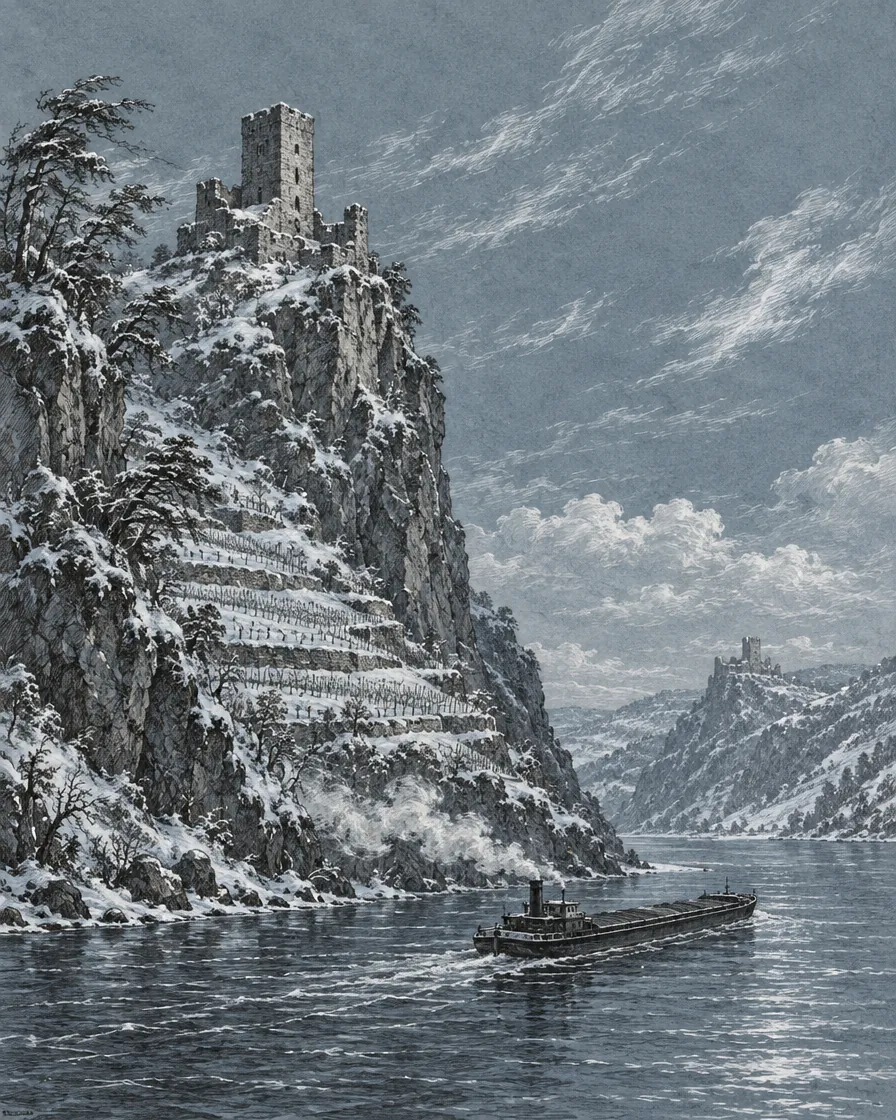
They chug upstream. The cabin is papered with film stars, and the fried potatoes with bacon are the worst thing he has ever eaten. Later he slips another helping of bacon over the side, to join the Rhinegold. Uli does an impression of Hitler with a comb for a moustache, and when the engine breaks down at Bonn, the three of them go to see Laurel and Hardy. Then the castles begin, on every crag, as the barges salute each other with flags and sirens. At Koblenz he jumps ashore, and Uli’s siren echoes off the cliffs in farewell. In a wine-house he learns that the stems of the glasses tell you the wine, green for the Moselle and amber for the Rhine, and he goes to bed tipsy. On foot again, he follows the gorge past the rock of the Lorelei, and reaches Bingen at dusk on Christmas Eve. At the inn he helps the innkeeper’s daughters, aged five to fifteen, to trim the tree. They sing carols and go to midnight Mass. Next morning the presents come out, and the smallest of the girls turns to the stranger.
The smallest of the daughters gave me a tangerine and a packet of cigarettes wrapped beautifully in tinsel and silver paper. I wished I’d had something to hand her, neatly done up in holly-patterned ribbon—I thought later of my aluminium pencil-case containing a new Venus or Royal Sovereign wound in tissue paper, but too late. The time of gifts.
— Patrick Leigh Fermor, A Time of Gifts, New York Review Books, 2005, p. 63
Relations are expected for Christmas Day, so he leaves, not wanting to intrude on the family. The roads are empty and white, and he is lonely. He eats the tangerine, the gulls take the peel, and he lights one of the cigarettes and feels better. At midday a Rheingau inn sweeps him into a Christmas dinner thirty strong, with the great wines of the valley poured round the table. There are car rides, perhaps a castle, and dancing, and he never quite learns where he went. On St Stephen’s Day he wakes up on a stranger’s sofa, above a street of sooty tramlines.
He leaves the Rhine for good at Mannheim and turns up the Neckar to Heidelberg. He reaches the Red Ox inn after dark, snow-caked and frozen, and the landlady, Frau Spengel, greets him with a line from Goethe’s “Erlkönig” about a rider out late in the night and the wind. She and her husband refuse to let him pay. Their son Fritz takes a sabre off the wall and explains the student duels that leave a young man’s face scarred for life. Fritz thinks very little of them. On New Year’s Eve they climb to the red castle above the town and watch the sun go down over the snow, “the dying wick of 1933”. On the way back, some youths on a wall whistle the Nazi marching song. Fritz says drily that he thinks he has heard that tune before. Later a drunk young man corners the Englishman about the colonies, the fleet and the Jews, and Fritz leads him away and apologises. Then the bells ring in 1934. Fritz will be killed in Norway in 1940.
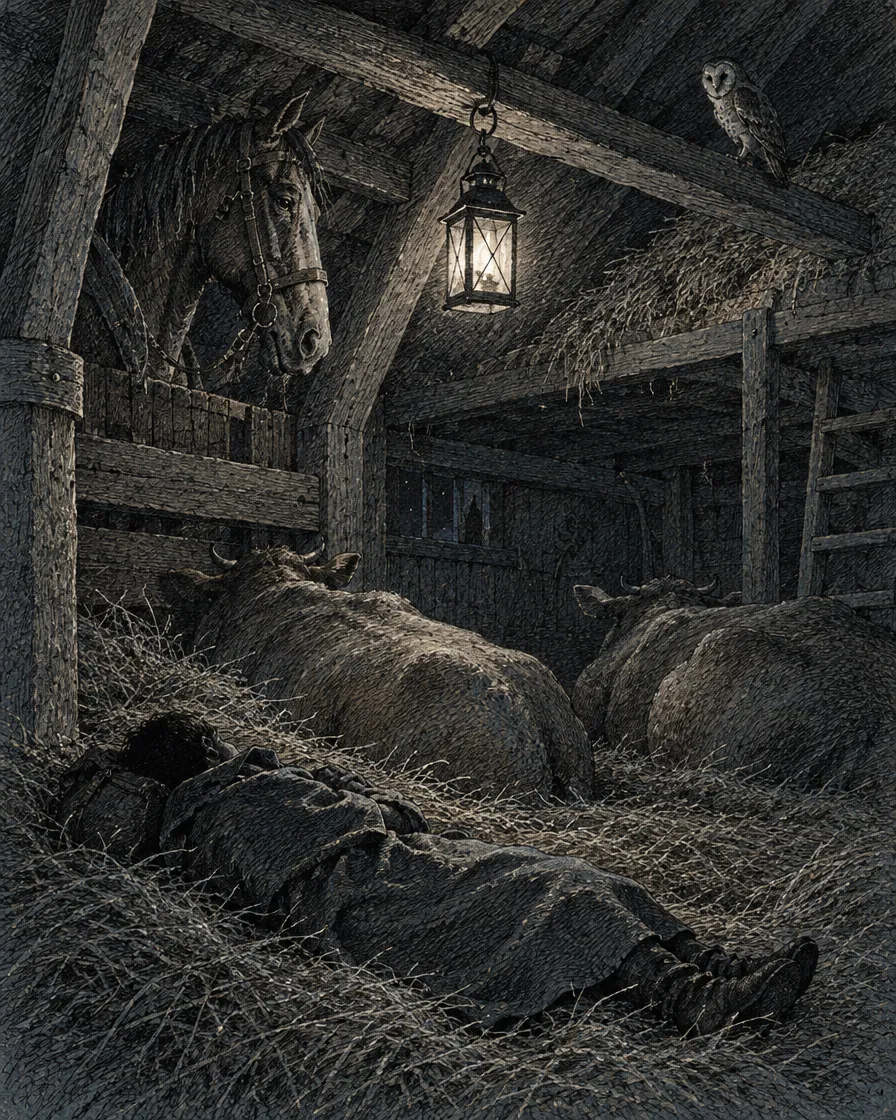
At Bruchsal the mayor shows him the first baroque palace he has ever seen, where light from the snow is thrown up onto the painted ceilings, and after dinner plays Beethoven through the cigar smoke. Next day, lost in the dark short of Pforzheim, the boy follows a light to a farmhouse. A dozen peasants are eating supper at a lantern-lit table, and they make room for him. A grandson leads him to the cattle barn, and he lies in the hay among the cows like a crusader on his tomb. This, he feels, is more like it. In the morning the old woman of the house, toothless, in a pleated coif, refuses his money. She gives him a slice of buttered black bread a foot long, and the family waves him off across the frozen fields.
In a Stuttgart café, with sleet coming down like grapeshot, two girls in eskimo hoods come in from the cold. Spotting his English dictionary, one of them greets him with a line from a popular song about a Mister Brown. They are Lise and Annie, music students, and from then on he is Mr Brown, a family friend. They take him to an Epiphany party, where he sings “We Three Kings”, and give him a sofa in Annie’s parents’ flat, while her father is away. On Sunday he wakes up in her father’s scarlet silk pyjamas, his hands lost in the sleeves. That evening a chauffeured Mercedes carries them to dinner with a rich industrialist, a big Nazi, in a villa of concrete and glass. He shakes hands round the room, saying “Brown!” each time, until an old professor answers “Braun!” When the host offers to drop the young man at his hotel, he names the best in the city, the Graf Zeppelin, praising it as “clean, comfortable and quiet”. He strolls once round its lobby and runs all the way back to the flat, where they dance. On Monday morning he waves his stick up at their seventh-floor window and feels like Ulysses leaving an island.
On the empty Swabian roads he carries a whole library in his head: Shakespeare above all, then Keats, Villon, Virgil, Catullus and Horace. He shouts the verse aloud where nobody can hear, and when he roars out Macaulay’s battle on the bridge, an old woman gathering sticks drops them and runs. Horace, he finds, can change his mood on a bad road. Years later, one ode does more than that. In 1944 Fermor and a band of Cretan guerrillas kidnap a German general and carry him off into the mountains, with the whole garrison of the island hunting them. During a lull they wake among the rocks as dawn breaks over the crest of Mount Ida, which they have crossed through snow. The general looks at the mountain and murmurs the first line of Horace’s ode about a mountain standing white with snow. Fermor knows it, and goes on from where the general stopped, to the end.
The general’s blue eyes had swivelled away from the mountain-top to mine—and when I’d finished, after a long silence, he said: “Ach so, Herr Major!” It was very strange. As though, for a long moment, the war had ceased to exist. We had both drunk at the same fountains long before; and things were different between us for the rest of our time together.
— Patrick Leigh Fermor, A Time of Gifts, New York Review Books, 2005, p. 86
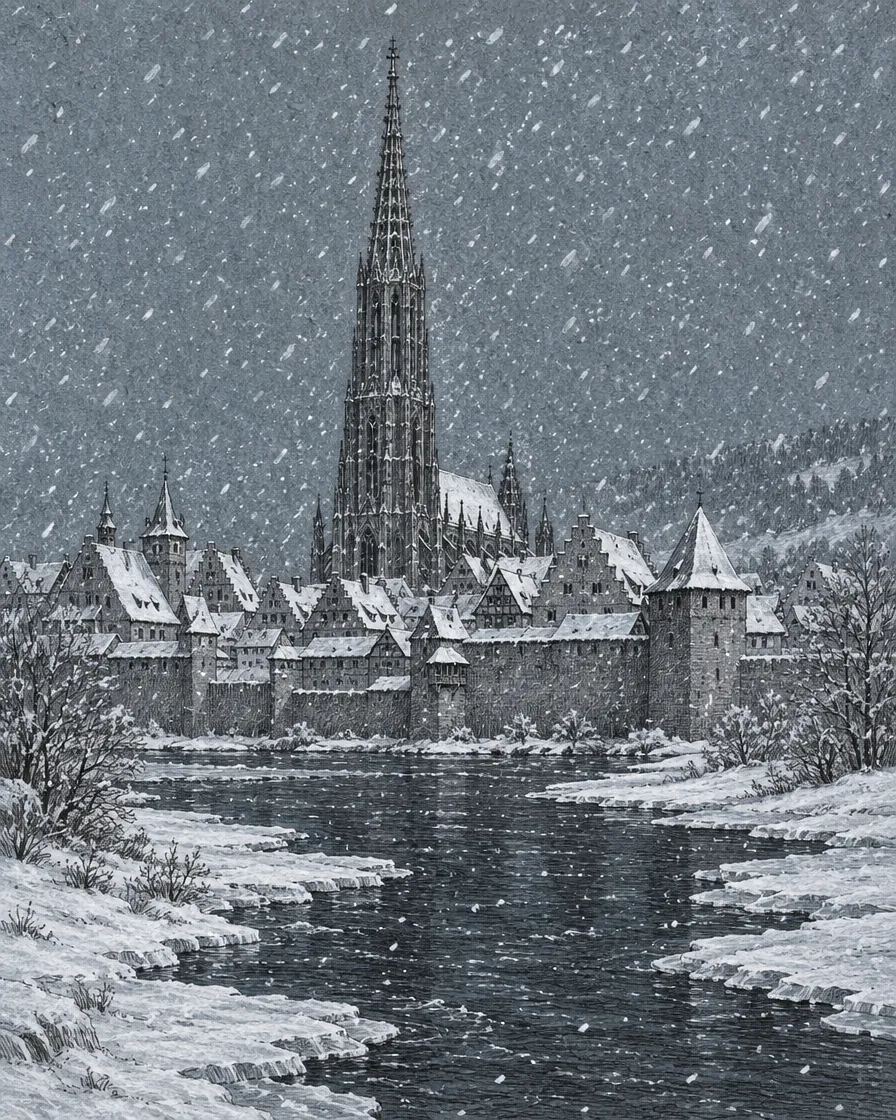
Back on the road in 1934, a blizzard catches him on a bare ridge, and for once he breaks his rule against lifts. A lorry loaded with girders stops for him, and the driver, who calls him Snowman, shares his schnapps. He is set down in Ulm, and there, for the first time, is the Danube, with the ice creeping out from both banks. From the top of the Minster steeple next morning he can see the Alps. Below him a swastika banner hangs in a lane, and he thinks of the armies that have marched past this tower, from the Romans to Napoleon. He crosses the Danube bridge into another blizzard, gets a second lift to Augsburg, and eats bread, cheese and an onion in the transept of Augsburg Cathedral.
Munich greets him with four new pound notes at the post office and a bed in the youth hostel, where a pimply boy takes the next bed and wants to chat. He escapes to the Hofbräuhaus. A Brownshirt is being sick on the stairs, storm troopers are singing in one of the halls, and the burghers eat on and on like ogres. Down in the great hall among the peasants, the litre mugs crash onto the tables like artillery, and he keeps up with them, first one, then a dark one, then another. The hall turns into a cavern out of Beowulf. He wakes on a sofa in a carpenter’s workshop, under a picture of the Virgin rising to heaven. He had passed out at the table, and the carpenter had wheeled him across Munich in a handcart full of chair legs. The carpenter’s wife brings him coffee and asks kindly after his hangover. He puts his head under the yard pump and slinks away, ashamed.
At the hostel his rucksack has gone, taken at first light by the pimply boy. His passport went with it, tucked into a pocket of the rucksack for the first time. So did the four pounds folded inside, and the diary of the whole journey so far. He has three marks and twenty-five pfennigs. A sympathetic policeman takes him by tram to the British Consulate, and he feels like a boy outside the headmaster’s study. The Consul-General is a tired, scholarly man who hears out his rambling story, asks a few dry questions, and wants to know whether he has a photograph. He sends him to a photo booth, issues a new passport marked “gratis”, and adds a five-pound note: His Majesty’s Government will lend him a fiver, to send back when he is less broke. Then he hands over the passport with a last instruction: “Try not to lose it this time.” The fiver is repaid from Constantinople a year later. The loss of the diary, Fermor writes, still aches like an old wound in bad weather.
HOEK VAN HOLLAND 10 DEC. 1933LONDON · TOWER BRIDGE 9 DEC. 1933GRENZÜBERGANG ≈ DEZ. 1933NEDERLAND ≈ DEC. 1933
STOLEN
Stolen with the rucksack, the diary and four pounds at the Munich youth hostel. Replaced by the Consul-General the same day, gratis, with a fiver from His Majesty’s Government.
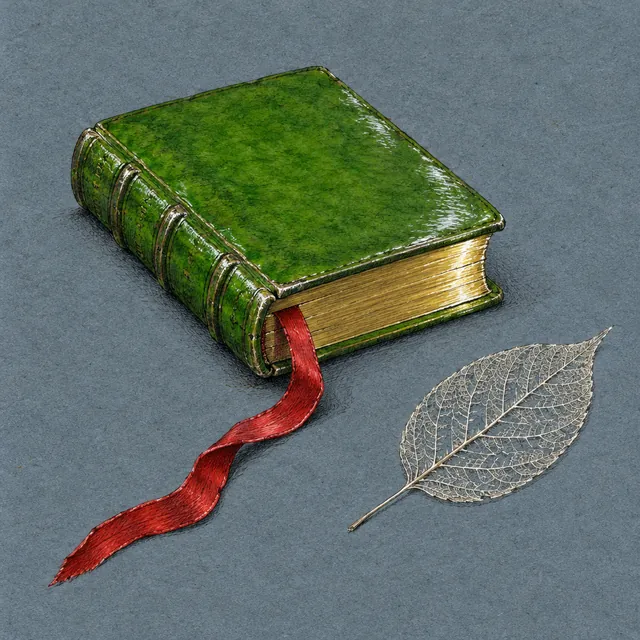
That evening he is at the lamp-lit table of Baron Rheinhard von Liphart-Ratshoff, at Gräfelfing outside Munich. The Lipharts are refugees from Estonia, a family of painters and patrons of painters who fled across Sweden and Denmark. The Baron and Baroness raid their attic and refit him in ten minutes: rucksack, jersey, shirts, socks and pyjamas. The elder son paints his portrait. He stays five days. When it is time to go, the Baron spreads out maps and writes letters to friends in castles down the Danube, while the Baroness worries about Bulgarian bandits. In the evenings the Baron reads Mark Antony’s funeral speech aloud in Russian, French, Italian and German, and in the German, for the first time, the boy hears how magnificent that language can be. When he leaves, the Baron gives him a little Horace printed in Amsterdam in the seventeenth century, bound in green leather as bright as grass after rain. He can’t replace all the lost books, he says, but here is Horace.
The road climbs into the snowbound villages of Upper Bavaria. In each one the mayor writes a slip that buys a wanderer supper, a bed and breakfast at the inn on the parish, an old charity once meant for poor scholars. Children on skis as wide as barrel staves squeak “Grüss Gott!” as he passes. He takes a turn on a woodcutter’s two-handed saw and rides on a log sledge. He learns Hamlet’s soliloquy in German across the snow and feels like one of the wandering scholars of the Middle Ages. One evening, lost in falling snow, he shelters in a ruined barn and sits there shivering for what feels like half the night. At last he hears voices and runs out shouting, to find that it is half past eight, and the village was just round the hill.
The talk in the inns turns, sooner or later, to England. Nazis crow about the Oxford Union’s vote never to fight for King and Country, and he can’t explain it away. In a Rhineland town, he remembers, a cheerful factory hand once showed him a shrine of Hitler photographs and a pistol in his attic. A year before, the man boasted, he had been a real Bolshevik. Then he changed sides overnight, and so, he said, did millions of others. Near Traunstein the weather clears and the Alps rise ahead like a wall. At the river Salzach he passes the last portrait of the Führer and the last swastika armbands. His passport takes an Austrian stamp, the twenty-fourth of January, 1934. By nightfall he is in Salzburg, at a café facing a fountain of stampeding horses hung with icicles.
Crossed the Salzach into Austria on 24 January 1934.
He leaves the crowds of skiers in Salzburg at once and strikes north through the woods of Upper Austria, sleeping in cow-sheds and one apple loft so sweet that it nearly makes him swoon. Then the Baron’s letters begin to work. At the second castle on his list he has a bath in a corner tower while pine logs roar in a copper stove. The old Count and his family have been told to feed him up, and they do. At dinner he picks up a goblet of what he takes for schnapps, meaning to tip it into his coffee. It is the very last of an ancient Tokay. The old Count stretches out a pleading hand. “NEIN! NEIN!” he falters. Then the Countesses dissolve in laughter, the boy joins them, and the Count manages a worried smile. Saying goodnight, the old man’s hand feels as light as a leaf. His wife takes up her needlework and asks the boy to tell them all about his travels.
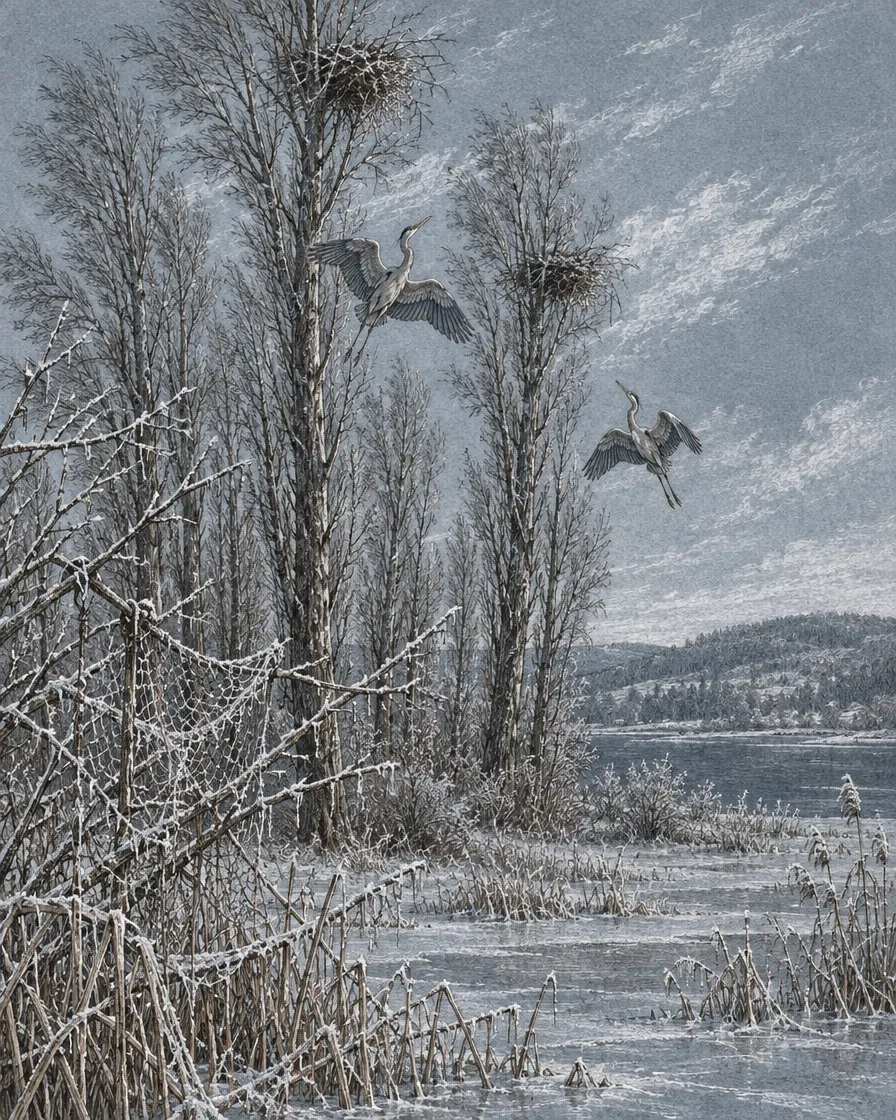
At the edge of a frozen marsh two herons rise to a heronry in the poplars, and suddenly there is the Danube again, half a day sooner than he expected. An innkeeper converts him to raspberry brandy. In Linz a young couple who keep a coffee house, Hans and Frieda, put him up, lend him boots and take him skiing, and he comes down battered black and blue. At the abbey of St Florian a kind canon shows him the altarpiece by Albrecht Altdorfer, the painter who first let landscape take over a picture. Long afterwards, looking upriver from Dürnstein, Fermor will realise that the river in Altdorfer’s great battle painting is the Danube. The snowy fields beyond the town look exactly like Brueghel’s “Hunters in the Snow”, and Brueghel, he feels, has presided over this whole winter journey.
The river narrows into the gorge of the Strudengau, once full of whirlpools that drowned the boatmen. At an inn at Persenbeug he sketches the innkeeper’s daughter, Maria, as she darns. A man reading the Vienna newspaper behind them laughs at one of his stories, and the boy realises he has struck a gold mine. The stranger is a tall, scholarly castle-dweller who learned perfect English from his governesses. He knows everything, and he stays nameless: the polymath. He lectures on the fish of the Danube, the sturgeons and above all the giant catfish, which can grow to thirteen feet. Maria and two boatmen take turns listing the things the catfish eats. Then, to show them its face, the polymath rises slowly across the wine glasses, transforming himself into the fish. Maria cries out, “Herr Jesus!”, and his dog barks. Late at night, when the third bottle is empty, he tells the boy that Schubert wrote the Trout Quintet at Steyr while on a walking tour, “like you”. Out on the snowy quay he whistles the tune and points to the castle window where the last Emperor was born.
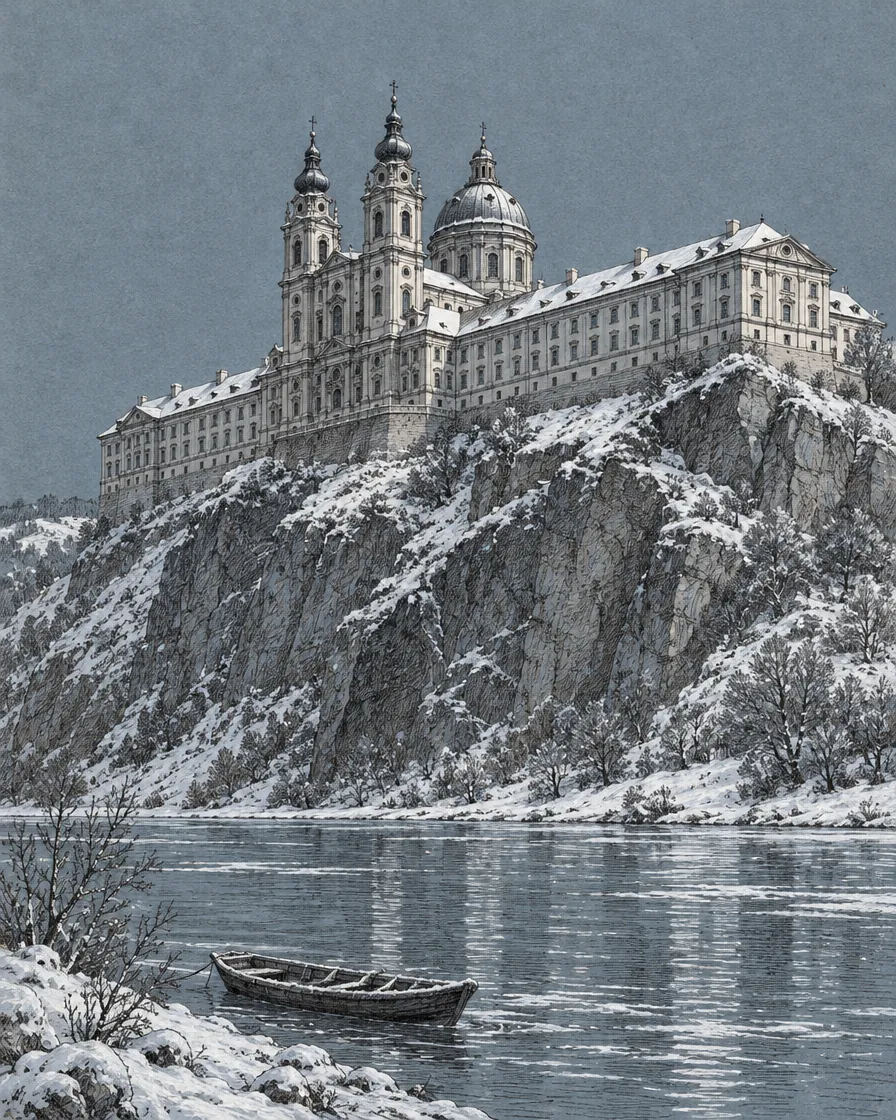
Walking on, the boy hatches a theory. Shakespeare gave Bohemia a coast in “The Winter’s Tale”, and everyone laughs at him for it. But if coast means only edge, then this very path along the Danube is the coast of Bohemia, and Shakespeare is saved. He drafts a triumphant letter to the newspapers in his head. Then Melk appears on its rock, a warship among abbeys. A young Benedictine who speaks French shows him round, and he remembers the visit afterwards as music: overtures, fugues and symphonies of gilded stone, and a church as still as an orchestra waiting for the downbeat. Under a whirling painted ceiling at noon, the monk turns to him and says that it makes one feel a little drunk. In his ecstasy, Fermor thinks that is far too mild a word for it.
The polymath’s voice travels with him through the Wachau. Sitting among the battlements of ruined Aggstein, he remembers the history of the barbarian invasions as the polymath drew it, with a stub of pencil, on the back of a Vienna newspaper. Huns shot across the page like an arrow, and Goths went west. The Vandals hopped over Gibraltar to Carthage, the Angles and Saxons were showers of dots, and Hengist and Horsa swam to England like tadpoles. At Mitter Arnsdorf he lodges with a widow, Frau Hübner, whose life story runs through laughter and tears while her macaw, Toni, heckles from his cage. When she covers it, Toni mutters, “Poor Toni!” At Dürnstein he climbs to the ruined fortress where Richard the Lionheart was held for ransom. Then, as the sun goes down, a tug on the river sounds its siren. The cliff throws the note back an octave higher, and the two hang together in the air like a chord. Three decades later he will hear it again.
The eleventh of February is his nineteenth birthday, and it is snowing hard. He trudges to a vast moated castle, where a man shovelling snow asks him which Count he wants, and arrives at the door caked like a snowman. This time the Baron’s letter has not come, and his hosts have been expecting a motorist. In a silence over the whisky he panics, decides they want to be alone, and invents a friend he must meet at a Vienna station at noon tomorrow. They insist that he stay, and that they will drive him to his train. The evening turns out delightful, and the young Countess has him write down the names of friends of hers in Hungary. He never mentions the birthday. At breakfast the Baron’s letter arrives, and he still can’t confess. At a little station, with no money for a ticket, he presses his last four coins on the old chauffeur, who protests, “O nein, junger Herr!”, and he slinks off down the Vienna road. He wishes he were dead.
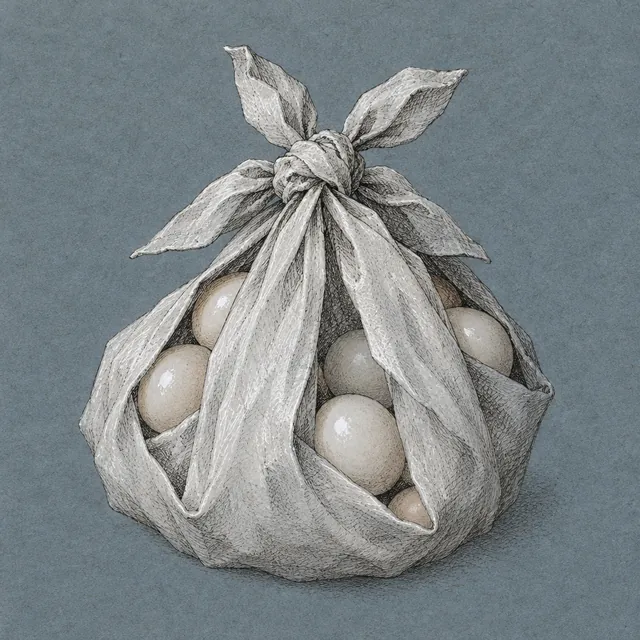
A thunderstorm drives him into a barn and then a dark church. At last a lorry stops, and under its tarpaulin sits Trudi, fifteen, taking eggs and a live drake to her grandmother in Vienna. She gives him caraway cake and wishes him a happy birthday, and they sing all the way through the Vienna Woods. The city is dark. There are soldiers with bayonets and barbed wire in the streets, and Trudi scolds one of them for handling her eggs. Perhaps, she says, it is war. It is the twelfth of February, 1934, and the fighting has begun: the army and the right-wing militia are firing on the great workers’ housing block, the Karl-Marx-Hof. When they part, Trudi knots a dozen eggs into his handkerchief as a birthday present. A policeman leads him to the Salvation Army hostel. A visiting officer, Major Brock from Chesterfield, on a tour of the Army’s hostels, gives him cocoa and bread and tells him he must be daft. The boy lays Trudi’s eggs on his desk, and the Major says, “Thanks, lad.” He lies down fully dressed among the tramps in a bare, bright hall. They are in Limbo.
He wakes next to Konrad, a gangling Frisian islander in blue-striped pyjamas, with something of Don Quixote about him. Konrad learned his English from Shakespeare, and he speaks it that way. He hopes, he says, that the boy’s slumbers were peaceful and mated with quiet dreams. He lends him his complete Shakespeare, and the boy looks up the shipwreck in “The Winter’s Tale”. The stage direction says plainly that the coast of Bohemia is a desert country near the sea. It is total collapse. But Konrad has a plan. The boy can draw, so he should sketch the little burghers of Vienna in their own homes, door to door, for a few schillings a portrait; Konrad suggests five, the boy settles on two. Konrad coaches him: never look at the peephole, ring, then gaze upward innocently, and carry your coat over your arm. At the first door a small bald man in a red dressing-gown takes him for his brother-in-law Helmut and shoves him out onto the landing. Then come apologies, wine, cake and cigars. The man changes into a velvet jacket, freezes like a bust, and pronounces the sketch a masterpiece.
For days the doors open on a whole empire in miniature, with names on the bells from every corner of the old Habsburg lands. A family of Czech acrobats won’t be drawn but give him a signed photograph of the troupe and won’t take a penny. A pretty blonde in a turquoise dressing-gown, with an officer’s sabre on the chair behind her, asks him to come back in an hour. The price goes up to three schillings. There is even a jolly retired admiral of the vanished Austro-Hungarian navy, which lost its seaports with the war. On the fourth evening Konrad reveals his deep plan. He needs capital of just twenty schillings to become a saccharine smuggler, slipping the sweetener across the river into Hungary, where the tax makes it dear. Between them they have almost exactly that. Next morning the boy’s money is waiting at the Consulate, and Konrad leaves by tram from the corner by the Opera. On the way he gives up his seat to a round little nun, and he lifts his battered smart hat in a long farewell. Eleven months later, in Constantinople, a letter arrives from Konrad’s island with sheets of stamps inside: the loan repaid, and half as much again.
A birthday cheque from his father brings him five pounds. He watches the victory procession of the Austrian government on the Ring, where the small Chancellor, Dollfuss, hurrying along, gets the loudest cheers. Then he moves into the flat of an Englishwoman, Robin Hale, and a whirl of carnival parties. Among his new friends is a young Bavarian, Baron von der Heydte, whom everyone calls Einer. Seven years later, in Crete in 1941, Fermor is a junior officer when a captured German order of battle names Captain von der Heydte as the commander of the parachute spearhead. In a library he works out how far he has come: just under halfway, seven hundred and fifty miles in sixty-two days, twelve miles a day. He sees the white horses of the Spanish Riding School and the trophies of the Turkish siege of 1683. In early March, on a last outing with friends, they skim icicles across a frozen pond in a beech forest, and the ice twitters back at them.
A friend drives him out of Vienna and offers to take him further. He refuses, because all horsepower corrupts, and walks east along the Danube. Ahead, an object in a field grows larger and turns out to be a Roman triumphal arch at Carnuntum, alone and enormous and covered with rooks, where Marcus Aurelius spent three winters. At the castle of Deutsch-Altenburg the old Count’s daughter skims stones with him among the ice floes until dark. Then he crosses into Czechoslovakia, his fourth country, and the great bridge into Bratislava, a city with three names: Pressburg to the Germans, Pozsony to the Hungarians. A young banker, Hans Ziegler, gives him a refuge for days. He hears Slovak and Hungarian for the first time, and the sounds conjure up whole landscapes, of pine forests and marshes, and of riders on the endless steppe. In a Hungarian tavern, farmers with drooping black moustaches drink fruit brandy from thimble glasses. On the edge of town there is a Gypsy camp with a dancing bear, and a little boy, naked except for his father’s enormous trilby, who holds out for a coin longest of all the beggars. Finally, from the castle ramparts, he looks out over the river fanning into the plains of Hungary and expects to march into them next day. Or so he thinks.
His fourth country, early March 1934; the date is approximate.
Instead, Hans carries him off by night train to Prague, backwards into winter. At a silent station in the small hours, snow hangs in the lamplight, and as they pull out, a goods train flashes past with the same name stencilled on truck after truck: BRNO, BRNO, BRNO. Prague is snowbound and full of rooks. Hans zigzags him round the city, and his eldest brother, Heinz, a professor who looks like a poet, talks with him in a night-club until nearly dawn. In the cathedral the boy finds the tomb of St Wenceslas and realises he is the Good King Wenceslas of the carol. In the great hall of the castle the stone ribs of the vault loop and twist like lassoes, and he thinks they look like the fluted armour of the Emperor Maximilian’s knights. In the council chamber next door, in 1618, Bohemian lords threw the Emperor’s men out of the window, the last act but one before the Thirty Years’ War. He crosses the Charles Bridge at dusk and sees the clock in the old Jewish town, which runs backwards. Then he catches himself: they will never get to Constantinople like this.
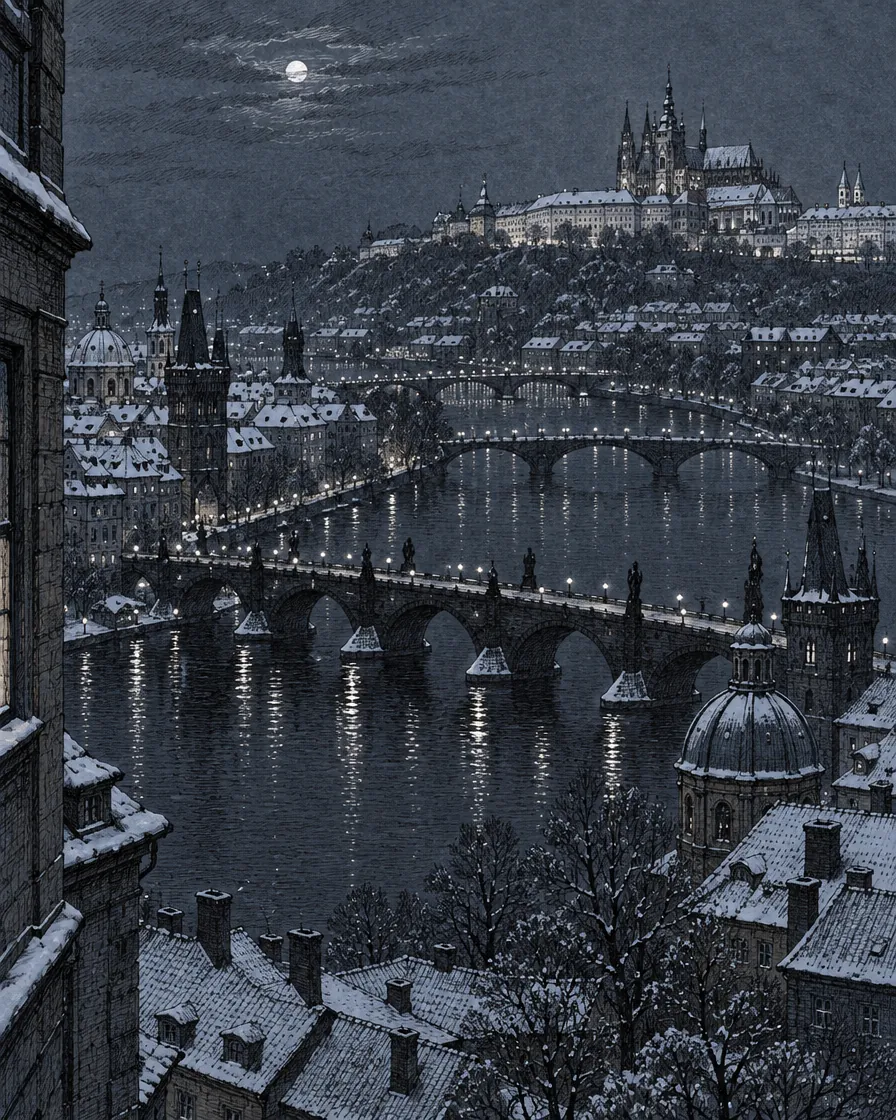
The coast of Bohemia still nags at him. On his last afternoon he hunts through Heinz’s library for any link at all between Bohemia and England. Heinz closes his eyes, taps his forehead and takes down a book. Bohemia did have a coastline once, he says. In the thirteenth century King Ottokar the Second won land on the Adriatic, though it lasted only thirteen years. The boy jumps up in triumph. Only later does Fermor admit the truth: Shakespeare took his plot from an older story and simply swapped Bohemia and Sicily round. They drink a farewell glass from a cut-glass decanter, and the boy looks down from the window as the city lamps come on. The bridges cross the dark river like necklaces of beads, and the bells are ringing. That last glimpse of Prague has had to last him, Fermor writes, from that evening to this.
Back in Bratislava his route changes again. Baron Philipp Schey has a house in the Slovak lowlands, and the Baron’s sister has arranged for the boy to stay there, so he will loop northeast and meet the Danube again a hundred miles downstream. The story changes too. Decades later, on a journey down the whole Danube, Fermor recovered in Romania the diary he had left in a country house there in 1939. It is a thick, cloth-backed notebook, bought in Bratislava, its covers warped by the rucksack. It has three hundred and twenty pages in pencil, all the way to Mount Athos, with word lists in five languages, and it still seems to smell of that old journey. Reading it again, he finds it worse than he feared. Its one virtue is that it was written at full speed. So from here he lets the nineteen-year-old speak for himself, starting on the morning of the nineteenth of March, 1934.
The sky was a lovely blue with big white clouds, and I walked along a twisting avenue of elm trees. The grass is a brilliant green and Spring has begun! Looking back, I could see all the chimney pots of Pressburg and the grey castle on the mountain and hear the bells over the fields.
— Patrick Leigh Fermor, A Time of Gifts, New York Review Books, 2005, p. 276
The diary goes on in the same breathless voice. By four o’clock he is lost. Old women are gathering catkins and pussy-willow for Palm Sunday and kneeling at the wayside crosses. An old man pulls him across a branch of the Danube on a rope ferry, and the larks go up over the flat fields at sunset. He spends the night with a Hungarian village mayor, drinking golden wine by the fire, and at supper an old woman kisses his hand. Next day he learns he is thirty miles off course. He rides a packed bus back to the city and a train out again, and at nightfall a jovial grocer sends him on in his car, with rabbits’ eyes shining in the headlights. At the house the old housekeeper, Sari, lets him in, and he finds the Baron in his library, in a leather armchair and slippers, three-quarters of the way through the last volume of Proust.
Baron Pips Schey is fifty-two, tall and silver-haired, with clear blue eyes and flawless, slightly Edwardian English. The place is a shooting lodge really, he says, but it is also Liberty Hall. He tells the boy to stop calling him Sir, and the boy feels it as a kind of coming of age. For a week they walk the river Váh among violets and green lizards, and talk until one in the morning. Pips remembers London in the Edwardian season, when the sheep poured into Hyde Park at dawn as the dancers went home. He tells the story of an old Count Sternberg, who on his deathbed confessed only one sin: he had shot hares. One evening, just after sunset, six or seven log rafts drift past on the Váh towards the Danube, each with a fire burning in a hut at the stern, and Pips calls out a greeting to the raftsmen. When the boy leaves, laden with a pocket Hölderlin, cigars and Sari’s lunch, Pips walks him to the next village, waves when he sees him take the right path, and disappears into his woods with his spaniel. They wrote to each other but never met again. Pips died in 1957 in Normandy, not far from the seaside town where Proust spent his summers. Long afterwards a relation in Paris told Fermor that Pips never did anything, you know. As Fermor puts it, “Well, he did in my case.”
Spring has come. In a café in the town of Nové Zámky a girl in tight black velvet keeps looking at him, and the waiter brings a slip of paper with her name, Mancsi, and an address. He declines, and feels a bit sad and rather an idiot. He shares Sari’s roast chicken with three peasants on the road, in return for their paprika bacon. An old peasant, Ferenc, explains why the Hungarians will never accept their new frontier, and a Slovak schoolmaster on a bicycle explains the opposite. On the evening of Maundy Thursday he limps into the village of Köbölkút with a nail sticking up in his boot and drifts into the church with the villagers for Tenebrae. The candles on a great triangular stand are put out one by one as the psalms are sung. For a split second, in the flicker, the shepherds in their sheepskins become the mob with swords and clubs in the garden of Gethsemane. Then the church is completely dark. A red-haired Jewish baker mends his boot and gives him a straw bed on the bakery floor. Next morning, on a bench outside, the boy tells him that he enjoys reading the Bible. So does the baker, “especially the first part”.
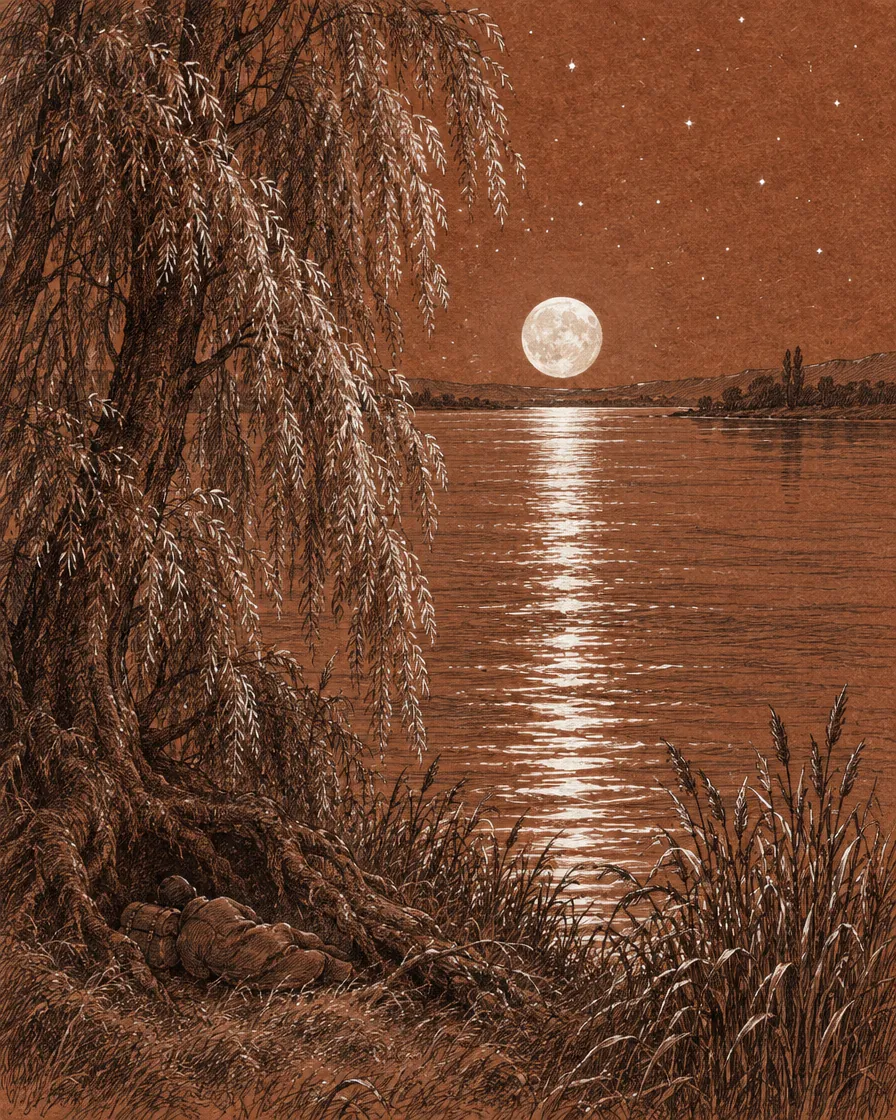
Good Friday spreads its stillness over the fields. Frogs leap away from him, kingcups shine in the ditches, and at four in the afternoon he climbs a bank at Karva. There is the Danube, long before he expected it, and Hungary on the far side, only a river’s width away. Three riders come by and lift their hats in a triple flourish. In his first Hungarian he tells them he comes from England and is going to Constantinople. They are going to Komárom, they reply, commend him to God, and canter off. He wishes he had a hat to lift. That night, for the first time, he sleeps in the open, in a hollow lined with leaves among the willows, three yards from the water. He writes his diary by a candle on a stone. Orion sinks in the west, two bitterns boom, and millions of frogs sing. He has come twelve hundred miles since Rotterdam, and nobody in the world knows where he is. Then a red rim lifts over the horizon and swells into a crimson moon. It turns orange, then yellow, then silver, and because the river runs due east, its path lies along the fastest current like quicksilver. The rushes look like thin metal and the poplar leaves like weightless coins. He means to watch for hours, and falls asleep.
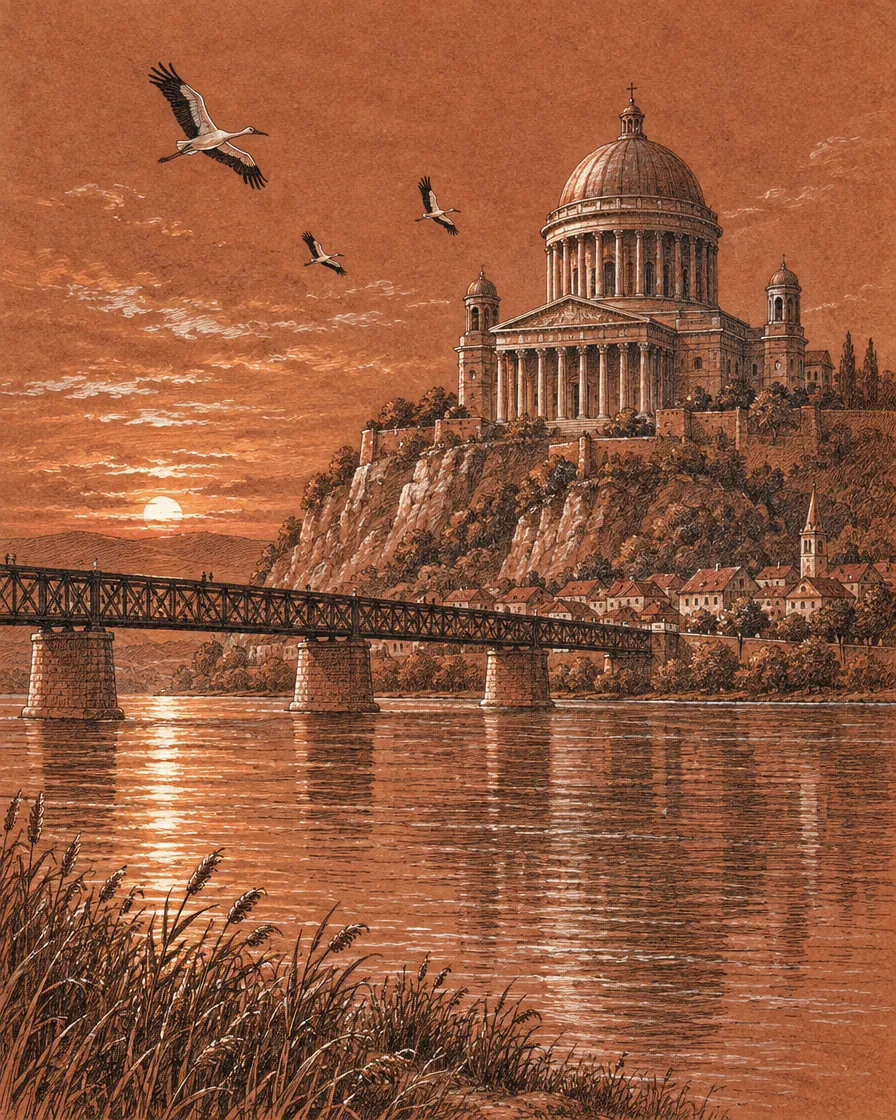
He wakes to a bayonet at his chest and a lantern swinging on a belt. Two Czechoslovak frontier guards march him to a hut and turn his rucksack out onto the floor, and then they find the passport. English! A fat guard who speaks German checks his age, nineteen, and bursts out laughing. They had taken him for Black Joseph, a famous saccharine smuggler. But Black Joseph is over fifty, and who would smuggle by the light of a full moon? The boy thinks of poor Konrad. Next morning, Holy Saturday, a farming couple from Silesia give him coffee, black bread, two boiled eggs and a swig of apricot brandy, and he feels like Elijah fed by the ravens. It is the hottest day of the year. He sleeps by a haystack through the afternoon. Then across the river, on its cliff, the great domed basilica of Esztergom rises like St Peter’s, as improbable as a mirage. He climbs into the little town of Parkan, has his passport stamped out of Czechoslovakia, and walks out onto the iron bridge. In the middle he stops, poised, in his own words, “in no man’s air”.
Stamped out of Czechoslovakia at Parkan on Holy Saturday, 31 March 1934. The Hungarian stamp is not on this passport.
A dozen storks come down out of the sunset, black and white, with beaks and legs as red as sealing wax. One lands on a haystack. Others inspect the chimney nests on the roofs, and two try for the belfry of the basilica. An old toothless shepherd beside him on the bridge points to the east. The storks are coming home from Africa, by way of the Nile and Palestine and the Bosphorus, perhaps on their way to Poland, and he looks up to see the whole of their migration at once.
Ragged and flocculent, fading to grey, scattered with specks of pink from the declining sun, varying in width as random fragments were dropping away and re-cohering and agitated with motion as though its whole length were turning on a single thread, a thick white line of crowding storks stretched from one side of the heavens to the other.
— Patrick Leigh Fermor, A Time of Gifts, New York Review Books, 2005, p. 309
Below the storks, Esztergom fills up for Easter. Hundreds of peasants crowd the quay, with a band, Gypsy women in violet and magenta, and a brown bear sitting on a cart beside his master. Hungarian magnates arrive in gala dress: velvet doublets, fur-trimmed jackets, scarlet boots, egret plumes and jewelled scimitars. Girls run across the bridge with armfuls of water lilies, narcissi and kingcups. And still he cannot make himself take the last step into Hungary. The future seems so full of marvels that he hangs back from it, while the river carries the past away beneath him, and he is held in mid-air between the two. In his mind he travels ahead into the town, as the older Fermor, where the sacristy is unpacking copes and mitres and the Cardinal sits in scarlet in his palace among the paintings. From the palace window, somebody can be seen still lingering on the bridge. The light turns the colour of the bloom on a greengage. A heron sculls upstream, leaving rings on the milky water, and the shadows join together. Then a bell rings from the basilica.
No-one else was left on the bridge and the few on the quay were all hastening the same way. Prised loose from the balustrade at last by a more compelling note from the belfries, I hastened to follow. I didn’t want to be late.
— Patrick Leigh Fermor, A Time of Gifts, New York Review Books, 2005, p. 316
The story went on. Fermor reached Constantinople at the start of 1935, and spent much of the next years in Greece and Romania. In 1944, on Crete, he and William Stanley Moss led the abduction of the German commander, General Heinrich Kreipe. The second volume of the walk, “Between the Woods and the Water”, appeared in 1986 and picks him up at Esztergom that Easter. Fermor died in June 2011, at ninety-six. His unfinished account of the last part of the journey, with the recovered diary, was published two years later as “The Broken Road”.